


Review of Evidence for Adult Diabetic Ketoacidosis Management Protocols
- PMID: 28659865
- PMCID: PMC5468371
- DOI: 10.3389/fendo.2017.00106
Review of Evidence for Adult Diabetic Ketoacidosis Management Protocols
Erratum in
-
Corrigendum: Review of Evidence for Adult Diabetic Ketoacidosis Management Protocols.Front Endocrinol (Lausanne). 2017 Jul 31;8:185. doi: 10.3389/fendo.2017.00185. eCollection 2017. Front Endocrinol (Lausanne). 2017. PMID: 28775713 Free PMC article.
Abstract
Background: Diabetic ketoacidosis (DKA) is an endocrine emergency with associated risk of morbidity and mortality. Despite this, DKA management lacks strong evidence due to the absence of large randomised controlled trials (RCTs).
Objective: To review existing studies investigating inpatient DKA management in adults, focusing on intravenous (IV) fluids; insulin administration; potassium, bicarbonate, and phosphate replacement; and DKA management protocols and impact of DKA resolution rates on outcomes.
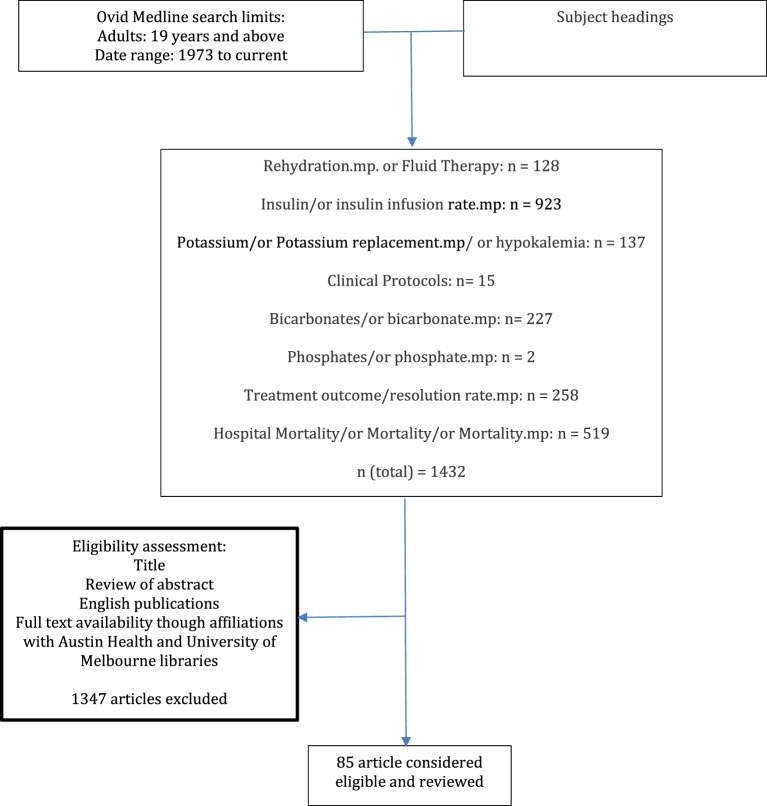
Methods: Ovid Medline searches were conducted with limits "all adult" and published between "1973 to current" applied. National consensus statements were also reviewed. Eligibility was determined by two reviewers' assessment of title, abstract, and availability.
Results: A total of 85 eligible articles published between 1973 and 2016 were reviewed. The salient findings were (i) Crystalloids are favoured over colloids though evidence is lacking. The preferred crystalloid and hydration rates remain contentious. (ii) IV infusion of regular human insulin is preferred over the subcutaneous route or rapid acting insulin analogues. Administering an initial IV insulin bolus before low-dose insulin infusions obviates the need for supplemental insulin. Consensus-statements recommend fixed weight-based over "sliding scale" insulin infusions although evidence is weak. (iii) Potassium replacement is imperative although no trials compare replacement rates. (iv) Bicarbonate replacement offers no benefit in DKA with pH > 6.9. In severe metabolic acidosis with pH < 6.9, there is lack of both data and consensus regarding bicarbonate administration. (v) There is no evidence that phosphate replacement offers outcome benefits. Guidelines consider replacement appropriate in patients with cardiac dysfunction, anaemia, respiratory depression, or phosphate levels <0.32 mmol/L. (vi) Upon resolution of DKA, subcutaneous insulin is recommended with IV insulin infusions ceased with an overlap of 1-2 h. (vii) DKA resolution rates are often used as end points in studies, despite a lack of evidence that rapid resolution improves outcome. (viii) Implementation of DKA protocols lacks strong evidence for adherence but may lead to improved clinical outcomes.
Conclusion: There are major deficiencies in evidence for optimal management of DKA. Current practice is guided by weak evidence and consensus opinion. All aspects of DKA management require RCTs to affirm or redirect management and formulate consensus evidence-based practice to improve patient outcomes.
Keywords: diabetes; diabetic ketoacidosis; hypoglycemia; hypokalemia; insulin; metabolic acidosis; protocol; rehydration.
Figures
References
Publication types
LinkOut - more resources
Full Text Sources
Other Literature Sources
