. 2016 Apr 21;7(4):2604-2613.
doi: 10.1039/c5sc04751j. Epub 2016 Jan 26.

Chemistry informer libraries: a chemoinformatics enabled approach to evaluate and advance synthetic methods

Affiliations

Chemistry informer libraries: a chemoinformatics enabled approach to evaluate and advance synthetic methods

Peter S Kutchukian et al. Chem Sci. .

Abstract

Major new advances in synthetic chemistry methods are typically reported using simple, non-standardized reaction substrates, and reaction failures are rarely documented. This makes the evaluation and choice of a synthetic method difficult. We report a standardized complex molecule diagnostic approach using collections of relevant drug-like molecules which we call chemistry informer libraries. With this approach, all chemistry results, successes and failures, can be documented to compare and evolve synthetic methods. To aid in the visualization of chemistry results in drug-like physicochemical space we have used an informatics methodology termed principal component analysis. We have validated this method using palladium- and copper-catalyzed reactions, including Suzuki-Miyaura, cyanation and Buchwald-Hartwig amination.


Figures

Fig. 1
Fig. 1. Synthetic chemistry diagnostic approaches. Standard literature reports typically demonstrate simple, high-performing substrates; the Glorius “robustness” test probes the effects of potentially interfering molecular fragments on chemistry performance, and in this work we examine how standardized collections of full, complex molecules can be used to compare and improve literature synthetic methods.
Fig. 2
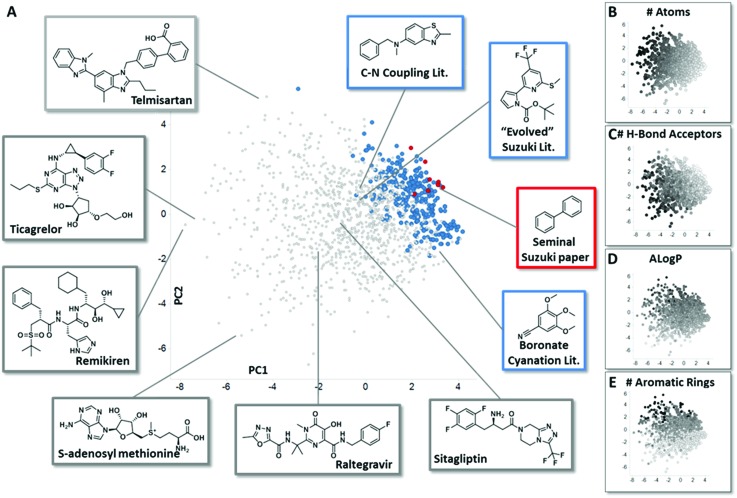
Fig. 2. Principal component analysis (PCA) comparing small molecule drugs with products described in synthetic literature reports. (A) shows a principal component analysis used to visualize the physicochemical space occupied by marketed small molecule drugs compounds (grey) and products described in literature reports for the several reaction types evaluated in this work: in red are compounds that were prepared in the seminal Suzuki–Miyaura paper, and in blue are the products formed in leading literature Suzuki–Miyaura reports, recent methods reported for the conversion of aryl pinacol boronates into aryl nitriles and recent Buchwald–Hartwig C–N coupling methods. Representative structures from both the small molecule drugs collection and literature reports are highlighted. Fig. 2B–E depict how properties with the greatest contribution to PC1 and PC2 are mapped by the PCA, with black representing the highest values for each parameter. See ESI for full details.
Fig. 3
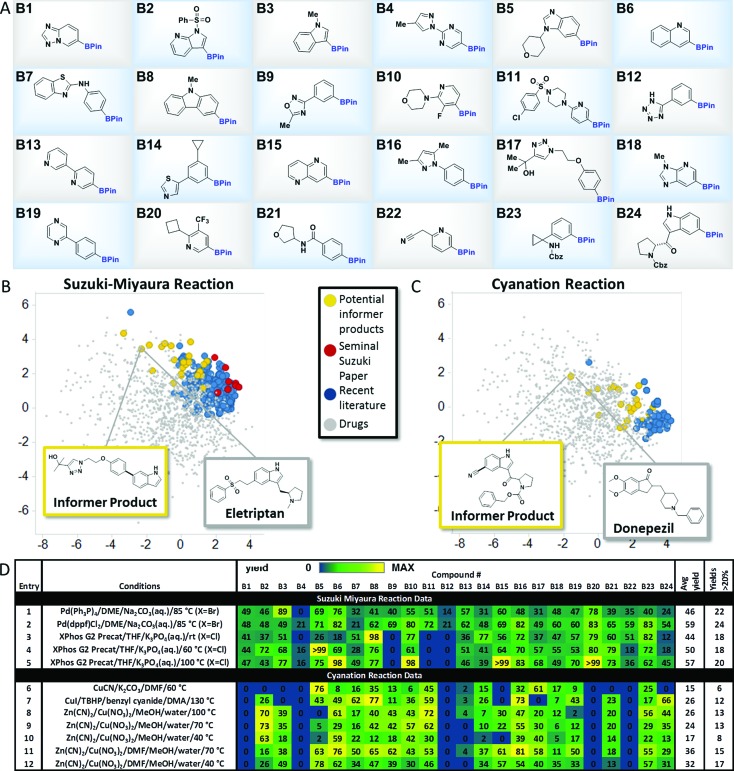
Fig. 3. Aryl and heteroaryl pinacol boronate informer library. (A) displays the 24-member boronate ester library plated in 1 mL vials in 10 μmol quantities, used for Suzuki–Miyaura and cyanation chemistry evaluation. (B) and (C) display the principal component analysis of potential products formed from Suzuki-Miyaura coupling and cyanation reactions, respectively, of the informer library (in yellow), literature products (in blue and red), and marketed drugs (in grey). (D) gives experimental results for Suzuki–Miyaura coupling reactions (entries 1–5) and cyanation reactions (entries 6–12) of the informer library members along with statistics for each method. For experimental details, see the ESI.
Fig. 4
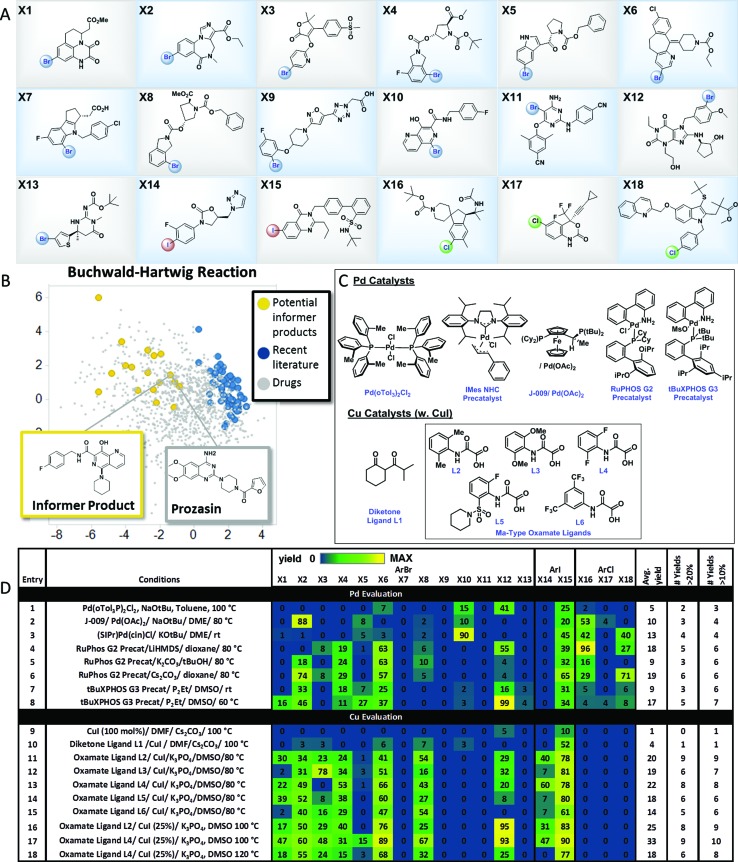
Fig. 4. High-complexity aryl halide informer library. (A) displays the 18-member aryl halide array, plated in 2.5 μmol quantities in 250 μL “microvials”, used for Pd and Cu C–N coupling chemistry evaluation. (B) displays the principal component analysis of potential products formed from C–N coupling reactions of the informer library (in yellow), literature products (in blue and red), and marketed drugs (in grey). (C) shows structures for the catalysts employed in the Pd and Cu C–N reactivity study depicted in (D). For experimental details, see the ESI.
Fig. 5
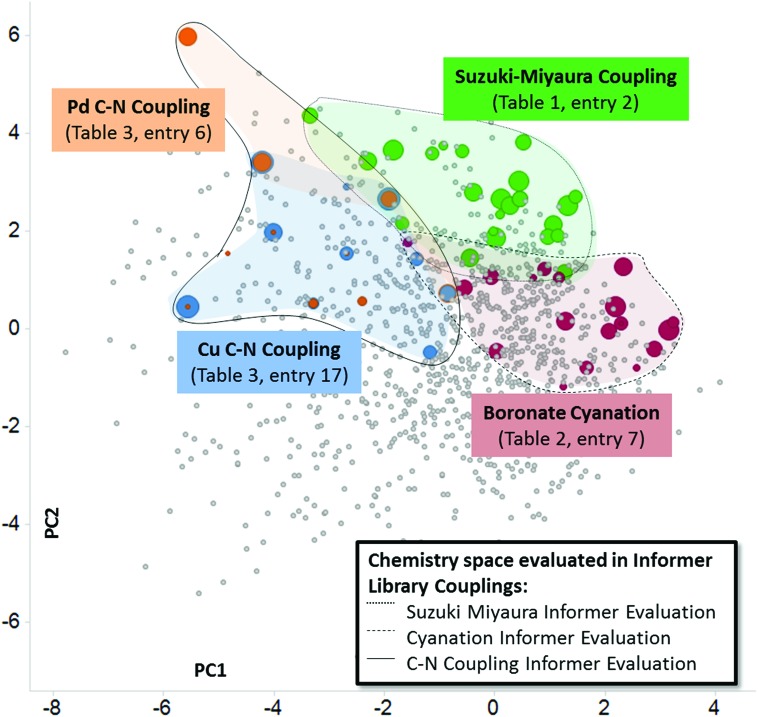
Fig. 5. Informer library reactivity data mapped onto relevant physicochemical PCA to produce a representation of structure–reactivity relationships. Each colored ball represents one molecule successfully prepared, and the size of the ball is proportional to the yield of the reaction. In this way, different reaction types can be directly compared for performance and relevance within a region of structural space.

References

    1. Nadin A., Hattotuwagama C., Churcher I. Angew. Chem., Int. Ed. 2012;51:1114. - PubMed
    1. For related approaches, see:

    2. Zhang K., El Damaty S., Fasan R. J. Am. Chem. Soc. 2011;133:3242. - PubMed
    3. Bess E. N., Bischoff A. J., Sigman M. S. PNAS. 2014;111:14698. - PMC - PubMed
    1. Collins K. D., Glorius F. Nat. Chem. 2013;5:597. - PubMed
    2. Collins K. D., Glorius F. Acc. Chem. Res. 2015;48:619. - PubMed
    3. Collins K. D., Glorius F. Tetrahedron. 2013;69:7817.
    4. Collins K. D., Ruhling A., Lied F., Glorius F. Chem. Eur. J. 2014;20:3800. - PubMed
    5. Collins K. D., Glorius F. Nat. Protoc. 2014;9:1348. - PubMed
    1. Medina-Franco J. L., Martinez-Mayorga K., Giulianotti M. A., Houghten R. A., Pinilla C. Curr. Comput.–Aided Drug Des. 2008;4:322.
    1. Shelat A. A., Guy R. K. Curr. Opin. Chem. Biol. 2007;11:244. - PubMed