doi: 10.3201/eid2309.170539.
Epub 2017 Sep 17.
Genetic Diversity of Highly Pathogenic Avian Influenza A(H5N8/H5N5) Viruses in Italy, 2016-17
- PMID: 28661831
- PMCID: PMC5572881
- DOI: 10.3201/eid2309.170539
Item in Clipboard
Genetic Diversity of Highly Pathogenic Avian Influenza A(H5N8/H5N5) Viruses in Italy, 2016-17
Emerg Infect Dis.
2017 Sep.
Abstract
In winter 2016-17, highly pathogenic avian influenza A(H5N8) and A(H5N5) viruses of clade 2.3.4.4 were identified in wild and domestic birds in Italy. We report the occurrence of multiple introductions and describe the identification in Europe of 2 novel genotypes, generated through multiple reassortment events.
Keywords: H5N5 subtype; H5N8 subtype; Italy; highly pathogenic avian influenza; influenza; influenza A virus; phylogeny; reassortments; respiratory infections; viruses; zoonoses.
Figures
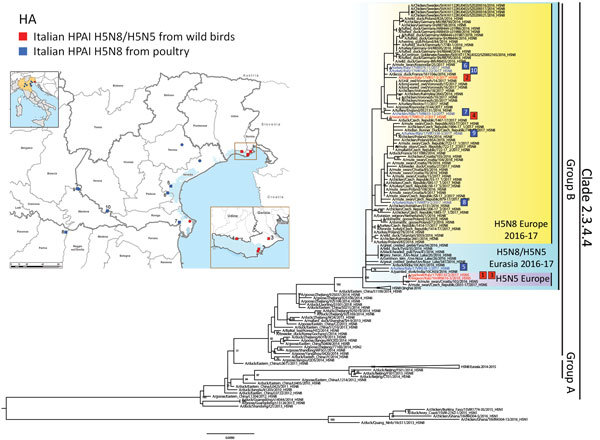
Highly pathogenic avian influenza A(H5N8) and A(H5N5) in birds, Italy, 2016–17). A) Geographic distribution of cases in wild (red) and domestic (blue) birds in northern Italy. Squares indicate the samples sequenced in this study; circles indicate positive samples for which no genetic information was available at the time of writing. B) Maximum likelihood phylogenetic tree of the hemagglutinin gene of clade 2.3.4.4 viruses. Viruses analyzed in this study are indicated with red (wild birds) and blue (domestic birds) squares, numbered according to the collection date. Bootstrap supports >60% are indicated above the nodes. Scale bar indicates nucleotide substitutions per site.
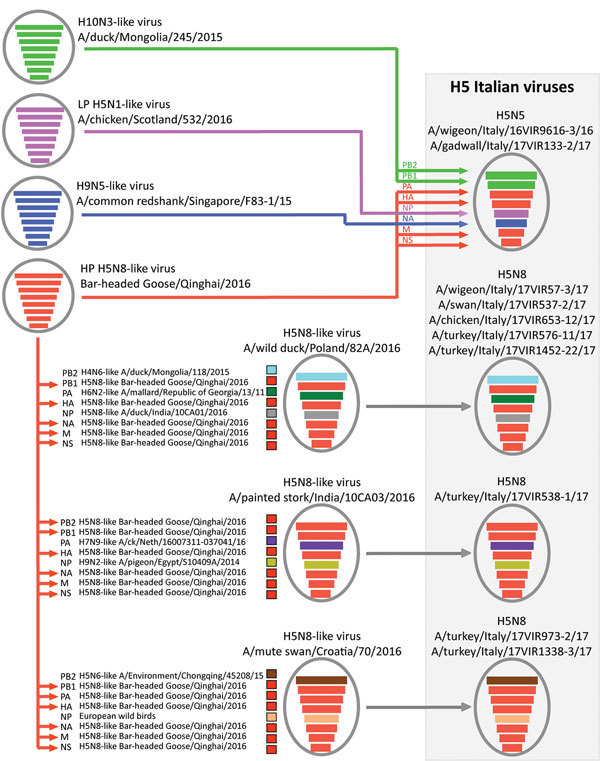
Probable genesis of highly pathogenic avian influenza A(H5N8) and A(H5N5) reassortant viruses identified in Italy, 2016–17 (gray box). Virus particles are represented by ovals containing horizontal bars that represent the 8 gene segments, colored according to their origin.
References
-
- World Organisation for Animal Health. Updated on highly pathogenic avian influenza in animals (type H5 and H7), 2016. [cited 2017 Mar 10]. http://www.oie.int/animal-health-in-the-world/update-on-avian-influenza/...
MeSH terms
LinkOut - more resources
Full Text Sources
Other Literature Sources
Medical