


In vitro optical quality measurements of three intraocular lens models having identical platform
- PMID: 28662629
- PMCID: PMC5492950
- DOI: 10.1186/s12886-017-0460-0
In vitro optical quality measurements of three intraocular lens models having identical platform
Abstract
Background: With recent advances in technology and introduction of new intraocular lens (IOL) models, surgeons today have the opportunity to choose from various optical designs, which can influence the postoperative quality of vision. In our laboratory study, we compared the optical quality of three different IOLs that use the identical platform and are produced by the same manufacturer. The study included two diffractive multifocal IOLs, a bifocal and a trifocal one, as well as a monofocal IOL.
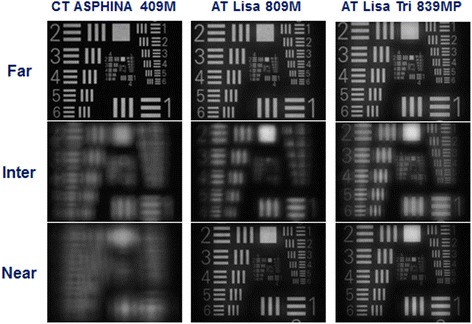
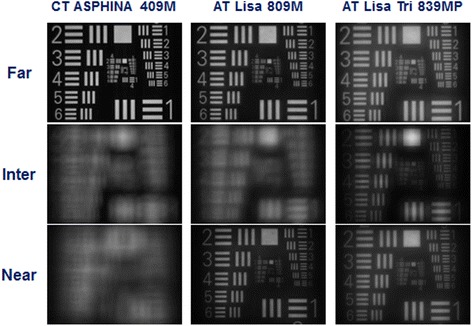
Methods: Three IOL models: monofocal CT ASPHINA 409 M, diffractive bifocal AT LISA 809 M, and diffractive trifocal AT LISA Tri 839MP (Carl Zeiss Meditec AG, Germany) were assessed for optical quality by measuring modulation transfer function (MTF) and Strehl Ratio (SR) values at pupil sizes of 3.0 and 4.5 mm on the OptiSpheric® IOL PRO (Trioptics GmbH, Germany). The United States Air Force (USAF) Target images were also recorded to comfirm the optical performance qualitatively.
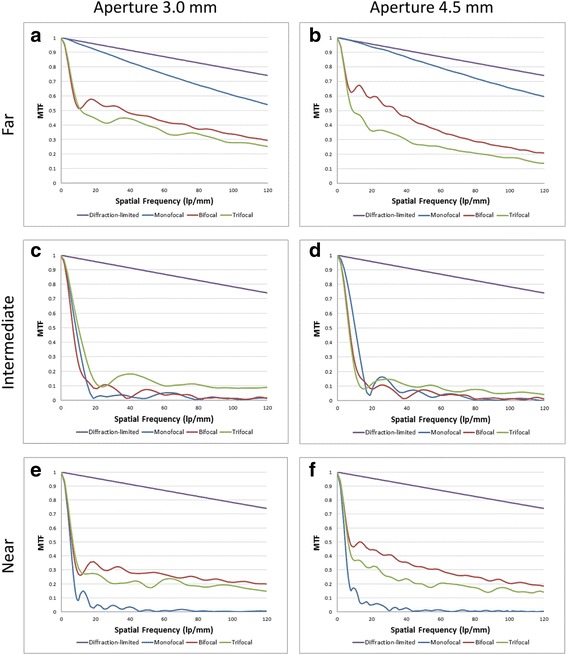
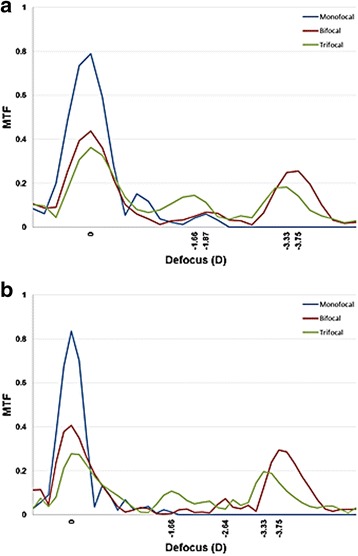
Results: For far focus at 50 lp/mm and 3.0 mm pupil size, MTF value of the monofocal lens (MTF = 0.798) was 1.8-fold and 2.1-fold better than the bifocal (MTF = 0.446) and the trifocal (MTF = 0.382) IOLs, respectively. For near focus, bifocal IOL (MTF = 0.265) was 1.4-fold better than trifocal IOL (MTF = 0.187), while for intermediate focus, the trifocal IOL (MTF = 0.148) was 1.7-fold better than the bifocal IOL (MTF = 0.086). For the same pupil size, total sum of light loss amounted to 5.2% for the monofocal, 16.0% for the bifocal and 6.0% for the trifocal IOL. For a larger pupil, the amount of light loss increased significantly for the multifocal IOLs.
Conclusions: The monofocal IOL performed the best for far, the bifocal IOL for near and the trifocal IOL for intermediate focus. While the monofocal IOL created the least amount of light loss for both pupil sizes, the trifocal IOL created less than half the amount of light loss than the bifocal IOL for small pupil. For large pupil, however, less light scatter was observed for the bifocal than the trifocal IOL.
Keywords: IOL; Light loss; MTF; Optical quality; USAF target.
Figures
References
-
- Calladine D, et al. Multifocal versus monofocal intraocular lenses after cataract extraction. Cochrane Database Syst Rev. 2012;12(9):Cd003169. - PubMed
MeSH terms
LinkOut - more resources
Full Text Sources
Other Literature Sources
Research Materials
Miscellaneous
