Review
. 2018 Dec 20;87(Pt A):22-32.
doi: 10.1016/j.pnpbp.2017.06.029. Epub 2017 Jun 27.

Defining the place of habit in substance use disorders

Affiliations
Review

Defining the place of habit in substance use disorders

Youna Vandaele et al. Prog Neuropsychopharmacol Biol Psychiatry. .

Abstract

It has long been suggested that alcohol or substance use disorders could emerge from the progressive development and dominance of drug habits. Like habits, drug-related behaviors are often triggered by drug-associated cues. Like habits, addictive behaviors are strong, rigid and "hard to break". Like habits, these behaviors are insensitive to their outcome and persist despite negative consequences. "Pathological habit" thus appears as a good candidate to explain the transition to compulsive drug use. However, drug use could also be considered as a goal-directed choice, driven by the expectation of drug outcomes. For example, drug addicts may engage in drug-seeking behaviors because they view the drug as more valuable than available alternatives. Substance use disorders therefore may not be all about habit, nor fully intentional, and could be considered as resulting from an imbalance between goal-directed and habitual control. The main objective of this review is to disentangle the relative contribution of habit formation and impairment of goal-directed behavior in this unbalanced control of addictive behaviors. Although deficits in goal-directed behavior have been demonstrated in alcohol and substance use disorders, reliable demonstration of abnormal habit formation has been curtailed by the paucity of paradigms designed to assess habit as a positive result. Refining our animal and human model of habit is therefore required to precisely define the place of habit in substance use disorders and develop appropriate and adapted neurobehavioral treatments.

Keywords: Addiction; Drugs; Goal-directed; Habit; Learning; Stimulus-response.


Figures

Figure 1
Figure 1
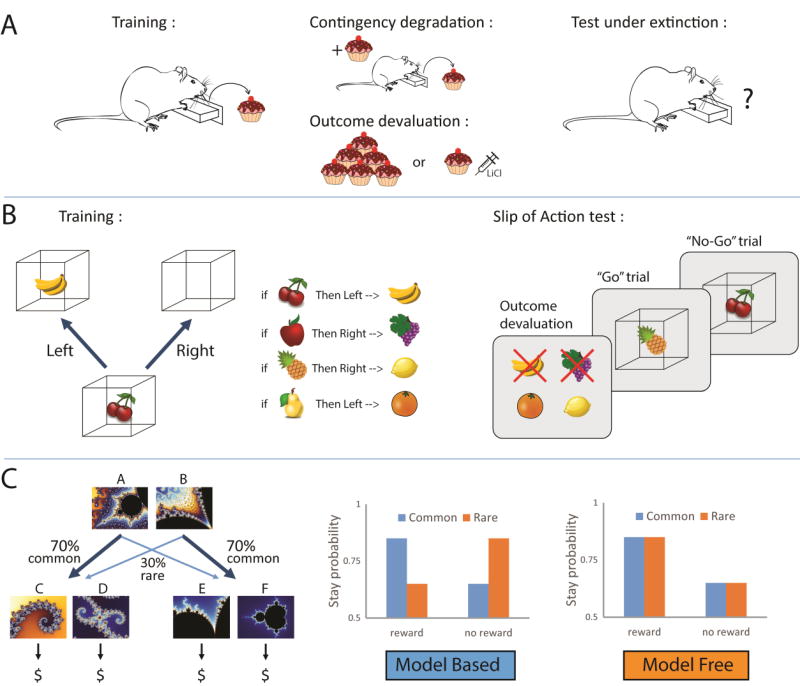
Illustration of behavioral paradigms used to assess whether control of performance is goal - directed or habitual. A. In instrumental tasks, rodents are trained to make an action (i.e. lever press) to obtain a reward. During the test, the instrumental contingency between the response and the outcome can be degraded with non-contingent reward delivery (upper panel). It is also possible to devalue the outcome by giving ad libitum access to the reward to generate sensory-specific satiety, or by pairing reward consumption with lithium chloride injection to generate conditioned taste aversion (lower panel). After contingency degradation or outcome devaluation, performance is assessed under extinction. A reduction in responding demonstrates that performance is goal-directed while persistent responding indicates habitual behavior. B. In some human instrumental tasks, fruit pictures (the stimuli) are presented and signal which associated response (a left or right key press) earns points signaled by a subsequent picture of fruit inside a box (the outcome). If the wrong response is emitted, the box is empty. Some outcomes are then devalued (indicated by a red cross on the fruit picture), and will now lead to a subtraction of points. During the test (right panel), subjects are presented with a rapid succession of stimuli, and are instructed to make the correct response for stimuli signaling still valuable outcomes (“go” trial), while they should refrain from responding for stimuli associated with devalued outcomes (“no go” trial). Adapted from (de Wit et al., 2012). C. In the sequential 2-stage decision task, one choice between 2 options at the first step leads commonly (70%) to a second pair of options but results occasionally (30%) in another set of options. At this second step, the selection of an option is rewarded or not, according to variable and unpredictable probabilities (left panel). Pure model-based agents are more likely to repeat the 1st step choice (i.e. ‘stay’) following rewarded trials after common transitions, but will switch to the alternative 1st step option after rare transitions (middle panel). In contrast, pure model -free agents will tend to repeat the same 1st step choice after rewarded trials, irrespective of the transition that preceded reward (right panel)(Daw et al., 2011).
Figure 2
Figure 2
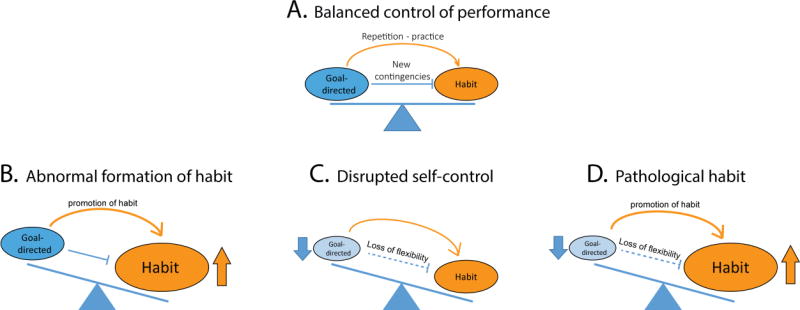
Disentangling abnormal habit from deficits in goal -directed control in substance use disorders. A. Balanced control of performance in non-addicted individuals; Repetition and practice promote the formation of habit but in situations that warrant deliberation, such as changes in environmental contingency, individuals can re-exert goal-directed control over habit to flexibly adjust their responding. B. According to the first model, the unbalance between goal-directed and habitual control in SUD would result from accelerated formation of abnormal and strong drug habits without deficit in goal-directed behavior C. According to the “disrupted self-control” model, habit would not be abnormally strong but would be expressed more frequently as a result of impaired goal-directed and inhibitory control. D. The “pathological habit” model posits that impairments in goal-directed control combine with abnormal habit formation to promote compulsive drug use in SUD.

References

    1. Adams CD. Variations in the sensitivity of instrumental responding to reinforcer devaluation. Q. J. Exp. Psychol. Sect. B. 1982;34:77–98. doi: 10.1080/14640748208400878. - DOI
    1. Adams CD, Dickinson A. Instrumental responding following reinforcer devaluation. Q. J. Exp. Psychol. Sect. B Comp. Physiol. Psychol. 1981;33:109–121. doi: 10.1080/14640748108400816. - DOI
    1. Ahmed SH. Validation crisis in animal models of drug addiction: Beyond non-disordered drug use toward drug addiction. Neurosci. Biobehav. Rev. 2010;35:172–184. doi: 10.1016/j.neubiorev.2010.04.005. - DOI - PubMed
    1. Bae SC, Lyoo IK, Sung YH, Yoo J, Chung A, Yoon SJ, Kim DJ, Hwang J, Kim SJ, Renshaw PF. Increased white matter hyperintensities in male methamphetamine abusers. Drug Alcohol Depend. 2006;81:83–88. doi: 10.1016/j.drugalcdep.2005.05.016. - DOI - PubMed
    1. Balconi M, Finocchiaro R, Campanella S. Reward sensitivity, decisional bias, and metacognitive deficits in cocaine drug addiction. J Addict Med. 2014;8:399–406. doi: 10.1097/adm.0000000000000065. - DOI - PubMed

Publication types