Review
. 2017 Apr 19;8(5):2536-2562.
doi: 10.1364/BOE.8.002536. eCollection 2017 May 1.

Review of adaptive optics OCT (AO-OCT): principles and applications for retinal imaging [Invited]

Affiliations
Review

Review of adaptive optics OCT (AO-OCT): principles and applications for retinal imaging [Invited]

Michael Pircher et al. Biomed Opt Express. .

Abstract

In vivo imaging of the human retina with a resolution that allows visualization of cellular structures has proven to be essential to broaden our knowledge about the physiology of this precious and very complex neural tissue that enables the first steps in vision. Many pathologic changes originate from functional and structural alterations on a cellular scale, long before any degradation in vision can be noted. Therefore, it is important to investigate these tissues with a sufficient level of detail in order to better understand associated disease development or the effects of therapeutic intervention. Optical retinal imaging modalities rely on the optical elements of the eye itself (mainly the cornea and lens) to produce retinal images and are therefore affected by the specific arrangement of these elements and possible imperfections in curvature. Thus, aberrations are introduced to the imaging light and image quality is degraded. To compensate for these aberrations, adaptive optics (AO), a technology initially developed in astronomy, has been utilized. However, the axial sectioning provided by retinal AO-based fundus cameras and scanning laser ophthalmoscope instruments is limited to tens of micrometers because of the rather small available numerical aperture of the eye. To overcome this limitation and thus achieve much higher axial sectioning in the order of 2-5µm, AO has been combined with optical coherence tomography (OCT) into AO-OCT. This enabled for the first time in vivo volumetric retinal imaging with high isotropic resolution. This article summarizes the technical aspects of AO-OCT and provides an overview on its various implementations and some of its clinical applications. In addition, latest developments in the field, such as computational AO-OCT and wavefront sensor less AO-OCT, are covered.

Keywords: (010.1080) Active or adaptive optics; (110.1758) Computational imaging; (170.2655) Functional monitoring and imaging; (170.4460) Ophthalmic optics and devices; (170.4500) Optical coherence tomography; (170.5755) Retina scanning; (330.5310) Vision - photoreceptors.


Figures
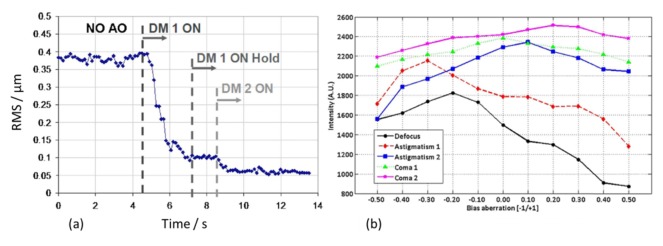
Fig. 1
Fig. 1
a.) Evolution of the RMS error of the measured wavefront during AO-correction of a dual DM AO-OCT system operating at 840nm (adapted from [39] with the permission of the Optical Society of America). b) Search result for optimum aberration correction in a wavefront sensor less AO OCT system. Changing the amplitude of the consecutive Zernike modes alters the wavefront at the pupil plane. The DM introduces these while changes in image intensity are monitored. (Reproduced from [47], with permission from Wolters Kluwer Health, Inc).
Fig. 2
Fig. 2
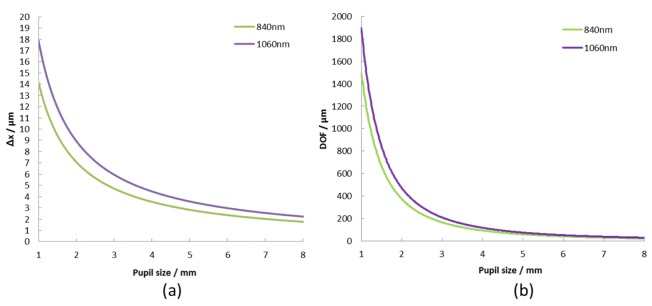
a) Diffraction limited transverse resolution of AO-OCT in the retina in dependence on the pupil size of the eye for different wavelength regions (assuming that the pupil of the eye is the limiting aperture of the system). b) Depth of focus (DOF) of AO-OCT in dependence on the pupil size of the eye.
Fig. 3
Fig. 3
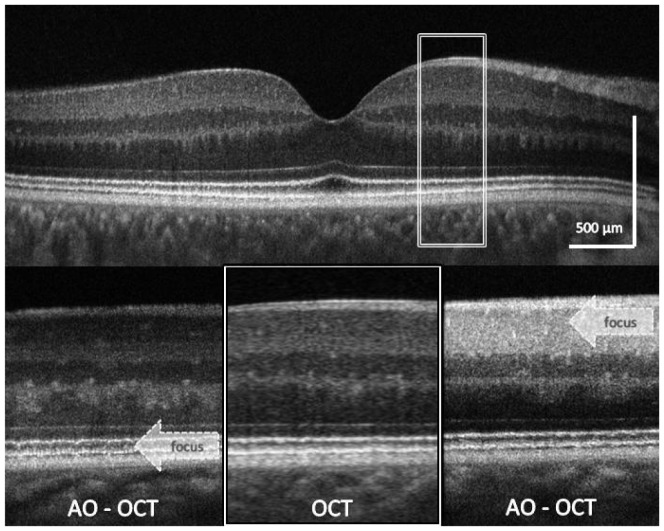
OCT B-scans of the retina obtained with different imaging techniques. (Top) Clinical OCT acquired over 5 mm; (bottom left) AO high-resolution spectral-domain OCT (0.5 mm scanning range) with focus set at photoreceptor layer; (bottom center) enlarged area (0.5 mm) from the clinical OCT; and (bottom right) AO high-resolution spectral-domain OCT (0.5 mm scanning range) with focus set at ganglion cell layer. The corresponding areas of the bottom images are similar. (Reproduced from [2], with permission from Wolters Kluwer Health, Inc.)
Fig. 4
Fig. 4
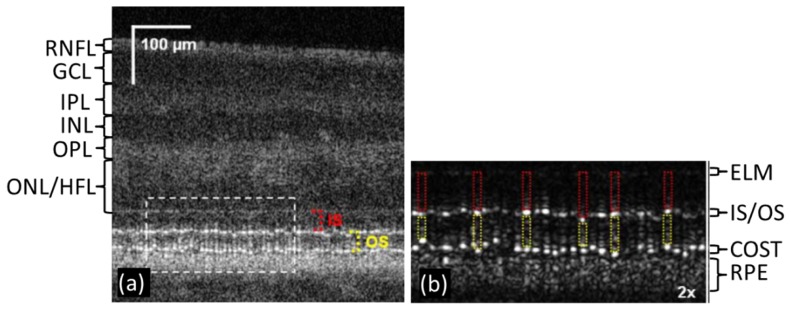
A) Representative AO-OCT B-scan with the focus set to the photoreceptors recorded in a healthy volunteer at 4.5 nasal eccentricity from the fovea (logarithmic intensity grey scale). B) 2x enlargement of the region marked with the white rectangle displayed on a linear intensity scale (some inner and outer segments of cones are marked with red and yellow rectangles, respectively). The retinal layers are labeled as follows: RNFL retinal nerve fiber layer, GCL ganglion cell layer, IPL inner plexiform layer, INL inner nuclear layer, OPL outer plexiform layer, ONL/HFL outer nuclear layer/Henle’s fiber layer, ELM external limiting membrane, IS/OS junction between inner and outer segments of cone photoreceptors, COST cone outer segment tips, RPE retinal pigment epithelium (adapted from [76] with the permission of the Optical Society of America).
Fig. 5
Fig. 5
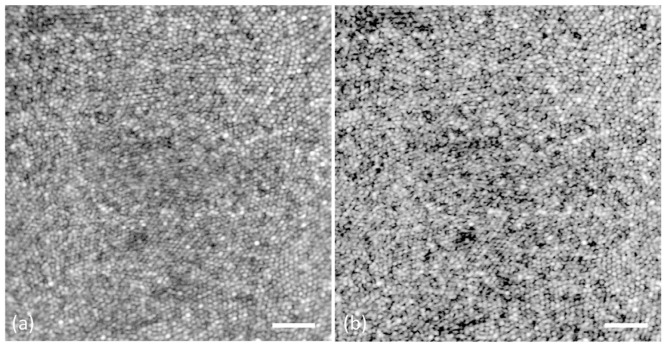
Representative en face images of the fovea of a healthy volunteer recorded with an AO-SLO/OCT instrument. (a) AO-SLO-image, (b) depth integrated AO-OCT image including following outer retinal layers: ELM, IS/OS, COST, and RPE. The images are displayed on a logarithmic scale in order to account for the high dynamic range of the image. Scale bar: 30µm (adapted from [42], with the permission of the Optical Society of America)
Fig. 6
Fig. 6
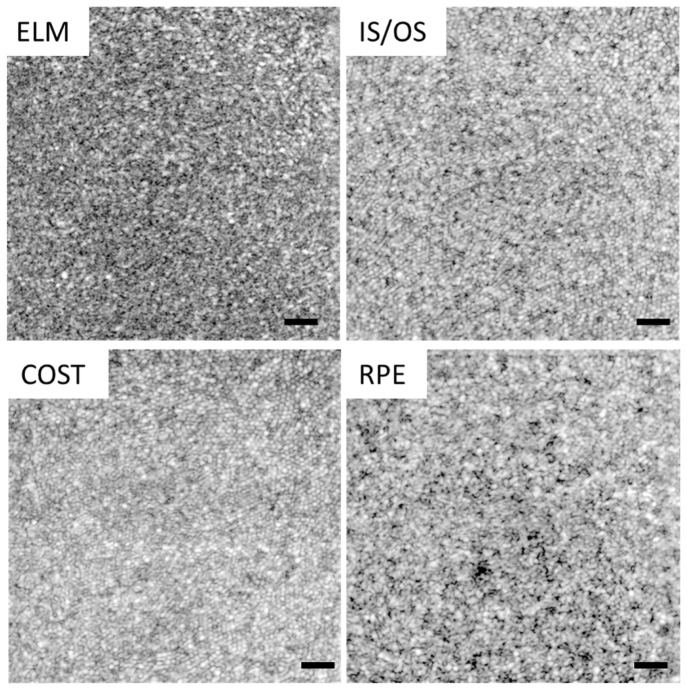
Representative AO-OCT images of different posterior retinal layers recorded in the fovea region of a healthy volunteer. ELM external limiting membrane, IS/OS junction between inner and outer segments of cone photoreceptors, COST cone outer segment tips, RPE retinal pigment epithelium. All images are displayed on a logarithmic intensity scale. (Scale bar: 30µm, image adapted from [42], with permission of the Optical Society of America).
Fig. 7
Fig. 7
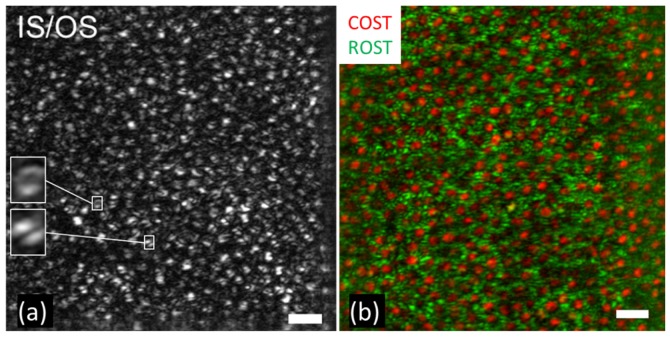
AO-OCT images recorded at ~8° eccentricity from the fovea. a) Segmented junction between inner and outer segments of cone photoreceptors showing distorted intensity patterns. Some patterns are enlarged (inset) and show intensity distributions that are typical to multimodal wave propagation. b) Composite image of different retinal layers recorded at the same retinal location and displayed in a false color scale. COST layer is indicated in red, rod outer segment tips (ROST) layer is indicated in green. (Scale bar: 30μm, images adapted from [42], with permission of the Optical Society of America).
Fig. 8
Fig. 8
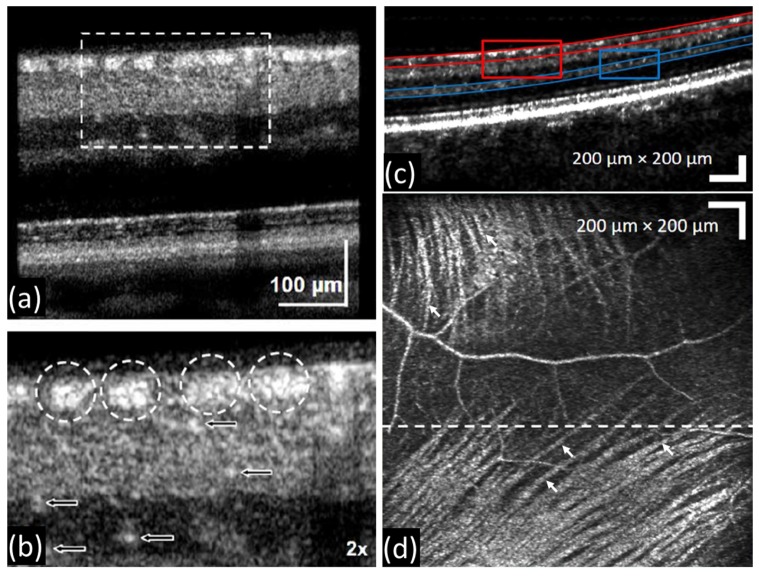
Representative AO-OCT images of a healthy volunteer with the focus set to the anterior layers. a) Averaged (10 frames) B-scan showing individual nerve fiber bundles. b) Enlarged region (by a factor of 2) of interest indicated with the white rectangle in a). The individual bundles are marked with the white circles. The black arrows indicate micro capillaries in the inner retina. c) Intensity B-scan recorded with a sensor less AO instrument showing different segmentation layers (indicated with different colors). d) En face projection of the layer indicated with red lines in c). White arrows point to individual nerve fiber bundles. The dashed horizontal line indicates the location of the B-scan shown in c). a) and b) are reproduced from [76], c) and d) are adapted from [47].
Fig. 9
Fig. 9
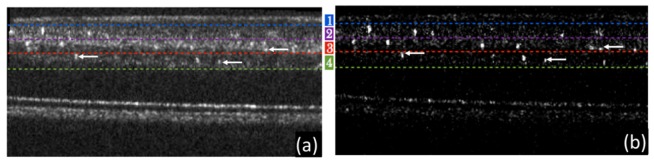
OCT B-scans recorded with a compact AO-OCT instrument. a) Intensity image (4 frames averaged) showing different segmentation layers (indicated with color bars and labeled with 1-4. b) OCTA B-scan with increased contrast of capillaries. White arrows point to representative capillaries in c) and d) (Images adapted from [126], with permission of the Optical Society of America).
Fig. 10
Fig. 10
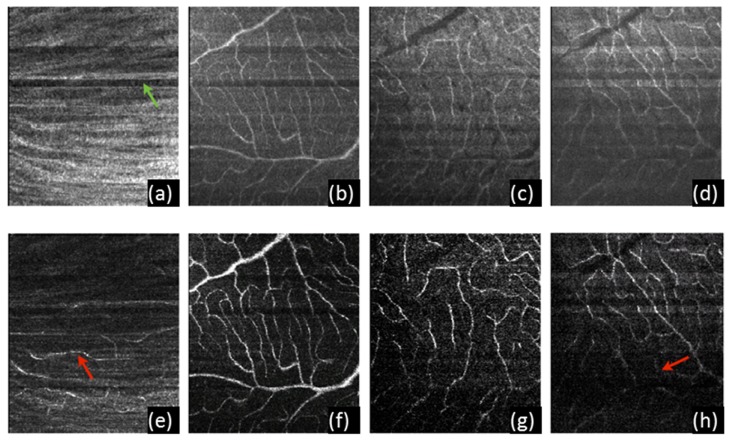
Comparison between AO-OCT intensity images and AO-OCTA images extracted at different depths. a-d) intensity images generated through depth integration of the depths indicated with numbers 1-4 in Fig. 8. The green arrow indicates an artifact caused by accommodation (and according shift of focus position) of the subject. e-h) Corresponding AO-OCTA images extracted at the same locations as in a-d. (The red arrow in e) points to a vessel that clearly shows increased contrast in this image compared to the intensity image. The red arrow in h) indicates areas with low signal intensity (reprinted from [126], with permission of the Optical Society of America).
Fig. 11
Fig. 11
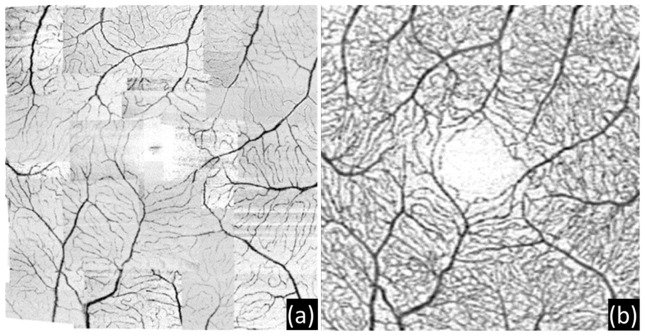
Comparison of vasculature recorded with different instruments. The images were generated through depth integration of region 2 in Fig. 8 and are displayed on an inverted grey scale. (a) Mosaic AO-OCTA image containing 25 images. (b) OCTA image recorded with a commercial instrument. Field of view: ~7° × 7°. (adapted from [126], with permission of the Optical Society of America).
Fig. 12
Fig. 12
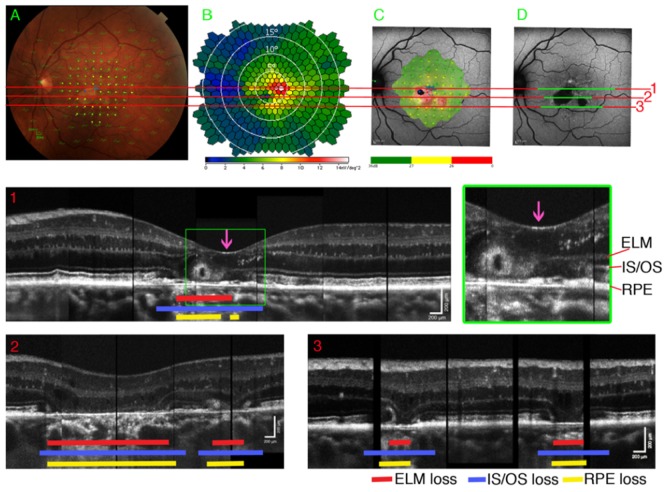
Application of AO-OCT for evaluating a patient with geographic atrophy. Panel A is the color fundus photograph (CF) with the multifocal electroretinogram (mfERG) traces and micro perimetry (mP) sensitivity superimposed. Panel B shows the mfERG response density map; panel C shows the mP sensitivity map superimposed on the Fundus Auto Fluorescense (FAF), and panel D is the FAF image. The three numbered green lines in panel D correspond to the three B-scan montages shown below. The magenta arrow in B-scan 1 shows the preferred retinal locus of the patient. The red, blue and yellow bars on the B-scans correspond to ELM, IS/OS and RPE loss, respectively. The magnified B-scan section shows remaining RPE that corresponds to the location of the preferred retinal locus [129]. (Reproduced with permission from the Association for Research in Vision and Ophthalmology, Inc (ARVO))
Fig. 13
Fig. 13
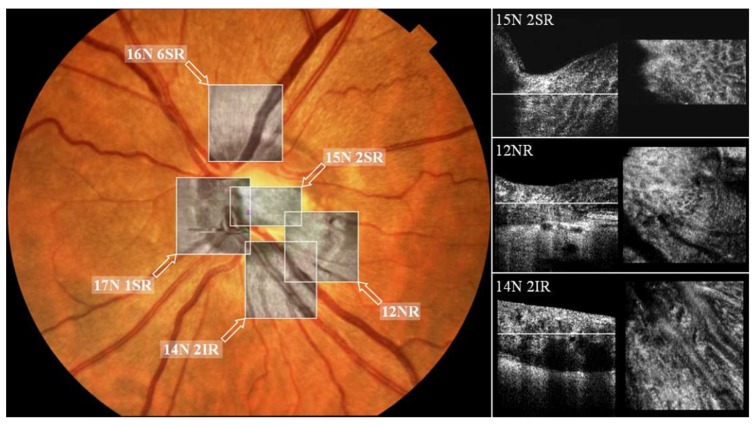
AO-OCT images recorded in close proximity to the optic disc. The left image shows a fundus photo overlaid with the fundus projections of the different regions of interest that have been imaged with AO-OCT. The right hand side shows representative B-scans and C-scans (the location of the C-scan is indicated with the horizontal white line in the B-scans) retrieved from the OCT volume (reproduced from [145], with permission of the Optical Society of America).
Fig. 14
Fig. 14
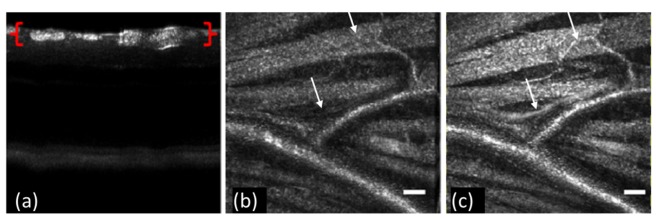
Representative AO-OCT of the nerve fiber layer of the mouse retina recorded with a wavefront sensor less AO-OCT instrument. a) B-scan showing individual nerve fiber bundles. The red brackets indicate the depth extension that was used for averaging in order to generate the corresponding en face images. b) En face image of the nerve fiber layer before adaptive optics correction. c) En face image of the nerve fiber layer after adaptive optics correction. The white arrows point to structures that are hardly visible in b) but can be clearly seen in c). The scale bar is 25µm (adapted from [38], with permission of the Optical Society of America).

References

    1. Huang D., Swanson E. A., Lin C. P., Schuman J. S., Stinson W. G., Chang W., Hee M. R., Flotte T., Gregory K., Puliafito C. A., Fujimoto J. G., “Optical coherence tomography,” Science 254(5035), 1178–1181 (1991).10.1126/science.1957169 - DOI - PMC - PubMed
    1. Wojtkowski M., Kaluzny B., Zawadzki R. J., “New directions in ophthalmic optical coherence tomography,” Optom. Vis. Sci. 89(5), 524–542 (2012).10.1097/OPX.0b013e31824eecb2 - DOI - PubMed
    1. de Carlo T. E., Romano A., Waheed N. K., Duker J. S., “A review of optical coherence tomography angiography (OCTA),” Int J Retina Vitreous 1(5), 5 (2015).10.1186/s40942-015-0005-8 - DOI - PMC - PubMed
    1. Drexler W., Fujimoto J. G., “State-of-the-art retinal optical coherence tomography,” Prog. Retin. Eye Res. 27(1), 45–88 (2008).10.1016/j.preteyeres.2007.07.005 - DOI - PubMed
    1. Walsh G., Charman W. N., Howland H. C., “Objective technique for the determination of monochromatic aberrations of the human eye,” J. Opt. Soc. Am. A 1(9), 987–992 (1984).10.1364/JOSAA.1.000987 - DOI - PubMed