


Long-term QALY-weights among spouses of dependent and independent midlife stroke survivors
- PMID: 28664459
- PMCID: PMC5655581
- DOI: 10.1007/s11136-017-1636-z
Long-term QALY-weights among spouses of dependent and independent midlife stroke survivors
Abstract
Purpose: The aim of this study was to investigate whether the dependency of midlife stroke survivors had any long-term impact on their spouses' QALY-weights.
Method: Data on stroke survivors, controls, and spouses were collected from the 7-year follow-up of the Sahlgrenska Academy Study on Ischemic Stroke. Health-related quality of life was assessed by the SF-36, and the preference-based health state values were assessed with the SF-6D. Spouses of dependent and independent stroke survivors were categorized according to their scores on the modified Rankin Scale. An ordinary least squares regression analysis was used to evaluate whether the dependency of the stroke survivors had any impact on the spouses' QALY-weights.
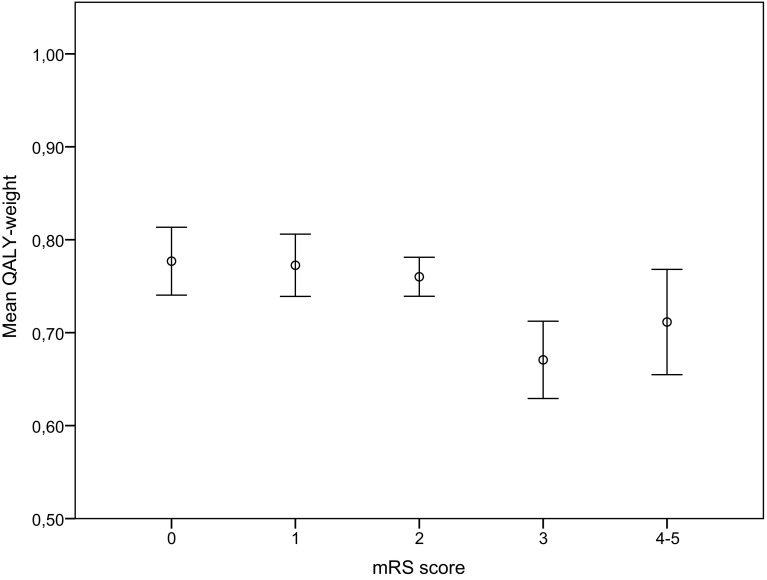
Result: Cohabitant dyads of 247 stroke survivors aged <70 at stroke onset and 245 dyads of controls were included in the study. Spouses of dependent stroke survivors (n = 50) reported a significant lower mean QALY-weight of 0.69 in comparison to spouses of independent stroke survivors (n = 197) and spouses of controls, (n = 245) who both reported a mean QALY-weight of 0.77. The results from the regression analysis showed that higher age of the spouse and dependency of the stroke survivor had a negative association with the spouses' QALY-weights.
Conclusion: The QALY-weights for spouses of dependent midlife stroke survivors were significantly reduced compared to spouses of independent midlife stroke survivors. This indicates that the inclusion of spouses' QALYs in evaluations of early treatment and rehabilitation efforts to reduce stroke patients' dependency would capture more of the total effect in dyads of stroke survivors.
Keywords: Health-related quality of life; Quality adjusted life years; SF-36; SF-6D; Spouses; Stroke.
Conflict of interest statement
Conflicts of interest
The authors, Josefine Persson, Mattias Aronsson, Lukas Holmegaard, Petra Redfors, Kaj Stenlöf, Katarina Jood, Christina Jern, Christian Blomstrand, Gunilla Forsberg-Wärleby, Lars-Åke Levin, declare that they have no conflicts of interest.
Ethical approval
All procedures performed in studies involving human participants were in accordance with the ethical standards of the institutional and/or national research committee and with the 1964 Helsinki declaration and its later amendments or comparable ethical standards.
Informed consent
Informed consent was obtained from all individual participants included in the study.
Figures

References
-
- Socialstyrelsen. Nationella riktlinjer för sjukdomsförebyggande metoder 2011—Hälsoekonomiskt underlag (Bilaga). [National guidelines for prevention methods 2011—Health economic evidence]. Socialstyrelsen, Stockholm. 2011. Retrieved January 19, 2017 from http://www.socialstyrelsen.se/nationellariktlinjerforsjukdomsforebyggand....
-
- NICE. Guide to the methods of technology appraisal 2013. Retrieved January 19, 2017 from https://www.nice.org.uk/article/pmg9/resources/non-guidance-guide-to-the....
-
- Gold M, Siegel J, Russell L, Weinstein M. Cost-effectiveness in health and medicine. New York: Oxford University Press; 1996.
-
- Claxton, K., Walker, S., Palmer, S., & Sculpher, M. Appropriate perspectives for healthcare decisions. In University of York CHE Research Paper 54. York, University of York, 2010. Retrieved January 19, 2017 from http://www.york.ac.uk/che/pdf/rp54.pdf.
MeSH terms
LinkOut - more resources
Full Text Sources
Other Literature Sources
Medical
