


Placebo response and its determinants in children with ADHD across multiple observers and settings: A randomized clinical trial
- PMID: 28664541
- PMCID: PMC6877247
- DOI: 10.1002/mpr.1572
Placebo response and its determinants in children with ADHD across multiple observers and settings: A randomized clinical trial
Abstract
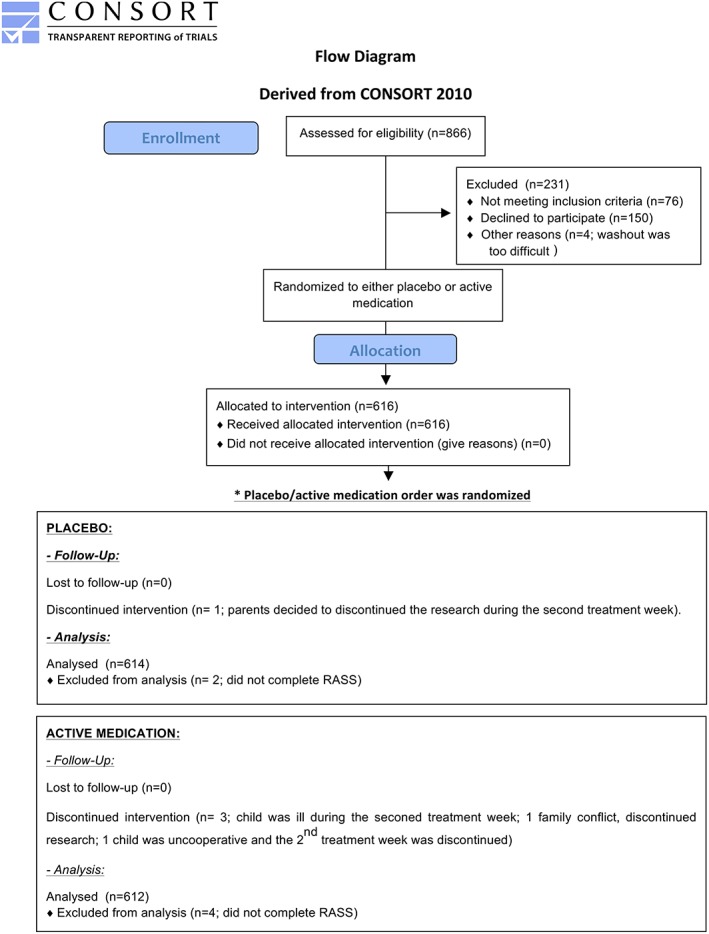
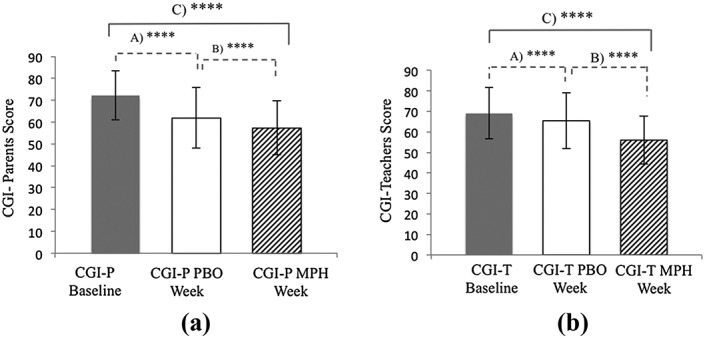
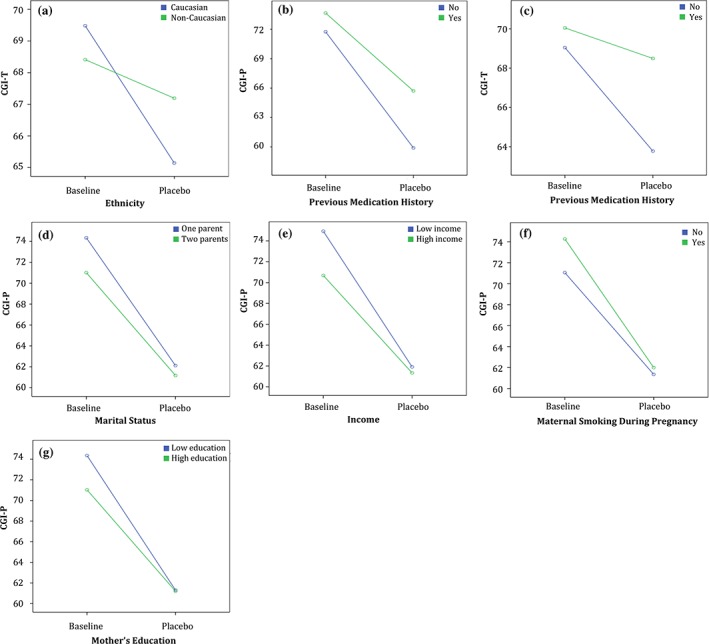
This study aims to quantify placebo response (PR) in children with attention deficit hyperactivity disorder (ADHD) as assessed by parents and teachers and to explore some of its determinants. Five hundred and forty children with ADHD (ages 6-12) were recruited to a randomized, double-blind, placebo-controlled crossover trial with methylphenidate. The main outcome variable was Conners' Global Index (CGI), based on assessment of behaviour by parents (CGI-P) and teacher (CGI-T). PR was calculated as the difference between CGI-P/T scores at baseline and placebo week. There was a highly significant PR as assessed by the parents' and teachers' (p < 0.001). The magnitude of PR as assessed by parents was greater (10.57 points) compared to that assessed by teachers (3.93 points). The determinants of PR were different between parents and teachers. For parents, income, marital status, education, maternal smoking during pregnancy, and prior psychostimulant exposure (PPE) showed a significant effect on PR. For teachers, only ethnicity and PPE had an effect. The pattern of PR revealed two distinct profiles that may shed some light on the mechanisms involved in PR. PR in children with ADHD varies depending on the setting of the observations and the evaluator. Several psychosocial factors have been identified as modulators of PR. This is relevant for the design and interpretation of clinical trials and for clinical practice.
Trial registration: ClinicalTrials.gov NCT00483106.
Keywords: ADHD; parents; placebo response; predictors; teachers.
Copyright © 2017 John Wiley & Sons, Ltd.
Figures
References
-
- Arnold, L. E. , Farmer, C. , Kraemer, H. C. , Davies, M. , Witwer, A. , Chuang, S. , … Swiezy, N. B. (2010). Moderators, mediators, and other predictors of risperidone response in children with autistic disorder and irritability. Journal of Child and Adolescent Psychopharmacology, 20(2), 83–93. 10.1089/cap.2009.0022 - DOI - PMC - PubMed
-
- Arnsten, A. F. (2006). Fundamentals of attention‐deficit/hyperactivity disorder: Circuits and pathways. Journal of Clinical Psychiatry, 67(Suppl. 8), 7–12. - PubMed
-
- Beecher, H. K. (1955). The powerful placebo. Journal of the American Medical Association, 159(17), 1602–1606. - PubMed
-
- Benedetti, F. (2009). Placebo Effects: Understanding the Mechanisms in Health and Disease. Oxford: Oxford University Press.
Publication types
MeSH terms
Substances
Associated data
Grants and funding
LinkOut - more resources
Full Text Sources
Other Literature Sources
Medical
Research Materials
