


How female community health workers navigate work challenges and why there are still gaps in their performance: a look at female community health workers in maternal and child health in two Indian districts through a reciprocal determinism framework
- PMID: 28666447
- PMCID: PMC5493888
- DOI: 10.1186/s12960-017-0222-3
How female community health workers navigate work challenges and why there are still gaps in their performance: a look at female community health workers in maternal and child health in two Indian districts through a reciprocal determinism framework
Abstract
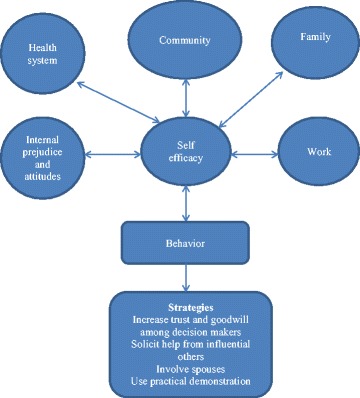
Background: Accredited Social Health Activists (ASHAs) are community health workers tasked to deliver health prevention in communities and link them with the health care sector. This paper examines the social, cultural, and institutional influences that either facilitate or impede ASHAs' abilities to deliver services effectively through the lens of the reciprocal determinism framework of social cognitive theory.
Methods: We conducted 98 semi-structured, in-depth interviews with ASHAs (n = 49) and their family members (n = 49) in Gurdaspur and Mewat districts. Data were analyzed by comparing and contrasting codes leading to the identification of patterns which were explained with the help of a theoretical framework.
Results: We found that while the work of ASHAs led to some positive health changes in the community, thus providing them with a sense of self-worth and motivation, community norms and beliefs as well as health system attitudes and practices limited their capacity as community health workers.
Conclusion: We outline potential mechanisms for improving ASHA capacity such as improved sensitization about religious, cultural, and gender norms; enhanced communication skills; and sensitization and advocating their work with health and state officials.
Keywords: Community health worker; Gender norms; Health worker performance; India; Reproductive and maternal health; Social cognitive theory.
Conflict of interest statement
Ethics approval and consent to participate
The protocol, interview guides, and consent forms were approved by the
1) Institutional Review Board, University Research Company, LLC, 7200 Wisconsin Avenue, Suite 600, Bethesda, MD 20814-4811, TEL 301-654-8338, FAX 301-941-8650,
2) Center for Media Studies, 34 B, research House, Community Centre
Saket, New Delhi 110017
IRB Number: IRB00006230
Consent for publication
Not applicable.
Competing interests
The authors declare that they have no competing interests.
Publisher’s Note
Springer Nature remains neutral with regard to jurisdictional claims in published maps and institutional affiliations.
Figures
References
-
- National Rural Health Mission . Guidelines for community processes. Nirman Bhavan: Ministry of Health and Family welfare; 2013.
Publication types
MeSH terms
LinkOut - more resources
Full Text Sources
Other Literature Sources
