


Comment
doi: 10.15252/embj.201797519.
Epub 2017 Jun 30.
A chief source of cancer and repair in stomachs
Affiliations
- PMID: 28666994
- PMCID: PMC5556266
- DOI: 10.15252/embj.201797519
Item in Clipboard
Comment
A chief source of cancer and repair in stomachs
EMBO J.
.
Abstract
Differentiated cells had long been thought to be non‐dividing, though we now know many can proliferate after injury. A new study by Leushacke et al (2017) shows how injury recruits mature, Lgr5‐expressing gastric chief cells to become stem cells that can either regenerate damaged tissue or fuel precancerous lesions.
Figures
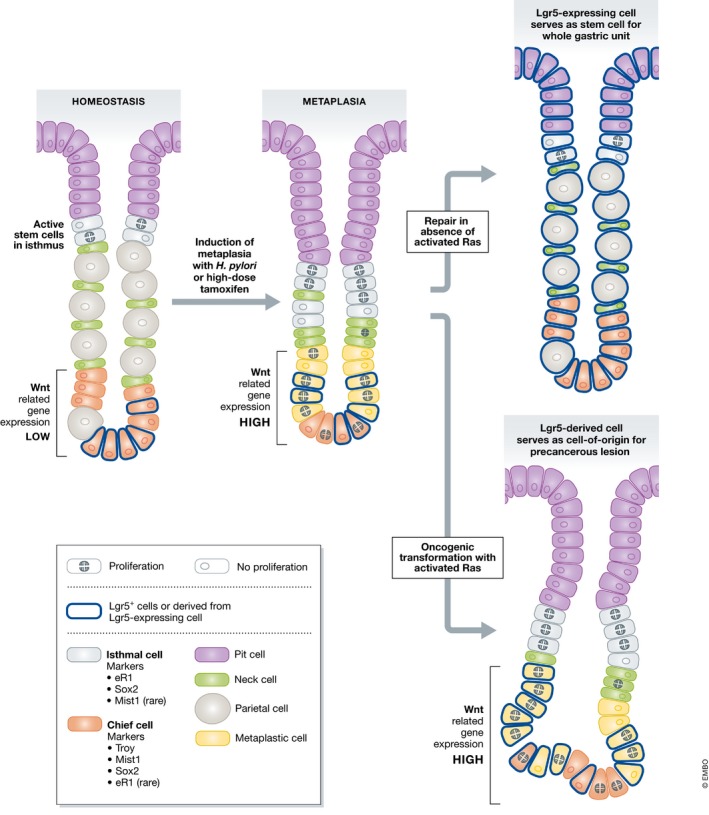
At homeostasis, Lgr5‐expressing chief cells remain in the base of the corpus unit and are not proliferative, while active stem cells in the isthmus give rise to all other epithelial cell types. However, after metaplasia‐inducing injury (as can be induced in the laboratory setting with high doses of tamoxifen; Huh et al, 2012), Lgr5‐expressing, “reserve” stem cells in the bottom part of the gland activate Wnt signaling, become metaplastic, and re‐enter the cell cycle in a reprogramming event. Without incurring additional damage, Lgr5‐expressing cells have potential to generate all epithelial cells in the gastric gland. If chief cells acquire oncogenic mutations (e.g., activate Ras; Choi et al, 2016), they can form dysplastic lesions, thus being a precursor cell to gastric cancer formation.
Comment on
-
Lgr5-expressing chief cells drive epithelial regeneration and cancer in the oxyntic stomach.Nat Cell Biol. 2017 Jul;19(7):774-786. doi: 10.1038/ncb3541. Epub 2017 Jun 5. Nat Cell Biol. 2017. PMID: 28581476
References
-
- Barker N, van Es JH, Kuipers J, Kujala P, van den Born M, Cozijnsen M, Haegebarth A, Korving J, Begthel H, Peters PJ, Clevers H (2007) Identification of stem cells in small intestine and colon by marker gene Lgr5. Nature 449: 1003–1007 - PubMed
-
- Barker N, Huch M, Kujala P, van de Wetering M, Snippert HJ, van Es JH, Sato T, Stange DE, Begthel H, van den Born M, Danenberg E, van den Brink S, Korving J, Abo A, Peters PJ, Wright N, Poulsom R, Clevers H (2010) Lgr5 + ve stem cells drive self‐renewal in the stomach and build long‐lived gastric units in vitro . Cell Stem Cell 6: 25–36 - PubMed
-
- Hayakawa Y, Ariyama H, Stancikova J, Sakitani K, Asfaha S, Renz B, Dubeykovskaya Z, Shibata W, Wang H, Westphalen C, Chen X, Takemoto Y, Kim W, Khurana S, Tailor Y, Nagar K, Tomita H, Hara A, Sepulveda A, Setlik W et al (2015) Mist1 expressing gastric stem cells maintain the normal and neoplastic gastric epithelium and are supported by a perivascular stem cell niche. Cancer Cell 28: 800–814 - PMC - PubMed
Publication types
MeSH terms
LinkOut - more resources
Full Text Sources
Other Literature Sources
