


A prospective study on the variation in falling and fall risk among community-dwelling older citizens in 12 European countries
- PMID: 28667220
- PMCID: PMC5726118
- DOI: 10.1136/bmjopen-2017-015827
A prospective study on the variation in falling and fall risk among community-dwelling older citizens in 12 European countries
Abstract
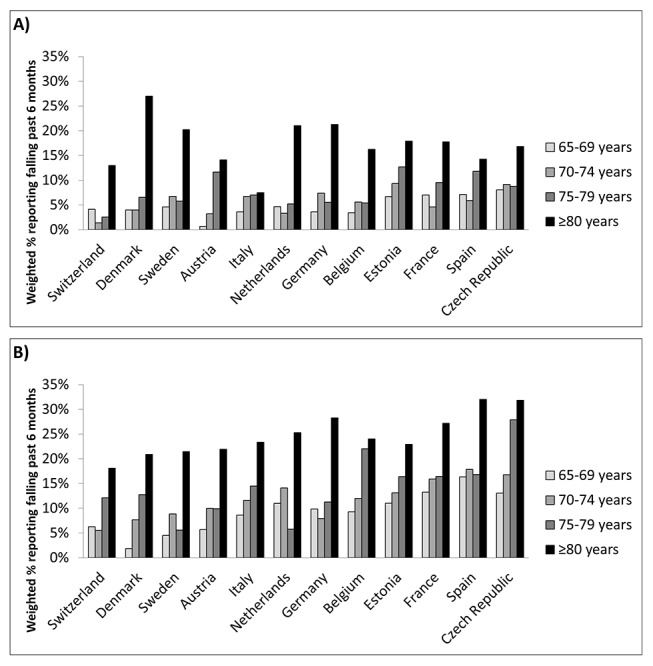
Objectives: The rate of falling among older citizens appears to vary across different countries, but the underlying aspects causing this variation are unexplained. We aim to describe between-country variation in falling and explore whether intrinsic fall risk factors can explain possible variation.
Design: Prospective study on data from the cross-national Survey of Health, Ageing and Retirement in Europe (SHARE).
Setting: Twelve European countries (Austria, Belgium, Czech Republic, Denmark, Estonia, France, Germany, Italy, The Netherlands, Spain, Sweden, Switzerland).
Participants: Community-dwelling persons aged ≥65 years (n=18 596).
Measurements: Socio-demographic factors (age, gender, education level and living situation) and intrinsic fall risk factors (less than good self-rated health (SRH), mobility limitations, limitations with activities of daily living (ADL), dizziness, impaired vision, depression and impaired cognition) were assessed in a baseline interview. Falling was assessed 2 years later by asking whether the participant had fallen within the 6 months prior to the follow-up interview.
Results: There was significant between-country variation in the rate of falling (varying from 7.9% in Switzerland to 16.2% in the Czech Republic). The prevalence of intrinsic fall risk factors varied twofold to fourfold between countries. Associations between factors age ≥80 years, less than good SRH, mobility limitations, ADL limitations, dizziness and depression, and falling were different between countries (p<0.05). Between-country differences in falling largely persisted after adjusting for socio-demographic differences but strongly attenuated after adjusting for differences in intrinsic fall risk factors.
Conclusion: There is considerable variation in the rate of falling between European countries, which can largely be explained by between-country variation in the prevalence of intrinsic fall risk factors. There are also country-specific variations in the association between these intrinsic risk factors and falling. These findings emphasise the importance of addressing intrinsic fall risk in (inter)national fall-prevention strategies, while highlighting country-specific priorities.
Keywords: epidemiology; geriatric medicine; preventive medicine.
© Article author(s) (or their employer(s) unless otherwise stated in the text of the article) 2017. All rights reserved. No commercial use is permitted unless otherwise expressly granted.
Conflict of interest statement
Competing interests: None declared.
Figures
References
Publication types
MeSH terms
Grants and funding
LinkOut - more resources
Full Text Sources
Other Literature Sources
Medical
