. 2017 Jun 30;7(1):4409.
doi: 10.1038/s41598-017-04594-9.

Proteomic shifts in multi-species oral biofilms caused by Anaeroglobus geminatus

Affiliations

Proteomic shifts in multi-species oral biofilms caused by Anaeroglobus geminatus

Kai Bao et al. Sci Rep. .

Abstract

Anaeroglobus geminatus is a relatively newly discovered putative pathogen, with a potential role in the microbial shift associated with periodontitis, a disease that causes inflammatory destruction of the periodontal tissues, and eventually tooth loss. This study aimed to introduce A. geminatus into a polymicrobial biofilm model of relevance to periodontitis, and monitor the proteomic responses exerted to the rest of the biofilm community. A. geminatus was grown together with another 10-species in a well-established "subgingival" in vitro biofilm model. Its effects on the other species were quantitatively evaluated by qPCR and label-free proteomics. A. geminatus caused a significant increase in P. intermedia numbers, but not the other species in the biofilm. Whole cell proteome profiling of the biofilms by LC-MS/MS identified a total of 3213 proteins. Label-free quantitative proteomics revealed that 187 proteins belonging to the other 10 species were differentially abundant when A. geminatus was present in the biofilm. The species with most up-regulated and down-regulated proteins were P. intermedia and S. oralis, respectively. Regulated proteins were of primarily of ribosomal origin, and other affected categories involved proteolysis, carbon metabolism and iron transport. In conclusion, A. geminatus can be successfully grown in a polymicrobial biofilm community, causing quantitative proteomic shifts commensurate with increased virulence properties.


Conflict of interest statement

The authors declare that they have no competing interests.

Figures
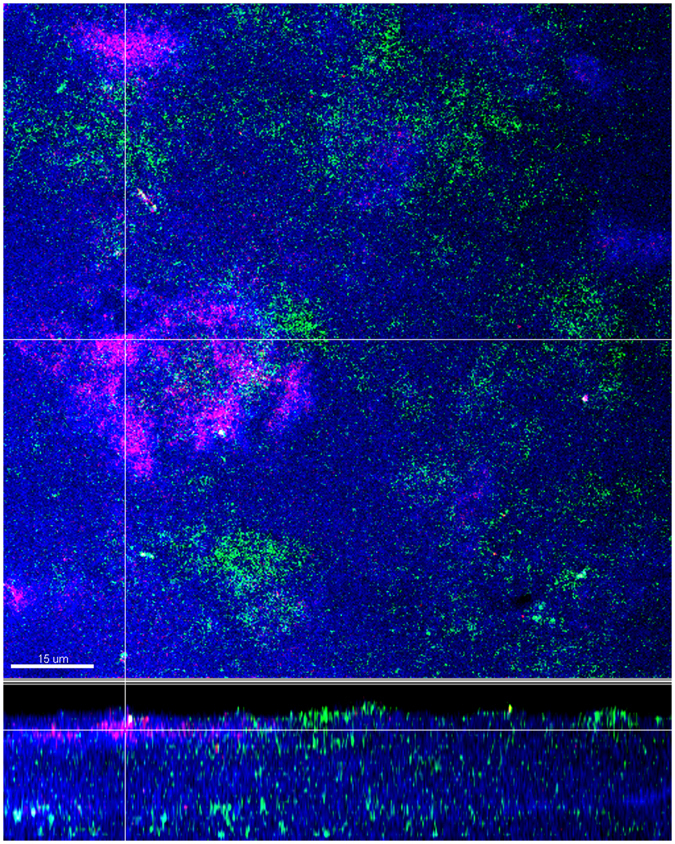
Figure 1
Figure 1
Localisation of A. geminatus within the biofilms. Confocal laser scanning microscopy images of fluorescence in situ hybridization (FISH) -stained 11-species biofilm. Bacteria appear blue due to DNA-staining using Syto 59. Due to FISH staining A. geminatus and V. dispar appear red and green, respectively. The biofilm base in the cross-sections is directed towards the top view. Scale bar: 15 µm.
Figure 2
Figure 2
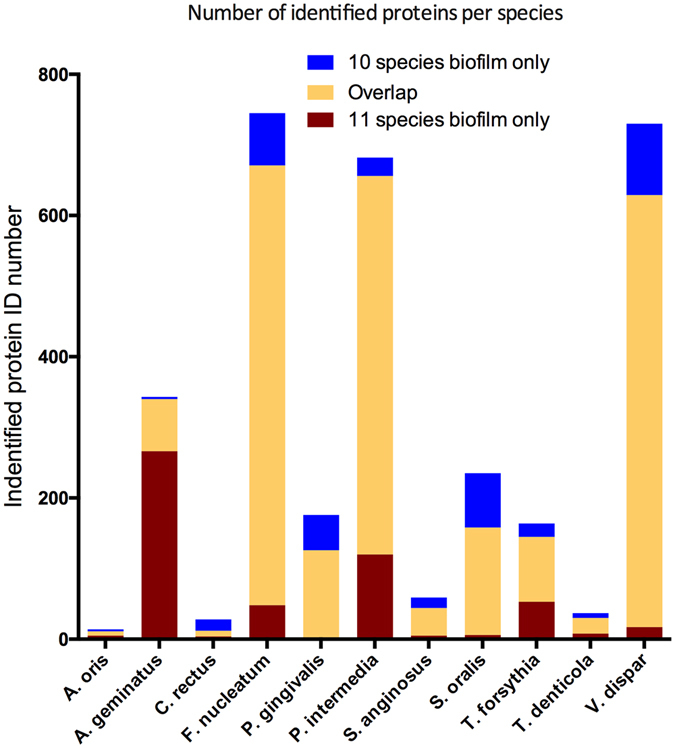
Number of identified proteins from each species. Identified proteins are shown based on whether they were uniquely identified in the 10 species biofilm alone (blue), 11 species biofilm alone (yellow), or in both groups (red).
Figure 3
Figure 3
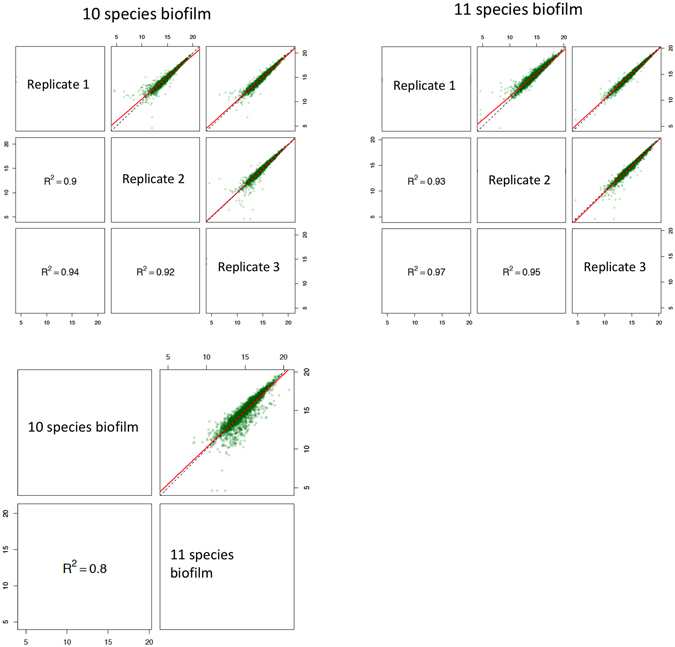
Quality control of the label-free quantitation data. Squared Pearson correlation coefficients of integrated peptide feature intensities are displayed for the comparisons within (n = 3) and between the two biofilm groups. The linear regressions of the integrated peptide feature intensities in different experimental group conditions are indicated in red, whereas the dashed lines correspond to direct proportionality.
Figure 4
Figure 4
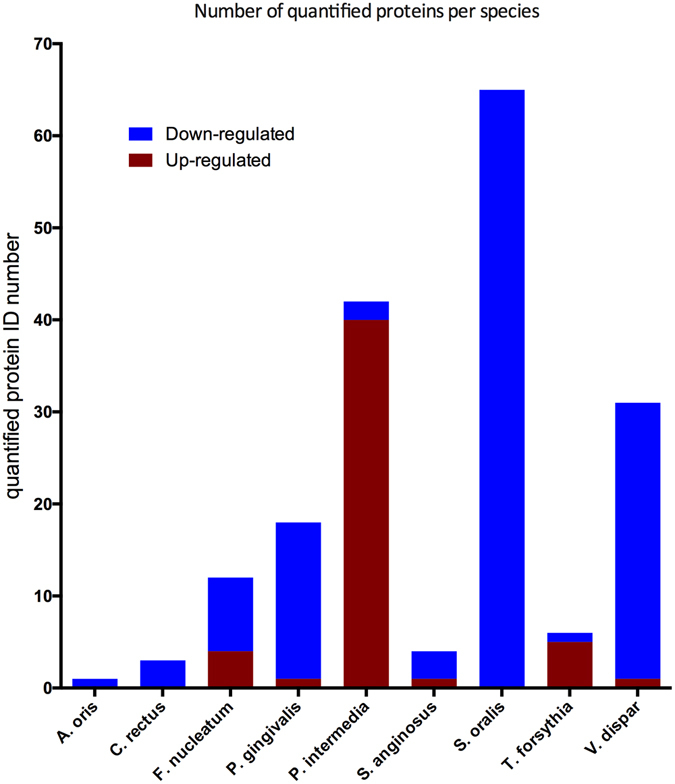
Number of differentially regulated proteins from each species. Regulation trends of label-free quantified proteins are shown based on whether they are down- (blue) or up- (red) regulated in relation to the present of A. geminatus in the biofilm. A significant (p < 0.05) difference of 2-fold in protein levels was defined as “regulation”.
Figure 5
Figure 5
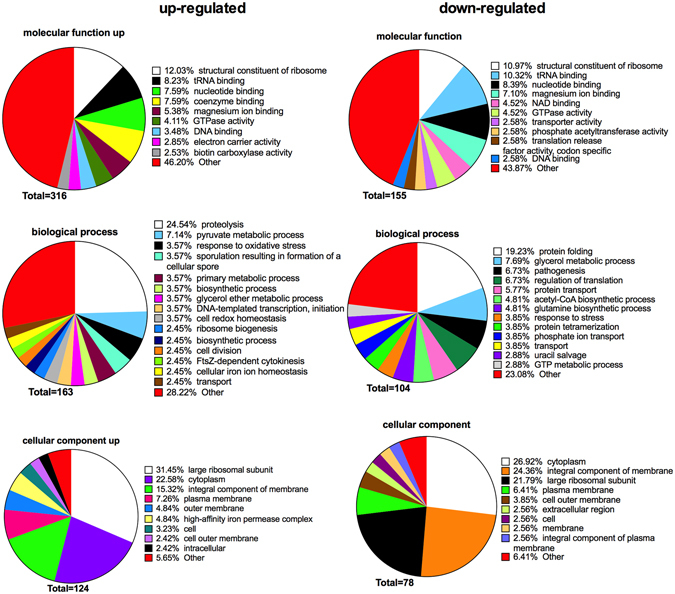
Annotation of regulated bacterial protein functions by Gene Ontology (GO) terms enrichment. The comparison was performed between the two biofilm variants. The GO terms from all regulated bacterial functions were categorized into three categories: a) biological process, b) molecular function, and c) cellular component, as displayed in the pie charts. These categories are displayed as “upregulated” or “downregulated” in relation to the presence of A. geminatus in the biofilm. The numbers of GO terms for each of the three categories are shown, whereas the proportion of each specific subcategory is also provided. Subcategories with GO terms less than 2% are classified as “other”.

References

    1. Albandar JM. Underestimation of periodontitis in NHANES surveys. Journal of periodontology. 2011;82:337–341. doi: 10.1902/jop.2011.100638. - DOI - PubMed
    1. Dewhirst FE, et al. The human oral microbiome. Journal of bacteriology. 2010;192:5002–5017. doi: 10.1128/JB.00542-10. - DOI - PMC - PubMed
    1. Teles R, Teles F, Frias-Lopez J, Paster B, Haffajee A. Lessons learned and unlearned in periodontal microbiology. Periodontology. 2013;2000(62):95–162. doi: 10.1111/prd.12010. - DOI - PMC - PubMed
    1. Hajishengallis, G., Lamont, R. J. & Graves, D. T. The enduring importance of animal models in understanding periodontal disease. Virulence, 0, doi:10.4161/21505594.2014.990806 (2015). - PMC - PubMed
    1. Hall-Stoodley L, Costerton JW, Stoodley P. Bacterial biofilms: from the natural environment to infectious diseases. Nature reviews. Microbiology. 2004;2:95–108. doi: 10.1038/nrmicro821. - DOI - PubMed

LinkOut - more resources