


Current and cutting-edge interventions for the treatment of obese patients
- PMID: 28668407
- PMCID: PMC5560073
- DOI: 10.1016/j.ejrad.2017.05.019
Current and cutting-edge interventions for the treatment of obese patients
Abstract
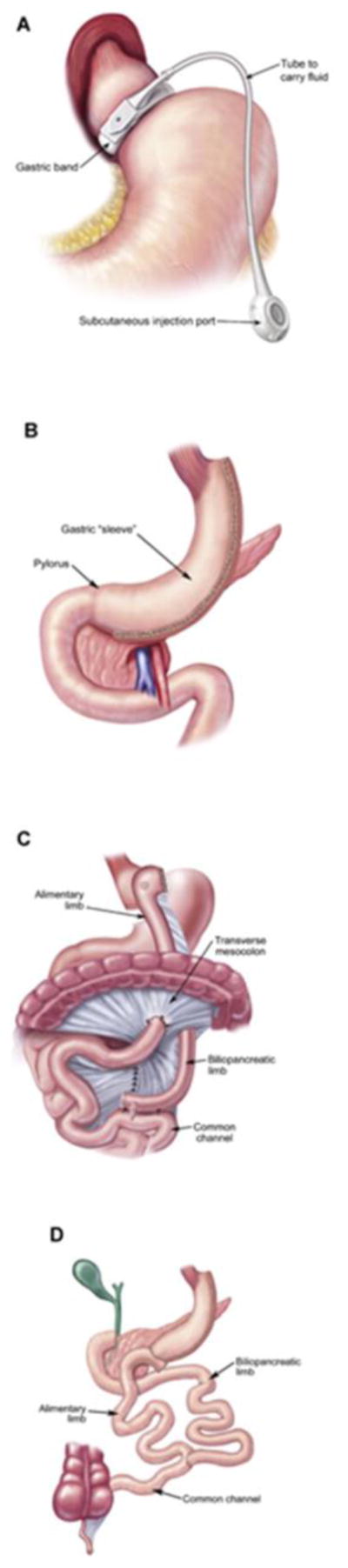
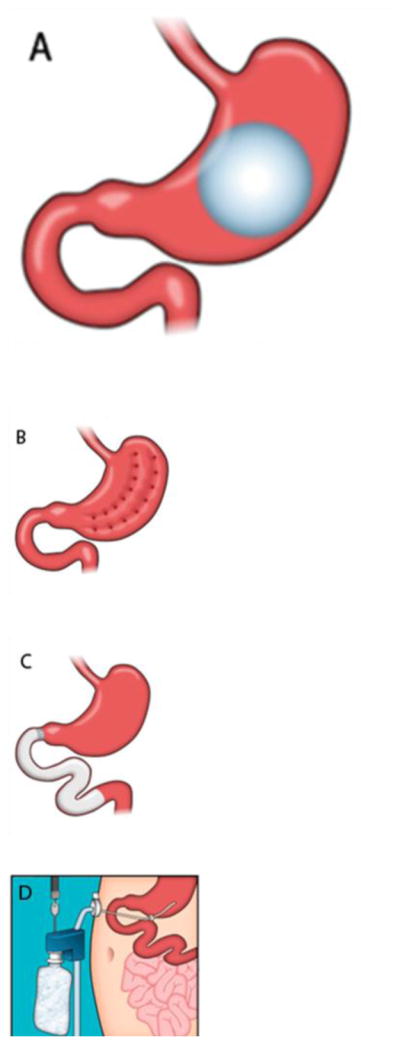
The number of people classified as obese, defined by the World Health Organization as having a body mass index ≥30, has been rising since the 1980s. Obesity is associated with comorbidities such as hypertension, diabetes mellitus, and nonalcoholic fatty liver disease. The current treatment paradigm emphasizes lifestyle modifications, including diet and exercise; however this approach produces only modest weight loss for many patients. When lifestyle modifications fail, the current "gold standard" therapy for obesity is bariatric surgery, including Roux-en-Y gastric bypass, sleeve gastrectomy, duodenal switch, and placement of an adjustable gastric band. Though effective, bariatric surgery can have severe short- and long-term complications. To fill the major gap in invasiveness between lifestyle modification and surgery, researchers have been developing pharmacotherapies and minimally invasive endoscopic techniques to treat obesity. Recently, interventional radiologists developed a percutaneous transarterial catheter-directed therapy targeting the hormonal function of the stomach. This review describes the current standard obesity treatments (including diet, exercise, and surgery), as well as newer endoscopic bariatric procedures and pharmacotherapies to help patients lose weight. We present data from two ongoing human trials of a new interventional radiology procedure for weight loss, bariatric embolization.
Keywords: BEAT Obesity; Bariatric surgery; Embolization; Obesity; Weight loss.
Copyright © 2017 Elsevier B.V. All rights reserved.
Conflict of interest statement
Conflicts of Interest: The authors do not have any conflicts of interest to report.
Figures

References
-
- Centers for Disease Control and Prevention. [Accessed on March 29, 2017];Defining adult overweight and obesity. Available at https://www.cdc.gov/obesity/adult/defining.html.
-
- Ogden CL, Yanovski SZ, Carroll MD, Flegal KM. The epidemiology of obesity. Gastroenterology. 2007;132(6):2087–102. - PubMed
-
- Obesity: preventing and managing the global epidemic. Report of a WHO consultation. World Health Organ. Tech Rep Ser. 2000;894:i–xii. 1–253. - PubMed
-
- Dent KM, Harper C, Kearney L, Lieber C, Finucane B. Embracing the unique role of genetic counselors: response to the commentary by Madeo et al. American Journal of Medical Genetics Part A. 2011;155A(8):1791–3. - PubMed
-
- Ng M, Fleming T, Robinson M, Thomson B, Graetz N, Margono C, Mullany EC, Biryukov S, Abbafati C, Abera SF, Abraham JP, Abu-Rmeileh NM, Achoki T, AlBuhairan FS, Alemu ZA, Alfonso R, Ali MK, Ali R, Guzman NA, Ammar W, Anwari P, Banerjee A, Barquera S, Basu S, Bennett DA, Bhutta Z, Blore J, Cabral N, Nonato IC, Chang JC, Chowdhury R, Courville KJ, Criqui MH, Cundiff DK, Dabhadkar KC, Dandona L, Davis A, Dayama A, Dharmaratne SD, Ding EL, Durrani AM, Esteghamati A, Farzadfar F, Fay DF, Feigin VL, Flaxman A, Forouzanfar MH, Goto A, Green MA, Gupta R, Hafezi-Nejad N, Hankey GJ, Harewood HC, Havmoeller R, Hay S, Hernandez L, Husseini A, Idrisov BT, Ikeda N, Islami F, Jahangir E, Jassal SK, Jee SH, Jeffreys M, Jonas JB, Kabagambe EK, Khalifa SE, Kengne AP, Khader YS, Khang YH, Kim D, Kimokoti RW, Kinge JM, Kokubo Y, Kosen S, Kwan G, Lai T, Leinsalu M, Li Y, Liang X, Liu S, Logroscino G, Lotufo PA, Lu Y, Ma J, Mainoo NK, Mensah GA, Merriman TR, Mokdad AH, Moschandreas J, Naghavi M, Naheed A, Nand D, Narayan KM, Nelson EL, Neuhouser ML, Nisar MI, Ohkubo T, Oti SO, Pedroza A, Prabhakaran D, Roy N, Sampson U, Seo H, Sepanlou SG, Shibuya K, Shiri R, Shiue I, Singh GM, Singh JA, Skirbekk V, Stapelberg NJ, Sturua L, Sykes BL, Tobias M, Tran BX, Trasande L, Toyoshima H, van de Vijver S, Vasankari TJ, Veerman JL, Velasquez-Melendez G, Vlassov VV, Vollset SE, Vos T, Wang C, Wang X, Weiderpass E, Werdecker A, Wright JL, Yang YC, Yatsuya H, Yoon J, Yoon SJ, Zhao Y, Zhou M, Zhu S, Lopez AD, Murray CJ, Gakidou E. Global, regional, and national prevalence of overweight and obesity in children and adults during 1980–2013: a systematic analysis for the Global Burden of Disease Study 2013. Lancet (London, England) 2014;384(9945):766–81. - PMC - PubMed
Publication types
MeSH terms
Grants and funding
LinkOut - more resources
Full Text Sources
Other Literature Sources
Medical
Research Materials
Miscellaneous
