Review
. 2017 Aug:68:34-41.
doi: 10.1016/j.semcdb.2017.06.026. Epub 2017 Jun 30.

Floppy but not sloppy: Interaction mechanism of FG-nucleoporins and nuclear transport receptors

Affiliations
Review

Floppy but not sloppy: Interaction mechanism of FG-nucleoporins and nuclear transport receptors

Iker Valle Aramburu et al. Semin Cell Dev Biol. 2017 Aug.

Abstract

The nuclear pore complex (NPC) forms a permeability barrier between the nucleus and the cytoplasm. Molecules that are able to cross this permeability barrier encounter different disordered phenylalanine glycine rich nucleoporins (FG-Nups) that act as a molecular filter and regulate the selective NPC crossing of biomolecules. In this review, we provide a current overview regarding the interaction mechanism between FG-Nups and the carrier molecules that recognize and enable the transport of cargoes through the NPC aiming to understand the general molecular mechanisms that facilitate the nucleocytoplasmic transport.

Keywords: Intrinsically disordered protein; Multivalency; Nuclear transport receptors; Nucleocytoplasmic transport; Nucleoporins.


Figures

Fig. 1
Fig. 1. Cartoon of the NPC and the main features of FG-Nups and NTRs.
A) Transversal section of the NPC structure with an estimated diameter of 45 nm and height of 24 nm of the central channel of the NPC (PDB:5IJN overlaid with a cryo-EM subtomogram average EMD-8087 [10]). B) Cartoon of the NPC indicating the location of FG-Nups from the cytoplasmic (red) central channel (blue) and nuclear basket (green). C) Example of FG-Nup containing a folded nuclear targeting and association domain and a disordered FG-motif rich region. The different FG-motifs are color coded and distributed through the FG-Nup sequence. D) Left, secondary structure of the HEAT repeat 5 of Importin-β (PDB:1QGK [46]). Each HEAT repeat is formed by two helices, an A-helix (cyan) and a B-helix (purple) which are oriented in an antiparallel manner. Right, structure of the ARM repeat 5 of Importin-α (PDB:1EE5 [55]). Structure showing the helix H1 (red), H2 (cyan) and H3 (purple), the last two having an antiparallel orientation as it is the case for the HEAT repeats. E) Cartoon representing an NTR composed of stacked HEAT forming a helicoidal structure. The pitch of the helicoid changes when it is bound to a protein by mildly modifying the angle of the repeats.
Fig. 2
Fig. 2. Structures of NTRs bound to FG-motifs.
A) Crystal structure of Importin-β (grey cartoon) bound to an FxFG motif (red) in between the HEAT repeats number 5–6 and 6-7 (PDB:1F59 [60]). B) Structure of NTF2 dimer (grey) bound to an FxFG peptide (red), the FxFG peptide binds to the hydrophobic groove formed in the binding interface between the NTF2 monomers (PDB:1GYB [57]). C) Crystal structure of CRM1/RanGTP (grey/light grey) bound to a 117 amino acid long C-terminal sequence of Nup214 (red). Nup214 wraps around the outer surface binding at different hydrophobic pockets connecting the C-and the N-terminal site of CRM1 (PDB:5DIS [66]).
Fig. 3
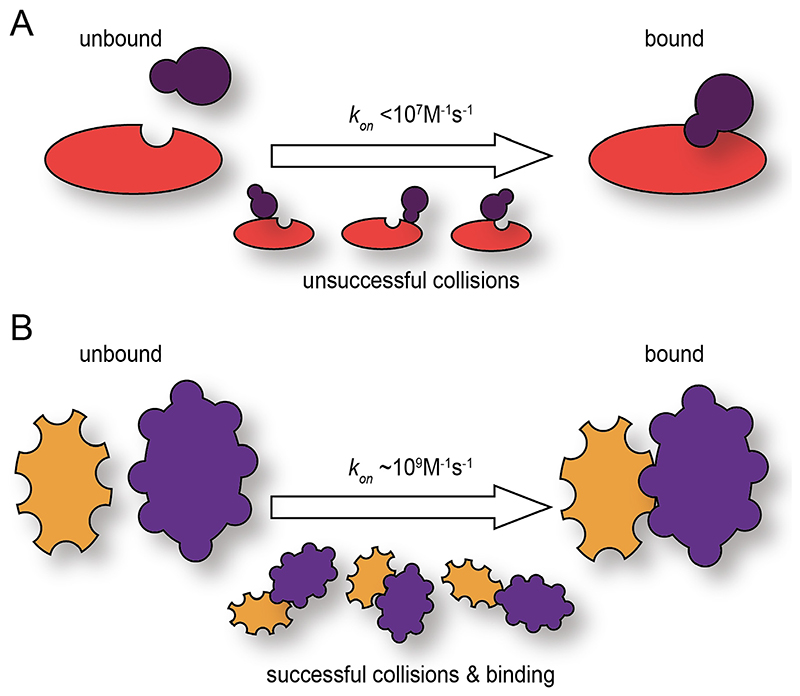
Fig. 3. Cartoon representing the different association rate constants (k on) for different binding modes.
A) Representation of the typical bimolecular binding that requires proper orientation of the binding partners to achieve a successful collision and binding. B) Representation of a diffusion limited protein-protein binding where the binding partners contain a highly reactive surface in which any collision encounter leads to a successful binding event.
Fig 4
Fig 4
Cartoon illustrating the differences between k off,global/k off,indiv. and K D,global/K D,single for molecules with different valency and cartoon of NTR crossing the NPC. A) Cartoon of 3 molecules (orange): a monovalent (molecule A), divalent (molecule B) and trivalent (molecule C) that bind to their binding partners (purple) that are also mono-,di- and trivalent. These three molecules contain the same binding sites and bind to the same motifs the only difference is the valency.

References

    1. Adams RL, Wente SR. Uncovering nuclear pore complexity with innovation. Cell. 2013;152:1218–1221. - PMC - PubMed
    1. Timney BL, Raveh B, Mironska R, Trivedi JM, Kim SJ, Russel D, et al. Simple rules for passive diffusion through the nuclear pore complex. J Cell Biol. 2016;215:57–76. - PMC - PubMed
    1. Popken P, Ghavami A, Onck PR, Poolman B, Veenhoff LM. Size-dependent leak of soluble and membrane proteins through the yeast nuclear pore complex. Mol Biol Cell. 2015;26:1386–1394. - PMC - PubMed
    1. Kalab P, Weis K, Heald R. Visualization of a Ran-GTP gradient in interphase and mitotic Xenopus egg extracts. Science (New York, NY) 2002;295:2452–2456. - PubMed
    1. Melchior F. Ran GTPase cycle: One mechanism – two functions. Curr Biol: CB. 2001;11:R257–R260. - PubMed

Publication types

MeSH terms

Substances

LinkOut - more resources