Review
. 2017;56(13):1613-1619.
doi: 10.2169/internalmedicine.56.8209. Epub 2017 Jul 1.

Cardiovascular and Metabolic Diseases Comorbid with Psoriasis: Beyond the Skin

Affiliations
Review

Cardiovascular and Metabolic Diseases Comorbid with Psoriasis: Beyond the Skin

Masutaka Furue et al. Intern Med. 2017.

Abstract

A close association of systemic inflammation with cardiovascular diseases and metabolic syndrome is recently a popular topic in medicine. Psoriasis is a chronic inflammatory skin disease with a prevalence of approximately 0.1-0.5% in Asians. It is characterized by widespread scaly erythematous macules that cause significant physical and psychological burdens for the affected individuals. The accelerated inflammation driven by the TNF-α/IL-23/IL-17A axis is now known to be the major mechanism in the development of psoriasis. Psoriasis is not a mere skin disease; it is significantly associated with cardiovascular diseases and metabolic syndrome, which suggests that the chronic skin inflammation extends the systemic inflammation beyond the skin. In this article, we review the epidemiological and pathological aspects of psoriasis and its comorbidities.

Keywords: cardiovascular disease; interleukin 17; interleukin 23; metabolic syndrome; psoriasis; tumor necrosis factor α.


Figures
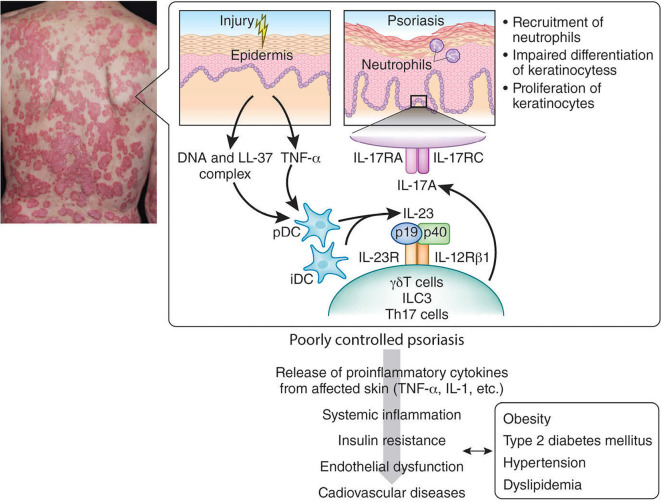
Figure.
Figure.
Pathophysiology of psoriasis and its comorbidities (simplified model modified from references 5, 8 and 67). The initial trigger of psoriasis is thought to be the activation of plasmacytoid dendritic cells (DCs) by complexes of host DNA and the antimicrobial peptide LL-37 (cathelicidin) produced by keratinocytes after minor injuries. Plasmacytoids and recruited inflammatory DCs (pDCs and iDCs) produce TNF-α, IL-12 and IL-23. IL-23 is critically involved in the generation and activation of IL-17-producing effector cells. In humans and experimental psoriasis models, γδT cells (Vγ9Vδ2 T cells in human), innate lymphoid cells type 3 (ILC3) and Th17 cells are detected in the lesional skin and blood, and these cells readily produce IL-17A. IL-17A binds to the IL-17 receptor (IL-17R), which is composed of IL-17RA and IL-17RC. IL-17A upregulates the proliferation and downregulates the differentiation of keratinocytes and also enhances the recruitment of neutrophils and aids in the crosstalk between neutrophils and keratinocytes. Chronically released proinflammatory cytokines (e.g., TNF-α, IL-1) from poorly controlled psoriatic skin to the circulatory system potentiates and perpetuates the systemic inflammation and induces insulin resistance, endothelial dysfunction and cardiovascular diseases. This systemic inflammation also causes obesity, hypertension, dyslipidemia and type 2 diabetes mellitus. These systemic involvements interact with each other to increase the mortality for psoriatic patients from cardiovascular diseases.

References

    1. Libby P, Nahrendorf M, Swirski FK. Leukocytes link local and systemic inflammation in ischemic cardiovascular disease: an expanded “cardiovascular continuum”. J Am Coll Cardiol 67: 1091-1103, 2016. - PMC - PubMed
    1. de Souza Bastos A, Graves DT, de Melo Loureiro AP, et al. Diabetes and increased lipid peroxidation are associated with systemic inflammation even in well-controlled patients. J Diabetes Complications 30: 1593-1599, 2016. - PMC - PubMed
    1. Herder C, Færch K, Carstensen-Kirberg M, et al. Biomarkers of subclinical inflammation and increases in glycaemia, insulin resistance and beta-cell function in non-diabetic individuals: the Whitehall II study. Eur J Endocrinol 175: 367-377, 2016. - PubMed
    1. Joshi AA, Lerman JB, Aberra TM, et al. GlycA is a novel biomarker of inflammation and subclinical cardiovascular disease in psoriasis. Circ Res pii: CIRCRESAHA.116.309637, 2016. - PMC - PubMed
    1. Boehncke WH, Schön MP. Psoriasis. Lancet 386: 983-994, 2015. - PubMed

MeSH terms
