


A Review of the Long-Term Efficacy, Tolerability, and Safety of Exenatide Once Weekly for Type 2 Diabetes
- PMID: 28674957
- PMCID: PMC5565650
- DOI: 10.1007/s12325-017-0499-6
A Review of the Long-Term Efficacy, Tolerability, and Safety of Exenatide Once Weekly for Type 2 Diabetes
Abstract
Introduction: Exenatide once weekly (ExeOW, Bydureon®, Astra Zeneca), a drug belonging to the class of glucagon-like peptide-1 (GLP-1) receptor agonists, is the first agent approved for treatment of type 2 diabetes (T2D) that can be administered on a weekly basis.
Methods: Data concerning treatment of T2D with ExeOW are reviewed with special reference to its long-term efficacy, tolerability, and safety. Relevant literature was identified through the PubMed database from inception to January 2015.
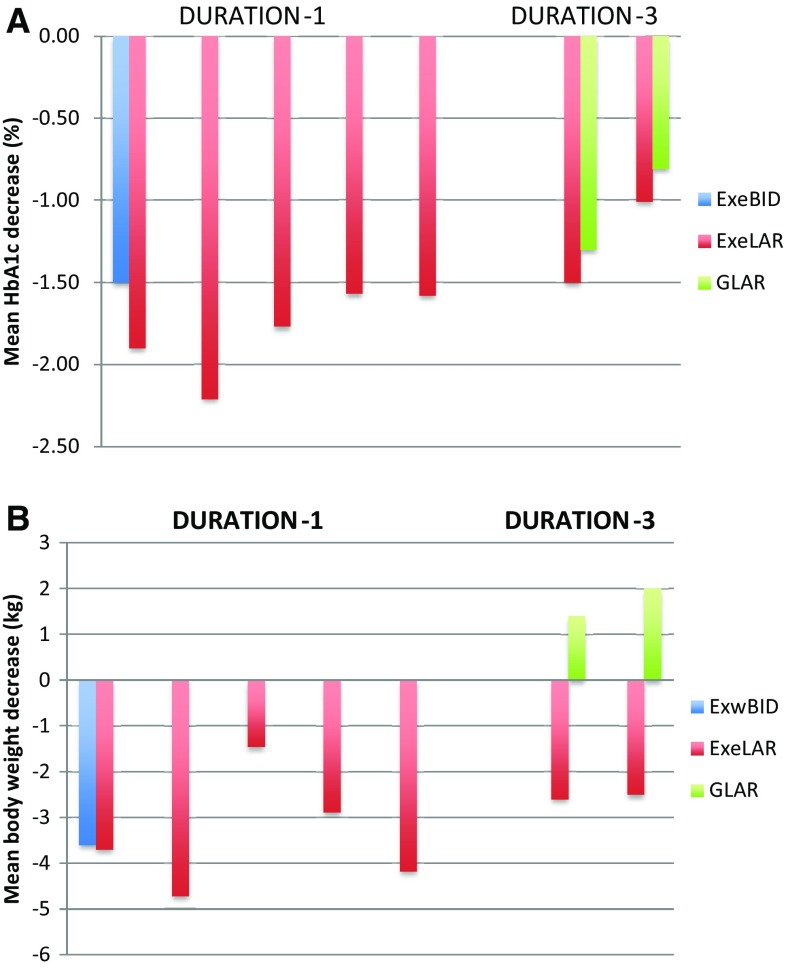
Results: In randomized clinical trials ExeOW, as add-on to oral antidiabetics, achieved significantly improved glycemic control compared to maximum recommended doses of exenatide twice daily, sitagliptin, pioglitazone, and insulin glargine, as measured by HbA1c. In drug-naïve patients ExeOW was superior to sitagliptin and non-inferior to metformin, whereas non-inferiority to pioglitazone and liraglutide was not proven. In different trials reductions in HbA1c ranged from -1.1% to -2.0%. ExeOW therapy over 6 months was also associated with a mean weight loss of -2 to -4 kg, improved systolic blood pressure and lipid profile, and no hypoglycemia unless associated to sulfonylurea. ExeOW long-term therapy up to 3-6 years allowed persistent glycemic control (HbA1c -1.6%), sustained decreases in blood pressure (-2 mmHg), and improvements of lipid profile. ExeOW tolerability was comparable to that of the other GLP-1 receptor agonists, with better gastrointestinal tolerability when direct comparison was done (namely liraglutide and exenatide BID), but higher incidence of injection site reactions and few treatment discontinuations mainly due to gastrointestinal events.
Conclusion: ExeOW is a well-tolerated and convenient option for long-term treatment of T2D allowing significant and persistent glycemic control with moderate weight loss and low risk of hypoglycemia unless associated with sulfonylureas.
Keywords: Diabetes; Exenatide long-acting release; Exenatide once weekly; Glucagon-like peptide 1; Type 2 diabetes.
Figures
References
-
- Nauck MA, Homberger E, Siegel EG, et al. Incretin effects of increasing glucose loads in man calculated from venous insulin and C-peptide responses. J Clin Endocrinol Metab. 1986;63(2):492–498. - PubMed
-
- Wick A, Newlin K. Incretin-based therapies: therapeutic rationale and pharmacological promise for type 2 diabetes. J Am Acad Nurse Pract. 2009;21(Suppl 1):623–630. - PubMed
-
- Nielsen LL, Young AA, Parkes DG. Pharmacology of exenatide (synthetic exendin-4): a potential therapeutic for improved glycemic control of type 2 diabetes. Regul Pept. 2004;117(2):77–88. - PubMed
-
- Kim D, MacConell L, Zhuang D, et al. Effects of once-weekly dosing of a long-acting release formulation of exenatide on glucose control and body weight in subjects with type 2 diabetes. Diabetes Care. 2007;30(6):1487–1493. - PubMed
Publication types
MeSH terms
Substances
LinkOut - more resources
Full Text Sources
Other Literature Sources
Medical
Molecular Biology Databases
