


Malaria in Brazil, Colombia, Peru and Venezuela: current challenges in malaria control and elimination
- PMID: 28676055
- PMCID: PMC5496604
- DOI: 10.1186/s12936-017-1925-6
Malaria in Brazil, Colombia, Peru and Venezuela: current challenges in malaria control and elimination
Abstract
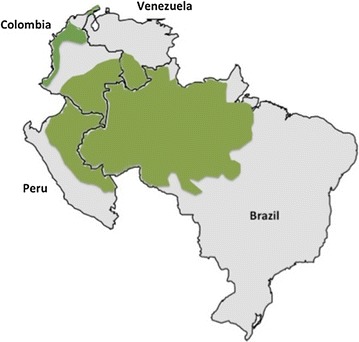
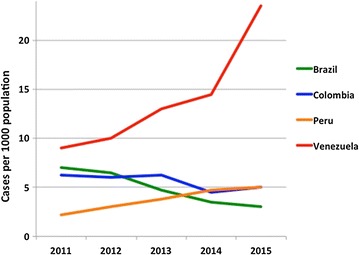
In spite of significant progress towards malaria control and elimination achieved in South America in the 2000s, this mosquito-transmitted tropical disease remains an important public health concern in the region. Most malaria cases in South America come from Amazon rain forest areas in northern countries, where more than half of malaria is caused by Plasmodium vivax, while Plasmodium falciparum malaria incidence has decreased in recent years. This review discusses current malaria data, policies and challenges in four South American Amazon countries: Brazil, Colombia, Peru and the Bolivarian Republic of Venezuela. Challenges to continuing efforts to further decrease malaria incidence in this region include: a significant increase in malaria cases in recent years in Venezuela, evidence of submicroscopic and asymptomatic infections, peri-urban malaria, gold mining-related malaria, malaria in pregnancy, glucose-6-phosphate dehydrogenase (G6PD) deficiency and primaquine use, and possible under-detection of Plasmodium malariae. Some of these challenges underscore the need to implement appropriate tools and procedures in specific regions, such as a field-compatible molecular malaria test, a P. malariae-specific test, malaria diagnosis and appropriate treatment as part of regular antenatal care visits, G6PD test before primaquine administration for P. vivax cases (with weekly primaquine regimen for G6PD deficient individuals), single low dose of primaquine for P. falciparum malaria in Colombia, and national and regional efforts to contain malaria spread in Venezuela urgently needed especially in mining areas. Joint efforts and commitment towards malaria control and elimination should be strategized based on examples of successful regional malaria fighting initiatives, such as PAMAFRO and RAVREDA/AMI.
Keywords: Amazon; Control; Elimination; Eradication; Plasmodium; South America.
Figures

References
-
- WHO . World Malaria Report. Geneva: World Health Organization; 2016.
-
- PAHO. Plan of action for malaria elimination 2016–2020 (CD55/13). 55th directing council, 68th session of the PAHO regional committte. Washington, D.C.: Pan American Health Organization/World Health Organization; 2016.
-
- Annual Report FY 2015. Amazon malaria initiative; 2016.
Publication types
MeSH terms
Substances
Grants and funding
LinkOut - more resources
Full Text Sources
Other Literature Sources
Medical
Miscellaneous
