


Desirable Components for a Customized, Home-Based, Digital Care-Management App for Children and Young People With Long-Term, Chronic Conditions: A Qualitative Exploration
- PMID: 28676470
- PMCID: PMC5516103
- DOI: 10.2196/jmir.7760
Desirable Components for a Customized, Home-Based, Digital Care-Management App for Children and Young People With Long-Term, Chronic Conditions: A Qualitative Exploration
Abstract
Background: Mobile apps for mobile phones and tablet devices are widely used by children and young people aged 0-18 years with long-term health conditions, such as chronic kidney disease (CKD), and their healthy peers for social networking or gaming. They are also poised to become a major source of health guidance. However, app development processes that are coproduced, rigorously developed, and evaluated to provide tailored, condition-specific, practical advice on day-to-day care management are seldom systematic or sufficiently described to enable replication. Furthermore, attempts to extrapolate to the real world are hampered by a poor understanding of the effects of key elements of app components. Therefore, effective and cost-effective novel, digital apps that will effectively and safely support care management are critical and timely. To inform development of such an app for children with CKD, a user requirements-gathering exercise was first needed.
Objective: To explore the views of children with CKD, their parents, and health care professionals to inform future development of a child-focused, care-management app.
Methods: Using age- and developmentally appropriate methods, we interviewed 36 participants: 5-10-year-olds (n=6), 11-14-year-olds (n=6), 15-18-year-olds (n=5), mothers (n=10), fathers (n=2), and health care professionals (n=7). Data were analyzed using Framework Analysis and behavior change theories.
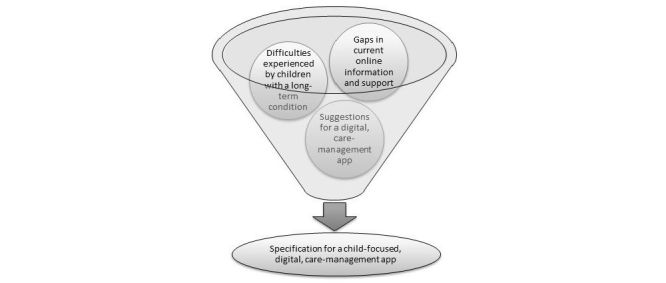
Results: Of the 27 interviews, 19 (70%) interviews were individual and 8 (30%) were joint-5 out of 8 (63%) joint interviews were with a child or young person and their parent, 1 out of 8 (13%) were with a child and both parents, and 2 out of 8 (25%) were with 2 professionals. Three key themes emerged to inform development of a software requirement specification for a future home-based, digital care-management app intervention: (1) Gaps in current online information and support, (2) Difficulties experienced by children with a long-term condition, and (3) Suggestions for a digital care-management app. Reported gaps included the fact that current online information is not usually appropriate for children as it is "dry" and "boring," could be "scary," and was either hard to understand or not relevant to individuals' circumstances. For children, searching online was much less accessible than using a professional-endorsed mobile app. Children also reported difficulty explaining their condition to others, maintaining treatment adherence, coping with feeling isolated, and with trying to live a "normal" life. There was recognition that a developmentally appropriate, CKD-specific app could support the process of explaining the condition to healthy peers, reducing isolation, adhering to care-management plans, and living a "normal" life. Participants recommended a range of media and content to include in a tailored, interactive, age- and developmentally appropriate app. For example, the user would be able to enter their age and diagnosis so that only age-appropriate and condition-specific content is displayed.
Conclusions: Future development of a digital app that meets the identified information and support needs and preferences of children with CKD will maximize its utility, thereby augmenting CKD caregiving and optimizing outcomes.
Keywords: adolescent; apps; child; chronic condition; long-term condition; mobile apps; qualitative; self-care; self-management.
©Ruth Nightingale, Andrew Hall, Carole Gelder, Simone Friedl, Eileen Brennan, Veronica Swallow. Originally published in the Journal of Medical Internet Research (http://www.jmir.org), 04.07.2017.
Conflict of interest statement
Conflicts of Interest: None declared.
References
-
- Health for the World's Adolescents: A Second Chance in the Second Decade. Geneva, Switzerland: World Health Organization; 2014. [2017-06-14]. http://apps.who.int/adolescent/second-decade/
-
- Anthony SJ, Hebert D, Todd L, Korus M, Langlois V, Pool R, Robinson LA, Williams A, Pollock-BarZiv SM. Child and parental perspectives of multidimensional quality of life outcomes after kidney transplantation. Pediatr Transplant. 2010 Mar;14(2):249–256. doi: 10.1111/j.1399-3046.2009.01214.x. - DOI - PubMed
-
- Beard C. From the Start: Engaging Young Adults With Long-Term Conditions in Their Care. NHS Kidney Care; 2013. Mar, [2017-06-13]. http://www.nwcscnsenate.nhs.uk/files/1014/2920/0015/16-04-2015_1600_642.pdf .
MeSH terms
LinkOut - more resources
Full Text Sources
Other Literature Sources
Medical
