. 2017 Jul 4;7(1):4616.
doi: 10.1038/s41598-017-04609-5.

Sorghum Dw2 Encodes a Protein Kinase Regulator of Stem Internode Length

Affiliations

Sorghum Dw2 Encodes a Protein Kinase Regulator of Stem Internode Length

Josie L Hilley et al. Sci Rep. .

Abstract

Sorghum is an important C4 grass crop grown for grain, forage, sugar, and bioenergy production. While tall, late flowering landraces are commonly grown in Africa, short early flowering varieties were selected in US grain sorghum breeding programs to reduce lodging and to facilitate machine harvesting. Four loci have been identified that affect stem length (Dw1-Dw4). Subsequent research showed that Dw3 encodes an ABCB1 auxin transporter and Dw1 encodes a highly conserved protein involved in the regulation of cell proliferation. In this study, Dw2 was identified by fine-mapping and further confirmed by sequencing the Dw2 alleles in Dwarf Yellow Milo and Double Dwarf Yellow Milo, the progenitor genotypes where the recessive allele of dw2 originated. The Dw2 locus was determined to correspond to Sobic.006G067700, a gene that encodes a protein kinase that is homologous to KIPK, a member of the AGCVIII subgroup of the AGC protein kinase family in Arabidopsis.


Conflict of interest statement

The authors declare that they have no competing interests.

Figures

Figure 1
Figure 1
QTL identified using the BTx623 x IS3620c RIL population. The RIL population was grown in the greenhouse and genotyped using DG. Stem length (a) was measured from the base of the plant to the base of the panicle. Genetic map generation and QTL mapping were performed in R/qtl using interval mapping (IM). The x-axis is the markers along the chromosomes and the y-axis is the LOD score. The significant QTL peaks are labeled with the Dw locus and location (Mb). Stem length (a), average internode length (b), and the length of the first internode below the peduncle (c) are shown.
Figure 2
Figure 2
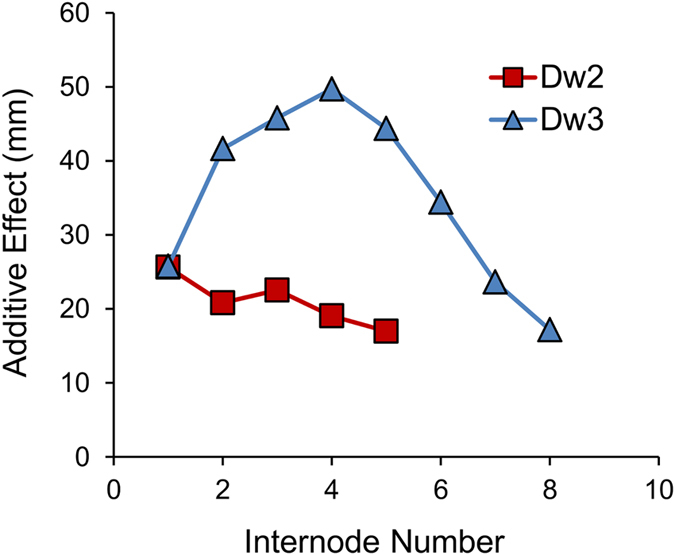
Additive effects of Dw2 and Dw3 on the length of each internode (BTx623 x IS3620c RIL population). The RIL population was grown in the greenhouse and the length of each internode (numbered from the peduncle) was measured. Additive effects were determined as part of QTL mapping performed in R/qtl using IM. The BTx623 allele of Dw2 increases internode length, whereas the IS3620c allele of Dw3 increases internode length.
Figure 3
Figure 3
Fine mapping of Dw2 in the BTx642 x Tx7000 RIL population. (a) QTL map of total plant height (2009) with Dw2 labeled. Plant height was measured as the length of the plant from the base of the stem at ground level to the top of the panicle. Genetic map construction and QTL analysis were performed in R/qtl using IM. The x-axis is the markers along the chromosomes and the y-axis is the LOD value. (b) Diagram of fine mapping in BTx642 x Tx7000. The diagram shows the location of the recombination breakpoints in the 2-LOD region in the eight fine mapping lines (numbers at bottom), two of these lines had more than one recombination breakpoint in the region. The markers found through DG using NgoMIV are labeled as “Ngo_”. The markers found with Sanger sequencing are labeled with “SNP_ _” with the last five digits of the gene name. The red, dashed-line box shows the refined region of Dw2. For both (b) and (c), asterisk indicates the approximate location of Dw2. (c) Diagram of the haplotypes of the four fine mapping lines with breakpoints closest to the refined region. The region between Ngo1 and Ngo3 is shown. Blue indicates that the RIL has the BTx642 allele, red is the Tx7000 allele, and grey is the region where the breakpoint is located. Dashed lines flank the refined region of Dw2. (d) The length of the first internode below the peduncle in the same lines shown in (c). Blue indicates that the line is dw2 while red is Dw2. Average (n = 4) and standard deviation is shown.
Figure 4
Figure 4
Phylogenetic tree of the AGCVIII subfamily in sorghum. The tree of the 21 sorghum AGCVIII genes was generated in MEGA6 using Maximum Likelihood. Dw2 is bolded. The four different groups, AGC1-4, are labeled and colored. The names in parenthesis are the best hit from a BLAST search of the Arabidopsis genome using that sorghum gene as a query. *The best hit for Sobic.008G170500 is PHOT2 but the score is much lower than Sobic.007G105500 to PHOT2 (203.4 vs. 1122.1 for the Dual Affine Smith Waterman alignment score). Further, Sobic.008G170500 is the best BLAST match of the maize PID homolog, BARREN INFLORESCENCE2, in sorghum.
Figure 5
Figure 5
Expression of Dw2 and Sobic.008G096200 in various tissues. Gene expression data is from the publicly available RNA-seq GeneAtlas on Phytozome v11. Tissues are from BTx623 (dominant Dw2) at 44 Days after Emergence (DAE). The leaf tissue was taken from the last ligulated leaf, so the base is still growing whereas the tip is maturing.

References

    1. Quinby, J. Sorghum Improvement and the Genetics of Growth. (Texas A&M University Press, 1974).
    1. Mullet J, et al. Energy sorghum-A genetic model for the design of C4 grass bioenergy crops. J. Exp. Bot. 2014;65:3479–3489. doi: 10.1093/jxb/eru229. - DOI - PubMed
    1. Slewinski TL. Non-structural carbohydrate partitioning in grass stems: A target to increase yield stability, stress tolerance, and biofuel production. J. Exp. Bot. 2012;63:4647–4670. doi: 10.1093/jxb/ers124. - DOI - PubMed
    1. Murray SC, et al. Genetic improvement of sorghum as a biofuel feedstock: I. QTL for stem sugar and grain nonstructural carbohydrates. Crop Sci. 2008;48:2165–2179. doi: 10.2135/cropsci2008.01.0016. - DOI
    1. McKinley B, Rooney W, Wilkerson C, Mullet J. Dynamics of biomass partitioning, stem gene expression, cell wall biosynthesis, and sucrose accumulation during development of Sorghum bicolor. Plant J. 2016;88:662–680. doi: 10.1111/tpj.13269. - DOI - PubMed

Publication types

LinkOut - more resources