. 2017 Jul 4;7(1):4574.
doi: 10.1038/s41598-017-04897-x.

Mutations in BRCA2 and taxane resistance in prostate cancer

Affiliations

Mutations in BRCA2 and taxane resistance in prostate cancer

Cathleen Nientiedt et al. Sci Rep. .

Abstract

Mutations in BRCA1 or BRCA2 define a subset of prostate cancer patients. Herein, we address the question whether BRCA1/2 mutations have a predictive impact on chemotherapy with docetaxel, a widely used drug in patients with metastatic castration resistant prostate cancer (mCRPC). Fifty-three men treated with docetaxel for mCRPC were tested for somatic BRCA1/2 mutations of the primary tumor. In a subgroup of patients, BRCA1/2 protein expression was tested as a potential surrogate marker for BRCA1/2 inactivation. Eight of 53 patients (15.1%) harbored a deleterious BRCA2 mutation. No BRCA1 mutation was found. Patients with a BRCA2 mutation showed a response rate of 25% to docetaxel in comparison to 71.1% in men with wildtype BRCA2 (p = 0.019). While the time to develop castration resistance was similar in both subgroups, the overall survival was significantly shorter in patients harboring a BRCA2 mutation. No correlation between the BRCA1/2 protein expression and the response to docetaxel was found. While the presence of a BRCA2 mutation does not preclude a response to docetaxel, there is overall a significant correlation between BRCA2 inactivation and a poor response rate. Our results suggest that a close oncological monitoring of patients with BRCA2 mutations for taxane resistance is warranted.


Conflict of interest statement

The authors declare that they have no competing interests.

Figures
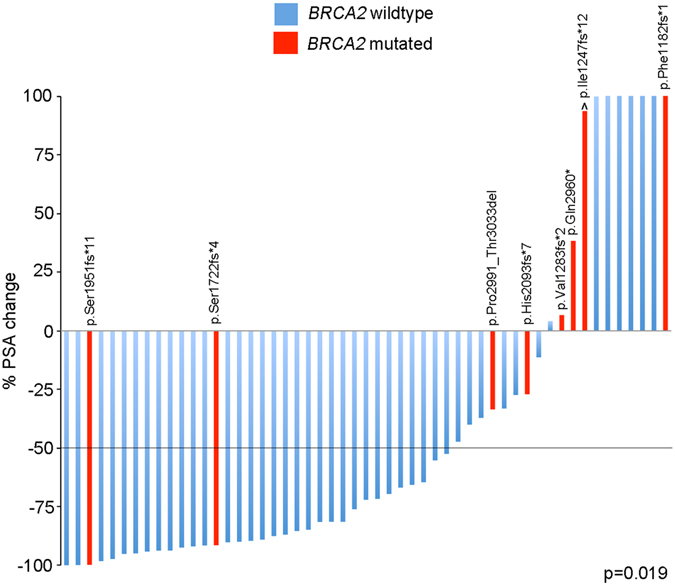
Figure 1
Figure 1
BRCA2 mutation status and response to docetaxel. Waterfall plot showing the PSA responses (% PSA change) in 53 men with primary metastatic or locally advanced prostate cancer. The dotted line indicates the threshold for defining a PSA response (PSA decline ≥50%). Changes in the protein coding sequence are given for all patients with a BRCA2 mutation. There was a statistically significant correlation between the presence of a BRCA2 mutation and the response to docetaxel (p = 0.019, Fisher’s Exact test). The circumflex denotes a patient who carried a known germline BRCA2 mutations that was also present in the tumor and whose course of disease has previously been reported. The y axis was cut off at 100%.
Figure 2
Figure 2
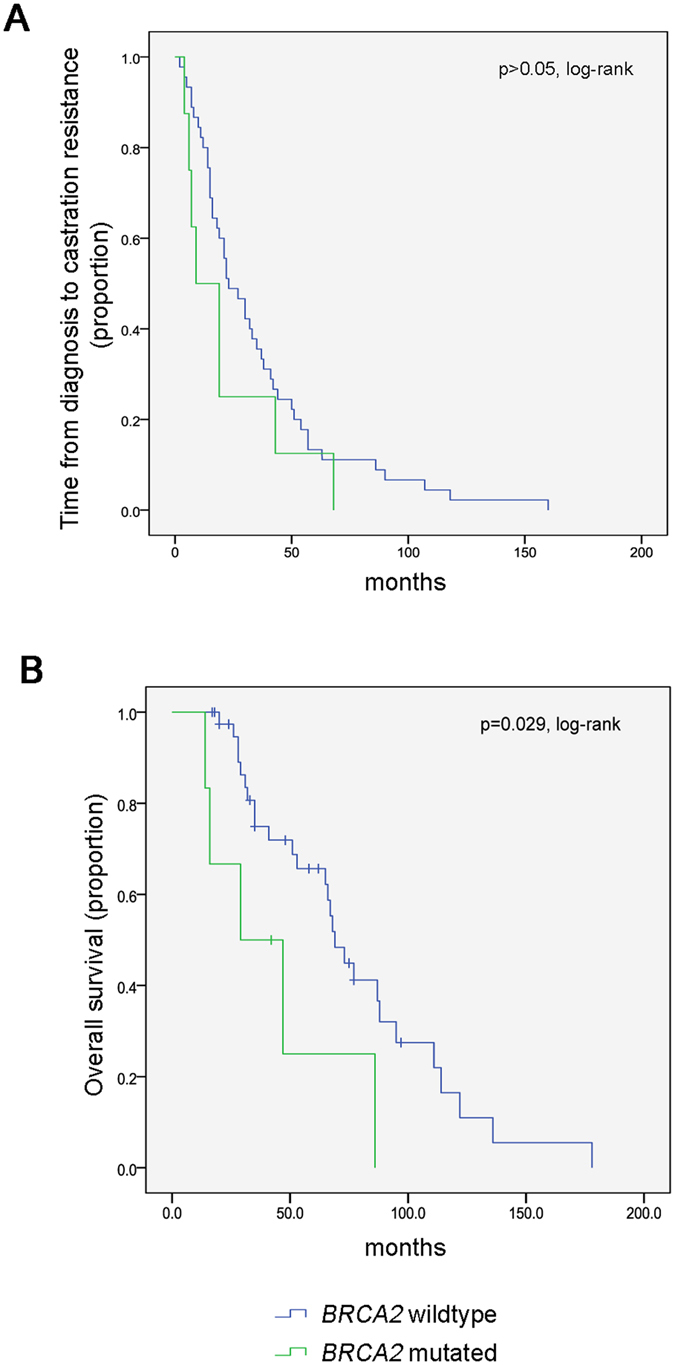
BRCA2 mutation status and patient survival. (A,B) Kaplan Meier curves showing time to castration resistance in 45 men who were wildtype for BRCA2 and eight men with a deleterious BRCA2 mutation (A). Overall survival (B) was significantly shorter in six men with a BRCA2 mutation in comparison to 40 men who carried the wildtype gene (p = 0.029; log-rank test). Differences in the patient number in (B) are due to the fact that seven men were lost to follow up.
Figure 3
Figure 3
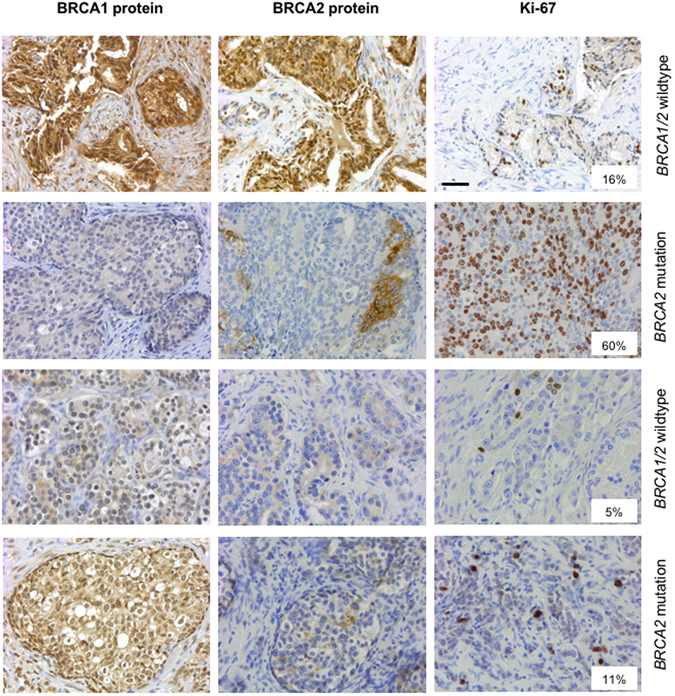
Heterogeneity in BRCA1/2 protein expression and BRCA1/2 mutational status. Immunohistochemical staining for BRCA1, BRCA2 or Ki-67 in four representative tumors. Note that the two BRCA1/2 wildtype tumors showed either a strong nucleocytoplasmic expression of both BRCA1 and BRCA2 or a weak cytoplasmic expression of both proteins. BRCA2 mutated tumors show a partial loss of BRCA2 protein expression but such a loss was also detectable in BRCA1/2 wildtype tumors (e.g., second row from the bottom). Scale bar = 50 µm.
Figure 4
Figure 4
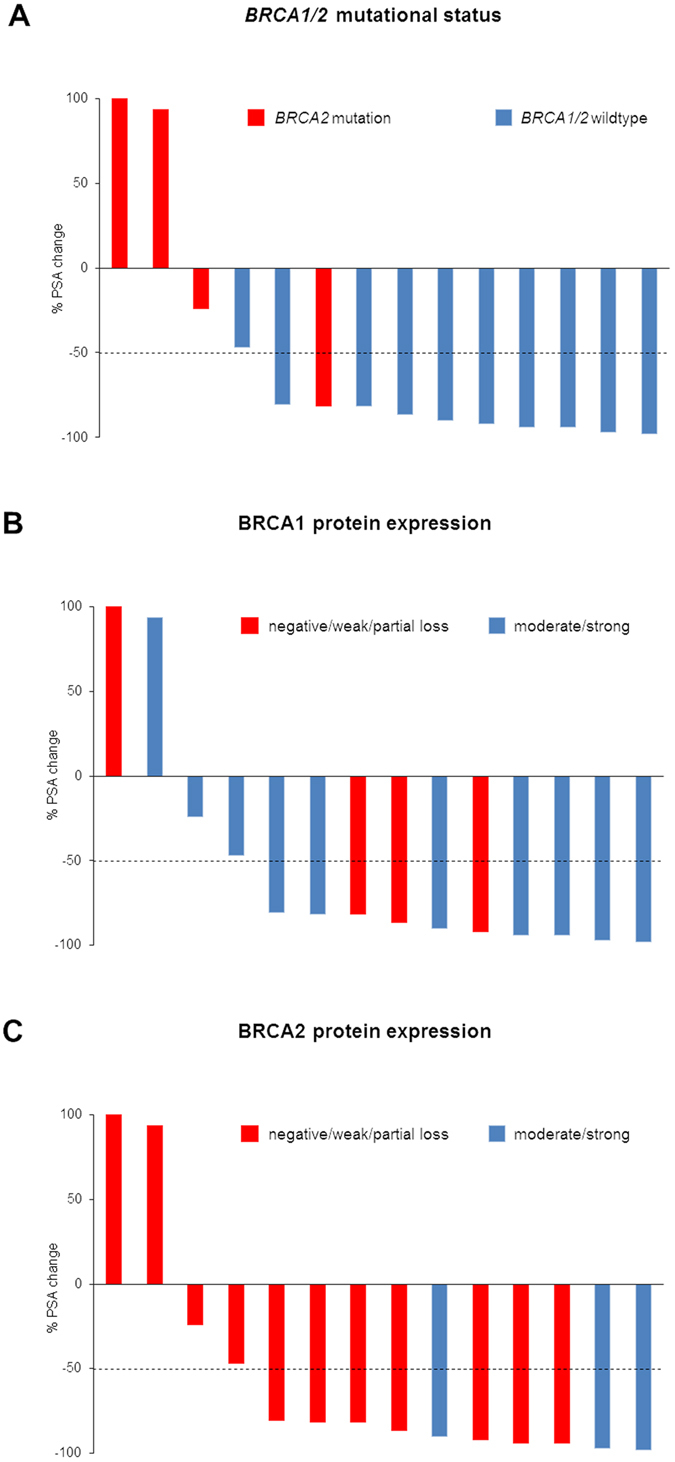
Correlation of BRCA1/2 mutational status or BRCA1/2 protein expression to the PSA response to docetaxel. Waterfall plots for the percentage PSA change after docetaxel treatment stratified into BRCA1/2 mutation status (A), BRCA1 protein expression (B) or BRCA2 protein expression (C). The dotted line indicates the threshold for defining a PSA response (PSA decline ≥50%). The y axis was cut off at 100%.

References

    1. Siegel R, Naishadham D, Jemal A. Cancer statistics, 2013. CA Cancer J Clin. 2013;63:11–30. doi: 10.3322/caac.21166. - DOI - PubMed
    1. Castro E, et al. Germline BRCA mutations are associated with higher risk of nodal involvement, distant metastasis, and poor survival outcomes in prostate cancer. J. Clin. Oncol. 2013;31:1748–1757. doi: 10.1200/JCO.2012.43.1882. - DOI - PMC - PubMed
    1. Leongamornlert D, et al. Germline BRCA1 mutations increase prostate cancer risk. Br. J. Cancer. 2012;106:1697–1701. doi: 10.1038/bjc.2012.146. - DOI - PMC - PubMed
    1. Levy-Lahad E, Friedman E. Cancer risks among BRCA1 and BRCA2 mutation carriers. Br. J. Cancer. 2007;96:11–15. doi: 10.1038/sj.bjc.6603535. - DOI - PMC - PubMed
    1. Edwards SM, et al. Prostate cancer in BRCA2 germline mutation carriers is associated with poorer prognosis. Br. J. Cancer. 2010;103:918–924. doi: 10.1038/sj.bjc.6605822. - DOI - PMC - PubMed

Publication types

MeSH terms