Review
. 2017 Jun 20:8:1108.
doi: 10.3389/fmicb.2017.01108. eCollection 2017.

Bacteriophages Contribute to the Spread of Antibiotic Resistance Genes among Foodborne Pathogens of the Enterobacteriaceae Family - A Review

Affiliations
Review

Bacteriophages Contribute to the Spread of Antibiotic Resistance Genes among Foodborne Pathogens of the Enterobacteriaceae Family - A Review

Anna Colavecchio et al. Front Microbiol. .

Abstract

Foodborne illnesses continue to have an economic impact on global health care systems. There is a growing concern regarding the increasing frequency of antibiotic resistance in foodborne bacterial pathogens and how such resistance may affect treatment outcomes. In an effort to better understand how to reduce the spread of resistance, many research studies have been conducted regarding the methods by which antibiotic resistance genes are mobilized and spread between bacteria. Transduction by bacteriophages (phages) is one of many horizontal gene transfer mechanisms, and recent findings have shown phage-mediated transduction to be a significant contributor to dissemination of antibiotic resistance genes. Here, we review the viability of transduction as a contributing factor to the dissemination of antibiotic resistance genes in foodborne pathogens of the Enterobacteriaceae family, including non-typhoidal Salmonella and Shiga toxin-producing Escherichia coli, as well as environmental factors that increase transduction of antibiotic resistance genes.

Keywords: Escherichia coli O157:H7; antibiotic resistance; bacteriophage; environment; foodborne pathogens; horizontal gene transfer; non-typhoidal Salmonella; transduction.


Figures
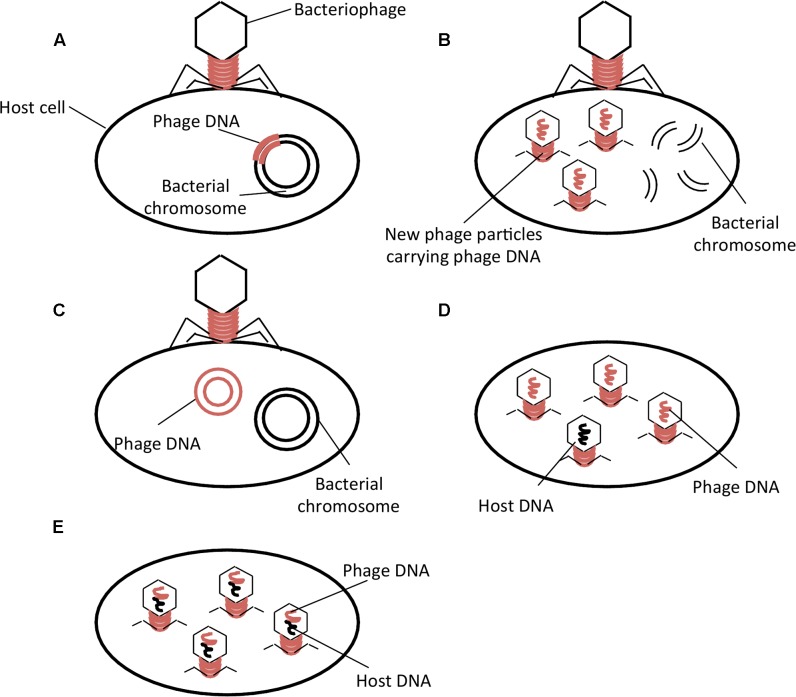
FIGURE 1
FIGURE 1
Phage life cycles and types of phage-mediated transduction. (A) Temperate phage life cycle; (B) Virulent phage life cycle; (C) Pseudolysogeny; (D) Generalized Transduction; (E) Specialized Transduction. Adapted from Feiner et al. (2015).
FIGURE 2
FIGURE 2
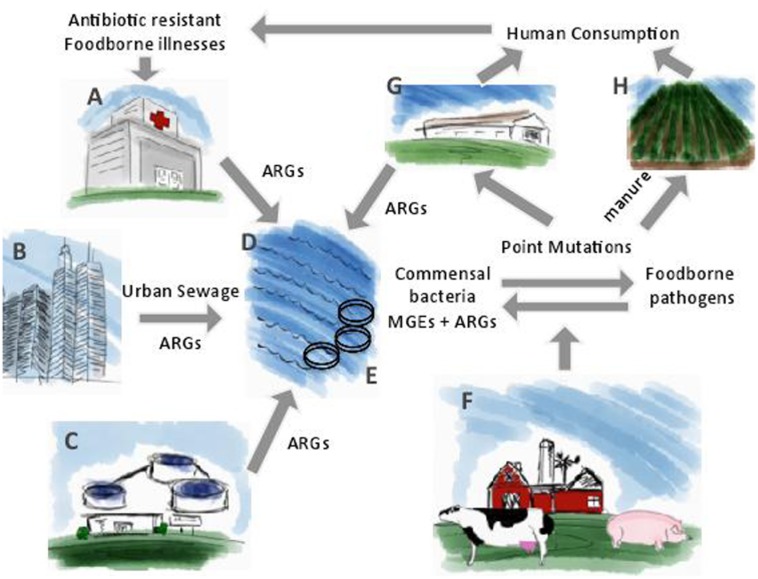
The cycle for the dissemination of antibiotic resistance genes from the environment to human consumption. (A) Hospital effluents; (B) Urban sewage; (C) Wastewater treatment plant effluents; (D) Bodies of water such as lakes and oceans; (E) Aquaculture; (F) Food-producing animals; (G) Slaughterhouse; (H) Manure application. Adapted from Muniesa et al. (2013).

References

    1. Acheson D., Hohmann E. L. (2001). Nontyphoidal salmonellosis. Clin. Infect. Dis. 32 263–269. 10.1086/318457 - DOI - PubMed
    1. Akiba T., Koyama K., Ishiki Y., Kimura S., Fukushima T. (1960). On the mechanism of the development of multiple-drug-resistant clones of Shigella. Jpn. J. Microbiol. 4 219–227. 10.1111/j.1348-0421.1960.tb00170.x - DOI - PubMed
    1. Allen H. K., Looft T., Bayles D. O., Humphrey S., Levine U. Y., Alt D., et al. (2011). Antibiotics in feed induce prophages in swine fecal microbiomes. mBio 2:e260-11. 10.1128/mBio.00260-11 - DOI - PMC - PubMed
    1. Alvarez-Fernandez E., Alonso-Calleja C., Garcia-Fernandez C., Capita R. (2012). Prevalence and antimicrobial resistance of Salmonella serotypes isolated from poultry in Spain: comparison between 1993 and 2006. Int. J. Food Microbiol. 153 281–287. 10.1016/j.ijfoodmicro.2011.11.011 - DOI - PubMed
    1. Balis E., Vatopoulos A. C., Kanelopoulou M., Mainas E., Hatzoudis G., Kontogianni V., et al. (1996). Indications of in vivo transfer of an epidemic R plasmid from Salmonella enteritidis to Escherichia coli of the normal human gut flora. J. Clin. Microbiol. 34 977–979. - PMC - PubMed

LinkOut - more resources