. 2017 Aug;38(2):819-828.
doi: 10.3892/or.2017.5766. Epub 2017 Jun 28.

Anticancer and apoptosis‑inducing effects of quercetin in vitro and in vivo

Affiliations

Anticancer and apoptosis‑inducing effects of quercetin in vitro and in vivo

Mahmoud Hashemzaei et al. Oncol Rep. 2017 Aug.

Abstract

The present study focused on the elucidation of the putative anticancer potential of quercetin. The anticancer activity of quercetin at 10, 20, 40, 80 and 120 µM was assessed in vitro by MMT assay in 9 tumor cell lines (colon carcinoma CT‑26 cells, prostate adenocarcinoma LNCaP cells, human prostate PC3 cells, pheocromocytoma PC12 cells, estrogen receptor‑positive breast cancer MCF‑7 cells, acute lymphoblastic leukemia MOLT‑4 T‑cells, human myeloma U266B1 cells, human lymphoid Raji cells and ovarian cancer CHO cells). Quercetin was found to induce the apoptosis of all the tested cancer cell lines at the utilized concentrations. Moreover, quercetin significantly induced the apoptosis of the CT‑26, LNCaP, MOLT‑4 and Raji cell lines, as compared to control group (P<0.001), as demonstrated by Annexin V/PI staining. In in vivo experiments, mice bearing MCF‑7 and CT‑26 tumors exhibited a significant reduction in tumor volume in the quercetin‑treated group as compared to the control group (P<0.001). Taken together, quercetin, a naturally occurring compound, exhibits anticancer properties both in vivo and in vitro.


Figures
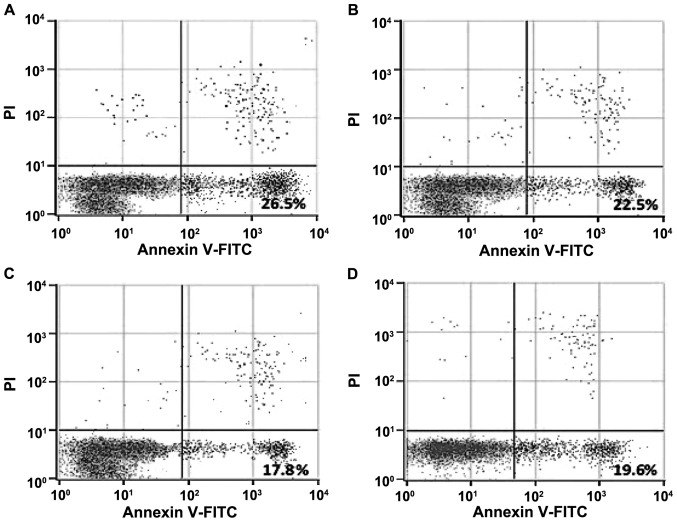
Figure 1.
Figure 1.
Apoptotic rate determined by Annexin V/PI staining in (A) CT-26, (B) LNCaP, (C) MOLT-4 and (D) Raji cell lines following 48 h of treatment with quercetin at 120 µM. Early apoptotic cells are Annexin V-positive and PI-negative (lower right quadrant). PI, propidium iodide.
Figure 2.
Figure 2.
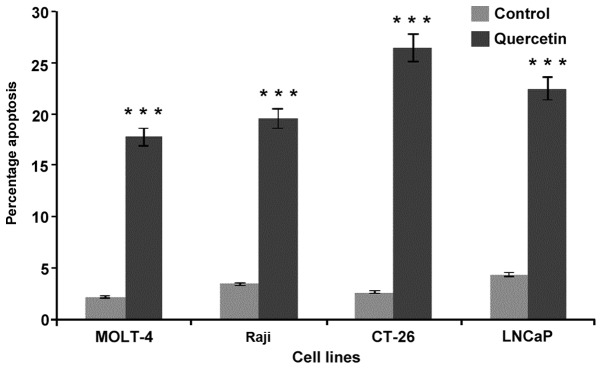
Induction of apoptosis in LNCaP, CT-26, MOLT-4 and Raji cell lines treated with quercetin as assessed by flow cytometer Annexin V/PI. The results revealed that quercetin significantly induced apoptosis in comparison to the control group (***P<0.001). PI, propidium iodide.
Figure 3.
Figure 3.
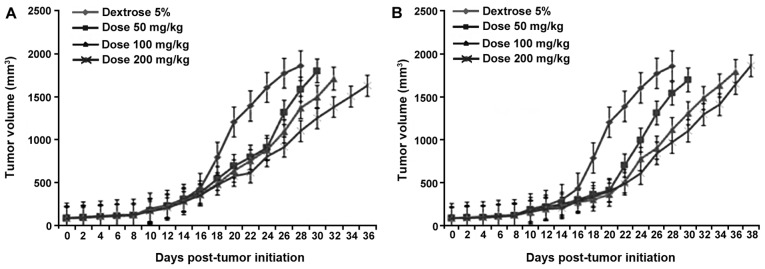
(A) In vivo tumor growth inhibition in BALB/c mice treated with various doses of quercetin (50, 100 and 200 mg/kg;intraperitoneally) inducted CT26 and (B) MCF-7 cell line. There were significant differences after 18 days of treatment between the quercetin-treated groups and the control group (dextrose 5%). P<0.001.
Figure 4.
Figure 4.
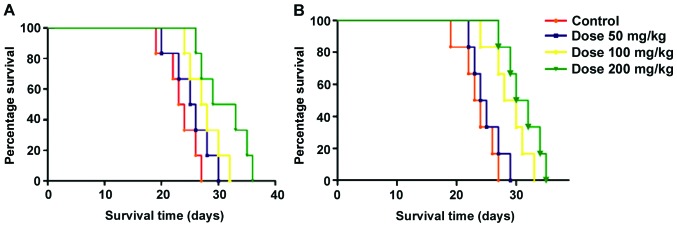
In vivo therapeutic efficacy of quercetin in BALB/c mice bearing (A) CT26 and (B) MCF-7 tumors following the intraperitoneal injection of quercetin at multiple doses (50, 100 and 200 mg/kg).
Figure 5.
Figure 5.
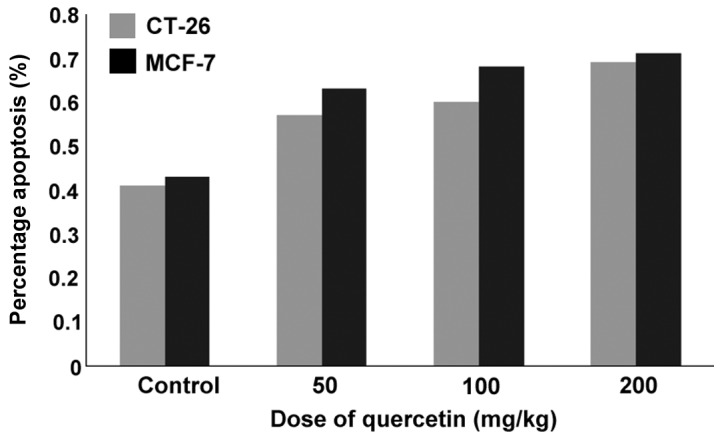
Percentage apoptosis in tumor slices from mice bearing CT-26 and MCF-7 tumors treatment with various concentration of quercetin (50, 100 and 200 mg/kg; intraperitoneally) as assessed by TUNEL assay.

References

    1. Schnekenburger M, Dicato M, Diederich M. Plant-derived epigenetic modulators for cancer treatment and prevention. Biotechnol Adv. 2014;32:1123–1132. doi: 10.1016/j.biotechadv.2014.03.009. - DOI - PubMed
    1. Butler MS, Robertson AA, Cooper MA. Natural product and natural product derived drugs in clinical trials. Nat Prod Rep. 2014;31:1612–1661. doi: 10.1039/C4NP00064A. - DOI - PubMed
    1. Hashemzaei M, Barani AK, Iranshahi M, Rezaee R, Tsarouhas K, Tsatsakis AM, Wilks MF, Tabrizian K. Effects of resveratrol on carbon monoxide-induced cardiotoxicity in rats. Environ Toxicol Pharmacol. 2016;46:110–115. doi: 10.1016/j.etap.2016.07.010. - DOI - PubMed
    1. Hashemzaei M, Heravi Entezari R, Rezaee R, Roohbakhsh A, Karimi G. Regulation of autophagy by some natural products as a potential therapeutic strategy for cardiovascular disorders. Eur J Pharmacol. 2017;802:44–51. doi: 10.1016/j.ejphar.2017.02.038. - DOI - PubMed
    1. DeVita VT, Jr, Young RC, Canellos GP. Combination versus single agent chemotherapy: A review of the basis for selection of drug treatment of cancer. Cancer. 1975;35:98–110. doi: 10.1002/1097-0142(197501)35:1<98::AID-CNCR2820350115>3.0.CO;2-B. - DOI - PubMed