


Reconstructing the recent West Nile virus lineage 2 epidemic in Europe and Italy using discrete and continuous phylogeography
- PMID: 28678837
- PMCID: PMC5497961
- DOI: 10.1371/journal.pone.0179679
Reconstructing the recent West Nile virus lineage 2 epidemic in Europe and Italy using discrete and continuous phylogeography
Abstract
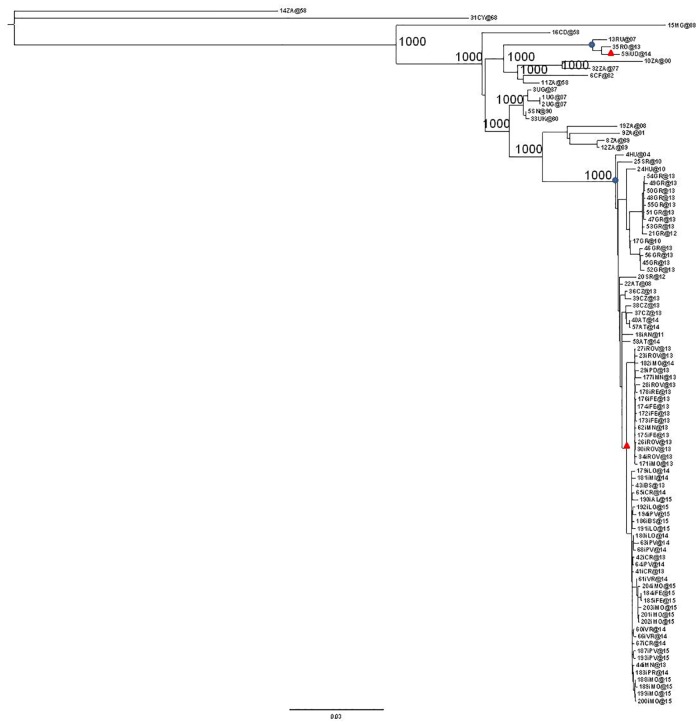
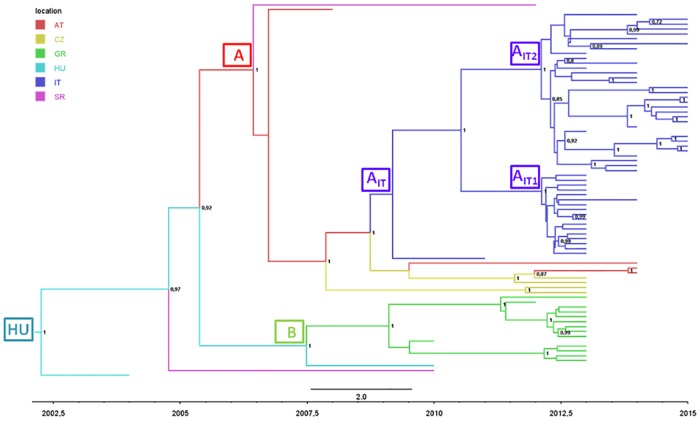
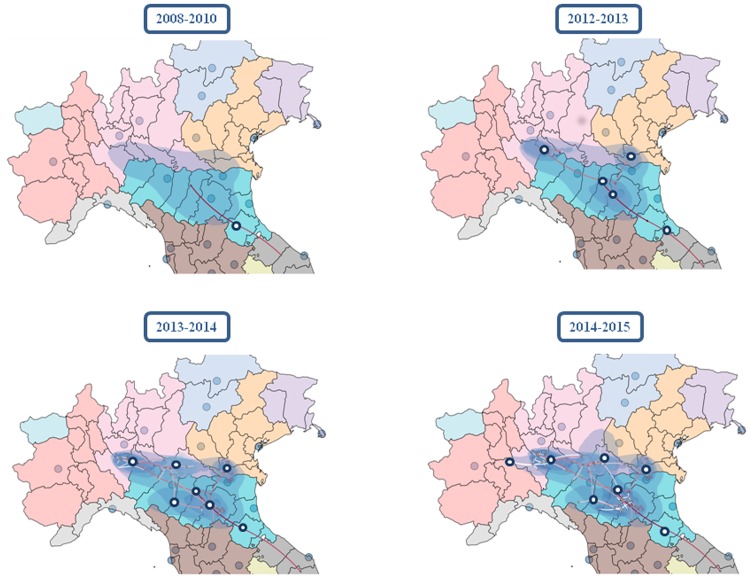
West Nile virus lineage 2 (WNV-2) was mainly confined to sub-Saharan Africa until the early 2000s, when it was identified for the first time in Central Europe causing outbreaks of human and animal infection. The aim of this study was to reconstruct the origin and dispersion of WNV-2 in Central Europe and Italy on a phylodynamic and phylogeographical basis. To this aim, discrete and continuous space phylogeographical models were applied to a total of 33 newly characterised full-length viral genomes obtained from mosquitoes, birds and humans in Northern Italy in the years 2013-2015 aligned with 64 complete sequences isolated mainly in Europe. The European isolates segregated into two highly significant clades: a small one including three sequences and a large clade including the majority of isolates obtained in Central Europe since 2004. Discrete phylogeographical analysis showed that the most probable location of the root of the largest European clade was in Hungary a mean 12.78 years ago. The European clade bifurcated into two highly supported subclades: one including most of the Central/East European isolates and the other encompassing all of the isolates obtained in Greece. The continuous space phylogeographical analysis of the Italian clade showed that WNV-2 entered Italy in about 2008, probably by crossing the Adriatic sea and reaching a central area of the Po Valley. The epidemic then spread simultaneously eastward, to reach the region of the Po delta in 2013, and westward to the border area between Lombardy and Piedmont in 2014; later, the western strain changed direction southward, and reached the central area of the Po valley once again in 2015. Over a period of about seven years, the virus spread all over an area of northern Italy by following the Po river and its main tributaries.
Conflict of interest statement
Figures
References
-
- Colpitts TM, Conway MJ, Montgomery RR, Fikrig E. West Nile Virus: biology, transmission, and human infection. Clin Microbiol Rev. 2012;25(4):635–48. Epub 2012/10/05 06:00. doi: 10.1128/CMR.00045-12 - DOI - PMC - PubMed
-
- Troupin A, Colpitts TM. Overview of West Nile Virus Transmission and Epidemiology. Methods in molecular biology (Clifton, NJ). 2016;1435:15–8. Epub 2016/05/18. doi: 10.1007/978-1-4939-3670-0_2 . - DOI - PubMed
-
- Zeller HG, Schuffenecker I. West Nile virus: an overview of its spread in Europe and the Mediterranean basin in contrast to its spread in the Americas. Eur J Clin Microbiol Infect Dis. 2004;23(3):147–56. Epub 2004/02/27 05:00. doi: 10.1007/s10096-003-1085-1 - DOI - PubMed
-
- Tsai TF, Popovici F, Cernescu C, Campbell GL, Nedelcu NI. West Nile encephalitis epidemic in southeastern Romania. Lancet. 1998;352(9130):767–71. Epub 1998/09/16. . - PubMed
-
- Platonov AE. West Nile encephalitis in Russia 1999–2001: were we ready? Are we ready? Ann N Y Acad Sci. 2001;951:102–16. Epub 2002/01/19 10:00. . - PubMed
MeSH terms
LinkOut - more resources
Full Text Sources
Other Literature Sources
Medical
