Association of Neural and Emotional Impacts of Reward Prediction Errors With Major Depression
- PMID: 28678984
- PMCID: PMC5710549
- DOI: 10.1001/jamapsychiatry.2017.1713
Association of Neural and Emotional Impacts of Reward Prediction Errors With Major Depression
Abstract
Importance: Major depressive disorder (MDD) is associated with deficits in representing reward prediction errors (RPEs), which are the difference between experienced and predicted reward. Reward prediction errors underlie learning of values in reinforcement learning models, are represented by phasic dopamine release, and are known to affect momentary mood.
Objective: To combine functional neuroimaging, computational modeling, and smartphone-based large-scale data collection to test, in the absence of learning-related concerns, the hypothesis that depression attenuates the impact of RPEs.
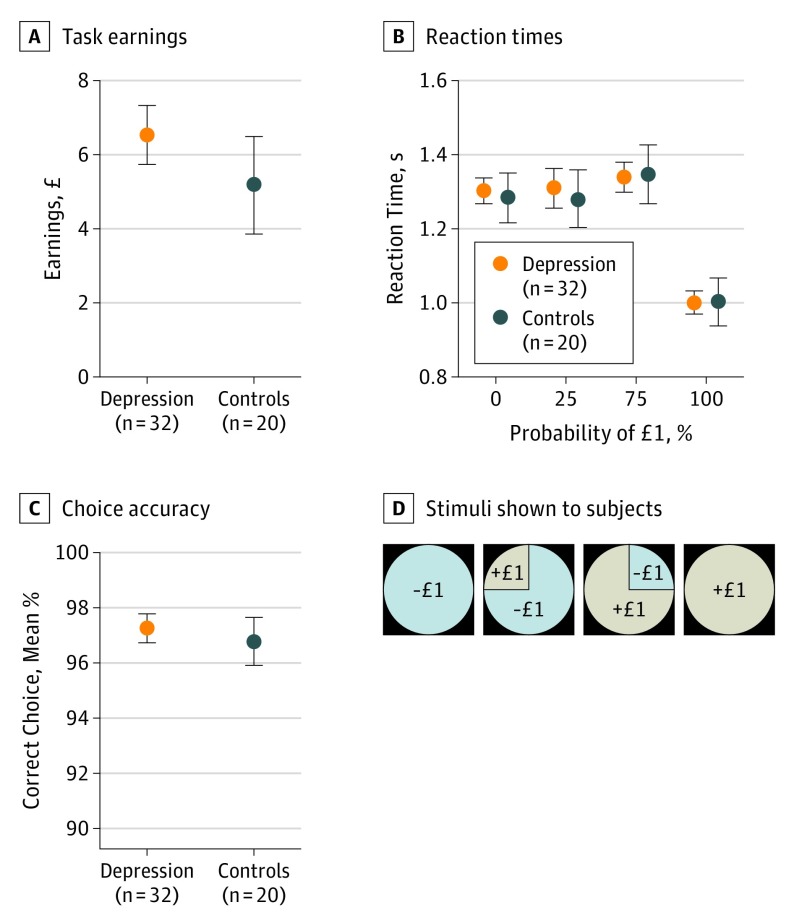
Design, setting, and participants: Functional magnetic resonance imaging (fMRI) data were collected on 32 individuals with moderate MDD and 20 control participants who performed a probabilistic reward task. A risky decision task with repeated happiness ratings as a measure of momentary mood was also tested in the laboratory in 74 participants and with a smartphone-based platform in 1833 participants. The study was conducted from November 20, 2012, to February 17, 2015.
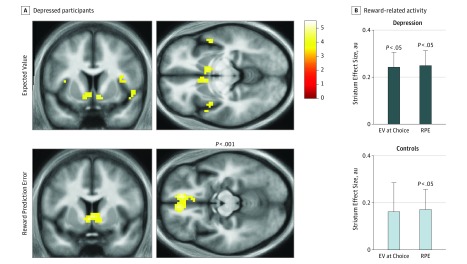
Main outcomes and measures: Blood oxygen level-dependent activity was measured in ventral striatum, a dopamine target area known to represent RPEs. Momentary mood was measured during risky decision making.
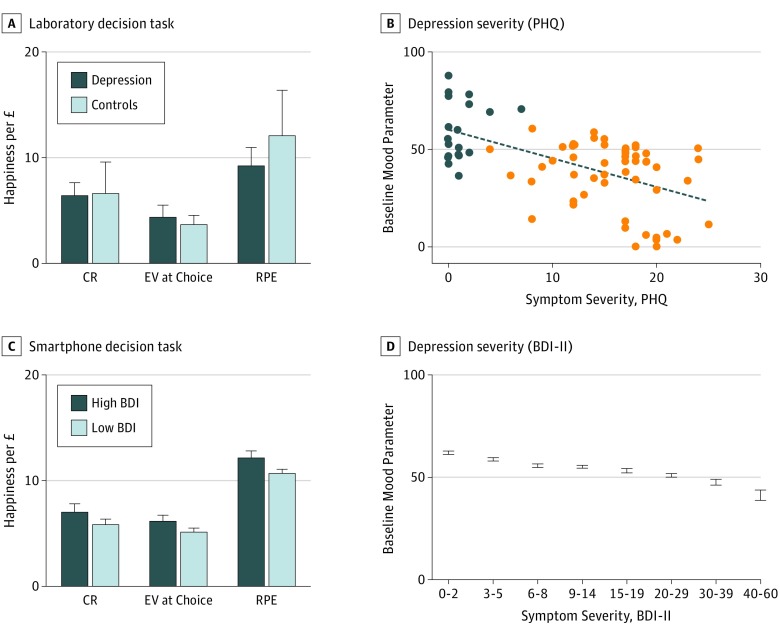
Results: Of the 52 fMRI participants (mean [SD] age, 34.0 [9.1] years), 30 (58%) were women and 32 had MDD. Of the 74 participants in the laboratory risky decision task (mean age, 34.2 [10.3] years), 44 (59%) were women and 54 had MDD. Of the smartphone group, 543 (30%) had a depression history and 1290 (70%) had no depression history; 918 (50%) were women, and 593 (32%) were younger than 30 years. Contrary to previous results in reinforcement learning tasks, individuals with moderate depression showed intact RPE signals in ventral striatum (z = 3.16; P = .002) that did not differ significantly from controls (z = 0.91; P = .36). Symptom severity correlated with baseline mood parameters in laboratory (ρ = -0.54; P < 1 × 10⁻⁶) and smartphone (ρ = -0.30; P < 1 × 10-39) data. However, participants with depression showed an intact association between RPEs and happiness in a computational model of momentary mood dynamics (z = 4.55; P < .001) that was not attenuated compared with controls (z = -0.42; P = .67).
Conclusions and relevance: The neural and emotional impact of RPEs is intact in major depression. These results suggest that depression does not affect the expression of dopaminergic RPEs and that attenuated RPEs in previous reports may reflect downstream effects more closely related to aberrant behavior. The correlation between symptom severity and baseline mood parameters supports an association between depression and momentary mood fluctuations during cognitive tasks. These results demonstrate a potential for smartphones in large-scale computational phenotyping, which is a goal for computational psychiatry.
Conflict of interest statement
Figures
Comment in
-
Using Computational Psychiatry to Rule Out the Hidden Causes of Depression.JAMA Psychiatry. 2017 Aug 1;74(8):777-778. doi: 10.1001/jamapsychiatry.2017.1500. JAMA Psychiatry. 2017. PMID: 28678978 No abstract available.
References
-
- Kessler RC, Berglund P, Demler O, Jin R, Merikangas KR, Walters EE. Lifetime prevalence and age-of-onset distributions of DSM-IV disorders in the National Comorbidity Survey Replication. Arch Gen Psychiatry. 2005;62(6):593-602. - PubMed
Publication types
MeSH terms
Grants and funding
LinkOut - more resources
Full Text Sources
Other Literature Sources
Medical