Case Reports
. 2017 Jul 5;3(4):a001701.
doi: 10.1101/mcs.a001701. Print 2017 Jul.

An unusual genomic variant of pancreatic ductal adenocarcinoma with an indolent clinical course

Affiliations
Case Reports

An unusual genomic variant of pancreatic ductal adenocarcinoma with an indolent clinical course

Zachary A Kohutek et al. Cold Spring Harb Mol Case Stud. .

Abstract

We describe an 85-yr-old male of Ashkenazi Jewish descent with biopsy-proven locally advanced pancreatic ductal adenocarcinoma (PDA). The patient underwent a modified course of gemcitabine and stereotactic body radiation therapy and survived for 42 mo with a stable pancreatic head mass and no evidence of metastatic disease before death due to complications from a stroke. Whole-exome sequencing of his tumor revealed a simple genome landscape with no evidence of mutations, copy-number changes, or structural alterations in genes most commonly associated with PDA (i.e., KRAS, CDKN2A, TP53, or SMAD4). An analysis of his germline DNA revealed no pathogenic variants of significance. Whole-exome and whole-genome sequencing identified a somatic mutation of RNF213 and an inversion/deletion of CTNNA2 as the genetic basis of his PDA. Although PDA is classically characterized by a predictable set of mutations, these data suggest that alternate genetic paths to PDA may exist, which can be associated with a more indolent clinical course.

Keywords: neoplasm of the pancreas; pancreatic adenocarcinoma.


Figures

Figure 1.
Figure 1.
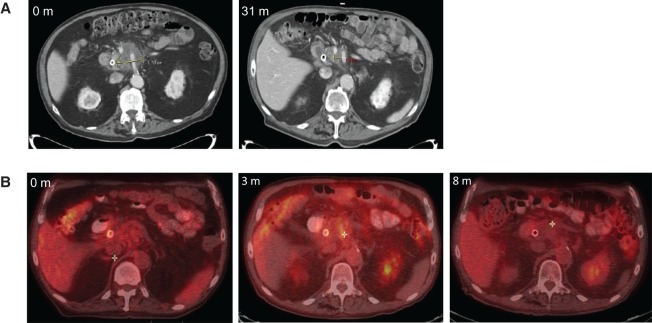
(A) Representative computed tomography (CT) images from the time of diagnosis and ∼10 mo before autopsy. A 2.0-cm diameter pancreatic head mass was identified at diagnosis. Before autopsy and after treatment with gemcitabine and stereotactic body radiotherapy (SBRT), the mass was stable to decreased size. (B) Fluorodeoxyglucose positron emission tomography (PET)-CT scans demonstrating a decrease in size and avidity of the pancreatic lesion by 8 mo after SBRT.
Figure 2.
Figure 2.
(A) Tumor samples obtained at the time of autopsy were hemotoxylin and eosin (H&E) stained and showed extensive fibrosis with focal areas of well-to-moderately differentiated duct carcinoma. (B) Immunolabeling of this same tissue for CK7, CK19, CK20, and CDX2. Staining patterns are consistent with a tumor of pancreatic origin. (C) Immunolabeling patterns for p53, p16, and SMAD4 proteins, all of which are consistent with wild-type status of the genes encoding each of these proteins.
Figure 3.
Figure 3.
(A) A lollipop plot of all reported mutations in RNF213 among a total of 531 sequenced pancreatic ductal adenocarcinomas (PDAs) (green, missense mutation; black, frameshift mutation). These include the present case (large green lollipop with a star) that contains a potentially damaging W3920C mutation. (B) Bayesian analysis of mutant allele frequencies for all missense mutations identified by whole-exome sequencing. The probability of a mutation being in a given sample ranges from likely absent (>99.99% confidence, dark red) to likely present (>99.99% confidence, dark blue). Based on these results, sample T3 was excluded from further analysis. (C) Proposed phylogenetic tree based on sequencing data of samples T1, T2, and T4. Numbers represent quantity of mutations gained in predicted subclones (SC1, SC2) or tumor samples. (D) Circos plot detailing the structural alterations found by whole-genome sequencing, including CTNNA2. Inversions are shown in red, deletions in blue, and duplications in green. (E) Phylogenetic tree of the present case drawn to scale compared with the average trunk length of PDA based on published data (Yachida et al. 2010). Dashed lines of branches in the standardized tree are simulated lengths and have no quantitative value. SNVs, single-nucleotide variants.

References

    1. Adzhubei IA, Schmidt S, Peshkin L, Ramensky VE, Gerasimova A, Bork P, Kondrashov AS, Sunyaev SR. 2010. A method and server for predicting damaging missense mutations. Nat Methods 7: 248–249. - PMC - PubMed
    1. Bailey P, Chang DK, Nones K, Johns AL, Patch AM, Gingras MC, Miller DK, Christ AN, Bruxner TJ, Quinn MC, et al. 2016. Genomic analyses identify molecular subtypes of pancreatic cancer. Nature 531: 47–52. - PubMed
    1. Biankin AV, Waddell N, Kassahn KS, Gingras MC, Muthuswamy LB, Johns AL, Miller DK, Wilson PJ, Patch AM, Wu J, et al. 2012. Pancreatic cancer genomes reveal aberrations in axon guidance pathway genes. Nature 491: 399–405. - PMC - PubMed
    1. Carter H, Douville C, Stenson PD, Cooper DN, Karchin R. 2013. Identifying Mendelian disease genes with the variant effect scoring tool. BMC Genomics 14Suppl 3: S3. - PMC - PubMed
    1. Cibulskis K, Lawrence MS, Carter SL, Sivachenko A, Jaffe D, Sougnez C, Gabriel S, Meyerson M, Lander ES, Getz G. 2013. Sensitive detection of somatic point mutations in impure and heterogeneous cancer samples. Nat Biotechnol 31: 213–219. - PMC - PubMed

Publication types

MeSH terms

LinkOut - more resources