


Size-dependent validation of MODIS MCD64A1 burned area over six vegetation types in boreal Eurasia: Large underestimation in croplands
- PMID: 28680076
- PMCID: PMC5498636
- DOI: 10.1038/s41598-017-03739-0
Size-dependent validation of MODIS MCD64A1 burned area over six vegetation types in boreal Eurasia: Large underestimation in croplands
Abstract
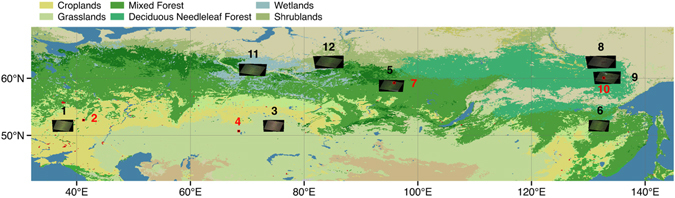
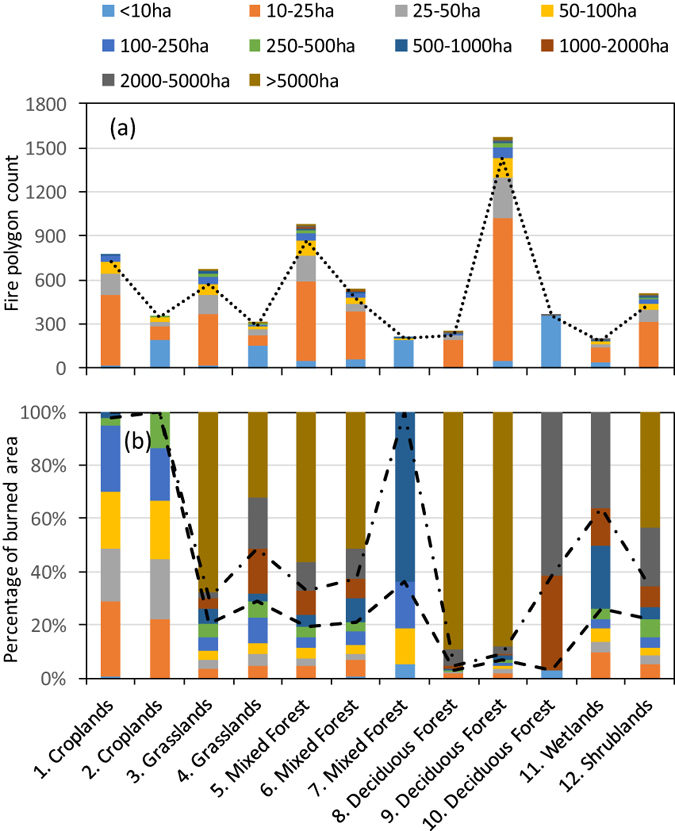
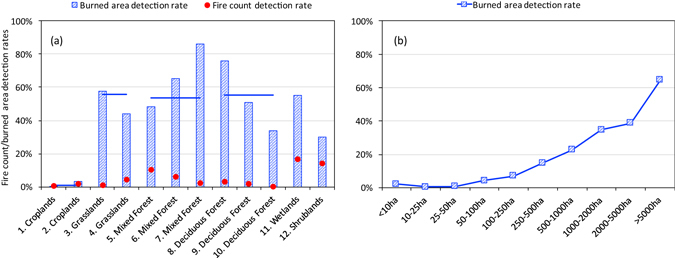
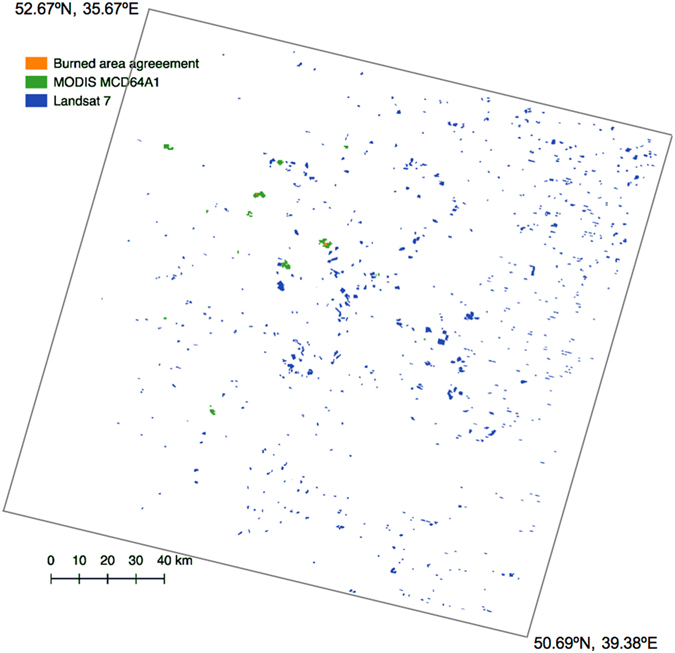
Pollutants emitted from wildfires in boreal Eurasia can be transported to the Arctic, and their subsequent deposition could accelerate global warming. The Moderate Resolution Imaging Spectroradiometer (MODIS) MCD64A1 burned area product is the basis of fire emission products. However, uncertainties due to the "moderate resolution" (500 m) characteristic of the MODIS sensor could be introduced. Here, we present a size-dependent validation of MCD64A1 with reference to higher resolution (better than 30 m) satellite products (Landsat 7 ETM+, RapidEye, WorldView-2, and GeoEye-1) for six ecotypes over 12 regions of boreal Eurasia. We considered the 2012 boreal Eurasia burning season when severe wildfires occurred and when Arctic sea ice extent was historically low. Among the six ecotypes, we found MCD64A1 burned areas comprised only 13% of the reference products in croplands because of inadequate detection of small fires (<100 ha). Our results indicate that over all ecotypes, the actual burned area in boreal Eurasia (15,256 km2) could have been ~16% greater than suggested by MCD64A1 (13,187 km2) when applying the correction factors proposed in this study. This implies the effects of wildfire emissions in boreal Eurasia on Arctic warming could be greater than currently estimated.
Conflict of interest statement
The authors declare that they have no competing interests.
Figures
References
-
- Giglio L, Randerson JT, Werf GR. Analysis of daily, monthly, and annual burned area using the fourth‐generation global fire emissions database (GFED4) Journal of Geophysical Research: Biogeosciences. 2013;118:317–328.
-
- Collins, M. et al. Climate change 2013: the physical science basis. Contribution of Working Group I to the Fifth Assessment Report of the Intergovernmental Panel on Climate Change. Long-term Climate Change Projection Commitments Irreversibility, Cambridge University Press. Cambridge, UK, New York (2013).
-
- Flannigan MD, Krawchuk MA, de Groot WJ, Wotton BM, Gowman LM. Implications of changing climate for global wildland fire. International journal of wildland fire. 2009;18:483–507. doi: 10.1071/WF08187. - DOI
-
- Spracklen DV, et al. Impacts of climate change from 2000 to 2050 on wildfire activity and carbonaceous aerosol concentrations in the western United States. Journal of Geophysical Research: Atmospheres. 2009;114:D20301. doi: 10.1029/2008JD010966. - DOI
-
- Veira A, Lasslop G, Kloster S. Wildfires in a warmer climate: Emission fluxes, emission heights, and black carbon concentrations in 2090–2099. Journal of Geophysical Research: Atmospheres. 2016;121:3195–3223.
Publication types
LinkOut - more resources
Full Text Sources
Other Literature Sources
