Dendritic Cell Dysfunction in Patients with End-stage Renal Disease
- PMID: 28680376
- PMCID: PMC5484645
- DOI: 10.4110/in.2017.17.3.152
Dendritic Cell Dysfunction in Patients with End-stage Renal Disease
Abstract
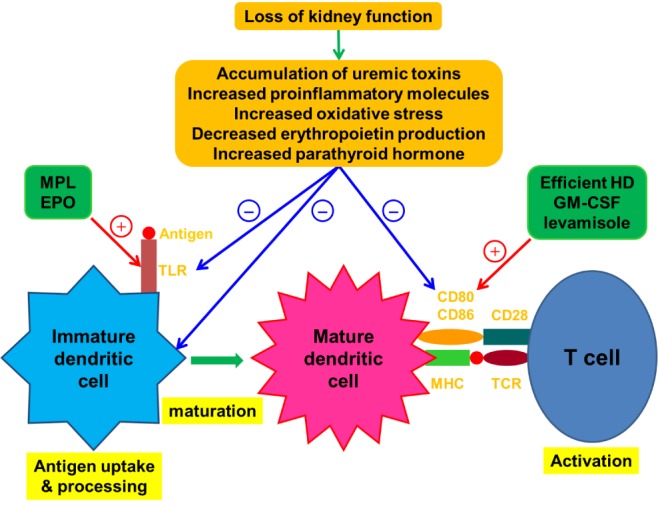
End-stage renal disease (ESRD) with immune disorder involves complex interactions between the innate and adaptive immune responses. ESRD is associated with various alterations in immune function such as a reduction in polymorphonuclear leukocyte bactericidal activity, a suppression of lymphocyte proliferative response to stimuli, and a malfunction of cell-mediated immunity at the molecular level. ESRD also increases patients' propensity for infections and malignancies as well as causing a diminished response to vaccination. Several factors influence the immunodeficiency in patients with ESRD, including uremic toxins, malnutrition, chronic inflammation, and the therapeutic dialysis modality. The alteration of T-cell function in ESRD has been considered to be a major factor underlying the impaired adaptive cellular immunity in these patients. However, cumulative evidence has suggested that the immune defect in ESRD can be caused by an Ag-presenting dendritic cell (DC) dysfunction in addition to a T-cell defect. It has been reported that ESRD has a deleterious effect on DCs both in terms of their number and function, although the precise mechanism by which DC function becomes altered in these patients is unclear. In this review, we discuss the effects of ESRD on the number and function of DCs and propose a possible molecular mechanism for DC dysfunction. We also address therapeutic approaches to improve immune function by optimally activating DCs in patients with ESRD.
Keywords: Antigen presenting cells; Costimulatory molecule; Dendritic cells; End-stage renal disease; Immunodeficiency.
Conflict of interest statement
CONFLICTS OF INTEREST: The authors have declared that they have no conflict of interest.
Figures
References
-
- Webster AC, Nagler EV, Morton RL, Masson P. Chronic Kidney Disease. Lancet. 2017;389:1238–1252. - PubMed
-
- Anding K, Gross P, Rost JM, Allgaier D, Jacobs E. The influence of uraemia and haemodialysis on neutrophil phagocytosis and antimicrobial killing. Nephrol Dial Transplant. 2003;18:2067–2073. - PubMed
-
- Verkade MA, van de Wetering J, Klepper M, Vaessen LM, Weimar W, Betjes MG. Peripheral blood dendritic cells and GM-CSF as an adjuvant for hepatitis B vaccination in hemodialysis patients. Kidney Int. 2004;66:614–621. - PubMed
-
- Sester M, Sester U, Clauer P, Heine G, Mack U, Moll T, Sybrecht GW, Lalvani A, Köhler H. Tuberculin skin testing underestimates a high prevalence of latent tuberculosis infection in hemodialysis patients. Kidney Int. 2004;65:1826–1834. - PubMed
-
- Yoon JW, Gollapudi S, Pahl MV, Vaziri ND. Naïve and central memory T-cell lymphopenia in end-stage renal disease. Kidney Int. 2006;70:371–376. - PubMed
Publication types
LinkOut - more resources
Full Text Sources
Other Literature Sources
Research Materials