. 2017 Jul 7;28(14):1819-1824.
doi: 10.1091/mbc.E16-09-0671.

Forces that shape fission yeast cells

Affiliations

Forces that shape fission yeast cells

Fred Chang. Mol Biol Cell. .

Abstract

One of the major challenges of modern cell biology is to understand how cells are assembled from nanoscale components into micrometer-scale entities with a specific size and shape. Here I describe how our quest to understand the morphogenesis of the fission yeast Schizosaccharomyces pombe drove us to investigate cellular mechanics. These studies build on the view that cell shape arises from the physical properties of an elastic cell wall inflated by internal turgor pressure. Consideration of cellular mechanics provides new insights into not only mechanisms responsible for cell-shape determination and growth, but also cellular processes such as cytokinesis and endocytosis. Studies in yeast can help to illuminate approaches and mechanisms to study the mechanobiology of the cell surface in other cell types, including animal cells.


Figures

FIGURE 1:
FIGURE 1:
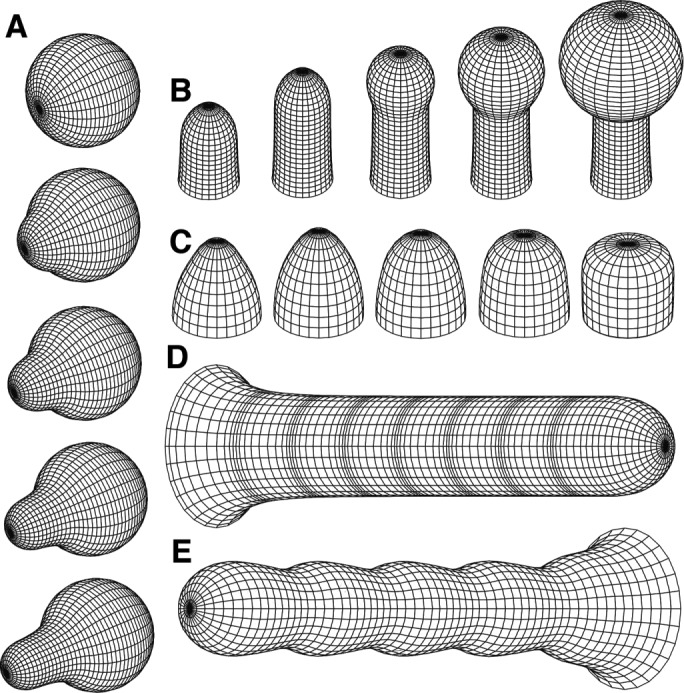
Physical models of tip growth in walled cells recapitulate cell shapes across kingdoms. These simulations depict (A) the emergence of a polarized projection from a sphere; (B) transition from tip growth to the formation of a spherical knob; (C) how changes in parameters alter tip shape; (D) periodic rates of tip growth; and (E) the formation of a beaded rod shape via periodic regulation of cell-wall properties at the growing tip. Reproduced with permission from Dumais et al. (2006).
FIGURE 2:
FIGURE 2:
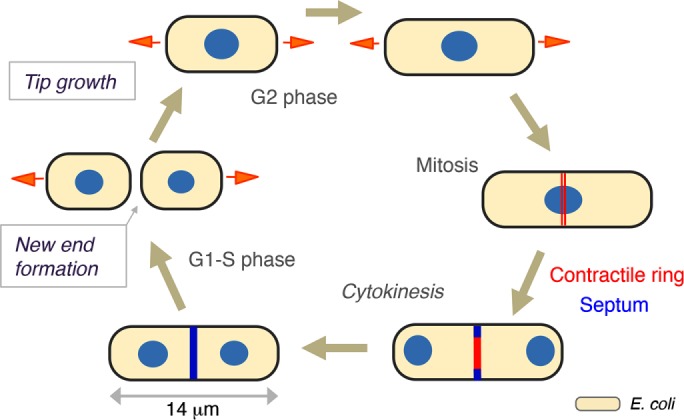
The cell cycle of fission yeast. During interphase, S. pombe cells grow from the cell tips (orange arrows) to 14 μm in length. During mitosis, the cell ceases growth, the mitotic spindle segregates chromosomes, and the actin-based contractile ring (red) assembles at the cell middle. During cytokinesis, the medial septum (blue) grows inward as the contractile ring constricts. Upon cell–cell separation, the cell wall at the septum rapidly adopts a rounded shape to form the new end. The relative size of E. coli is depicted for scale (bottom right).
FIGURE 3:
FIGURE 3:
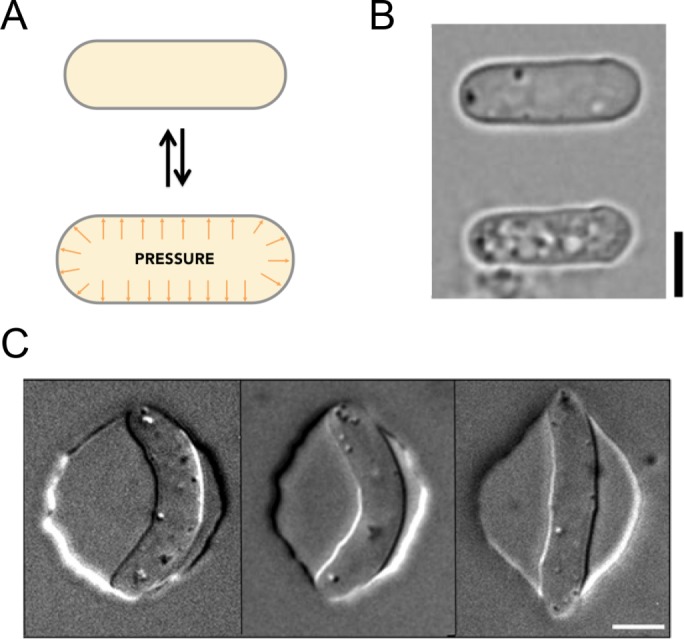
Measuring mechanical properties of fission yeast cells. (A) Modeling the cell wall as an elastic shell that is inflated by turgor pressure. (B) The cell shrinks upon loss of turgor. Bright-field images of a fission yeast cell before (top) and after (bottom) turgor pressure has been released via a laser cut to the cell surface. Reproduced with permission from Atilgan et al. (2015). (C) Images of fission yeast cells inserted into microfabricated chambers of varying stiffness (left to right: hard to soft) to measure cellular mechanical properties. Reproduced with permission from Minc et al. (2009). Scale bars, 5 μm.
FIGURE 4:
FIGURE 4:
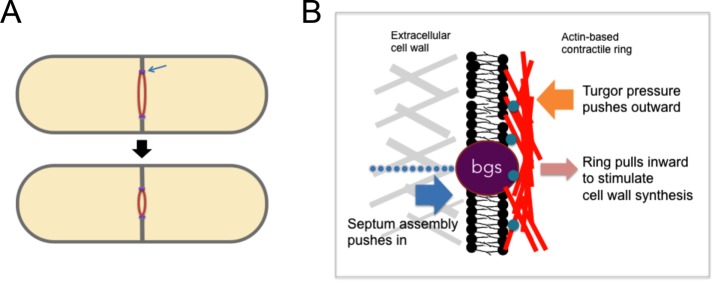
Mechanics of cytokinesis in fission yeast. (A) Ingression of the cleavage furrow during cytokinesis involves assembly of the septum and constriction of the contractile ring (red). (B) Model of forces involved in furrow ingression at the leading edge of the furrow (blue arrow in A). Septum assembly provides the major force by pushing the membrane inward, opposing turgor pressure. The actin-based contractile ring (red), which is attached to the plasma membrane via membrane proteins (turquoise), provides relatively small pulling forces on the membrane, which may shape the septum by stimulating the activity of glucan synthases (bgs proteins, purple). Adapted from Proctor et al. (2012) and Zhou et al. (2015b).

References

    1. Abenza JF, Couturier E, Dodgson J, Dickmann J, Chessel A, Dumais J, Carazo Salas RE. Wall mechanics and exocytosis define the shape of growth domains in fission yeast. Nat Commun. 2015;6:8400. - PMC - PubMed
    1. Aghamohammadzadeh S, Ayscough KR. Differential requirements for actin during yeast and mammalian endocytosis. Nat Cell Biol. 2009;11:1039–1042. - PMC - PubMed
    1. Atilgan E, Magidson V, Khodjakov A, Chang F. Morphogenesis of the fission yeast cell through cell wall expansion. Curr Biol. 2015;25:2150–2157. - PMC - PubMed
    1. Basu R, Munteanu EL, Chang F. Role of turgor pressure in endocytosis in fission yeast. Mol Biol Cell. 2014;25:679–687. - PMC - PubMed
    1. Bonazzi D, Julien JD, Romao M, Seddiki R, Piel M, Boudaoud A, Minc N. Symmetry breaking in spore germination relies on an interplay between polar cap stability and spore wall mechanics. Dev Cell. 2014;28:534–546. - PubMed

MeSH terms

LinkOut - more resources