


Ratio of visceral-to-subcutaneous fat area predicts cardiovascular events in patients with type 2 diabetes
- PMID: 28686352
- PMCID: PMC5835471
- DOI: 10.1111/jdi.12713
Ratio of visceral-to-subcutaneous fat area predicts cardiovascular events in patients with type 2 diabetes
Abstract
Aims/introduction: To investigate whether the ratio of visceral fat area (VFA) to subcutaneous fat area (SFA; V/S ratio) could be predictive of cardiovascular disease (CVD) as compared with VFA or SFA in patients with diabetes.
Materials and methods: A total of 682 patients with type 2 diabetes (mean age 64 ± 13 years; 41% women) were enrolled. VFA (cm2 ) and SFA (cm2 ) were assessed by a dual bioelectrical impedance analyzer. The patients were divided into four groups according to the quartiles of the V/S ratio. The study end-point was the first occurrence or recurrence of CVD.
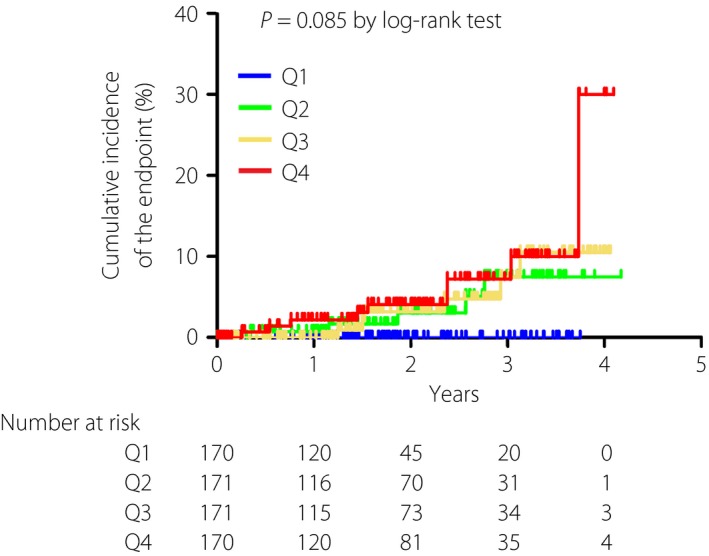
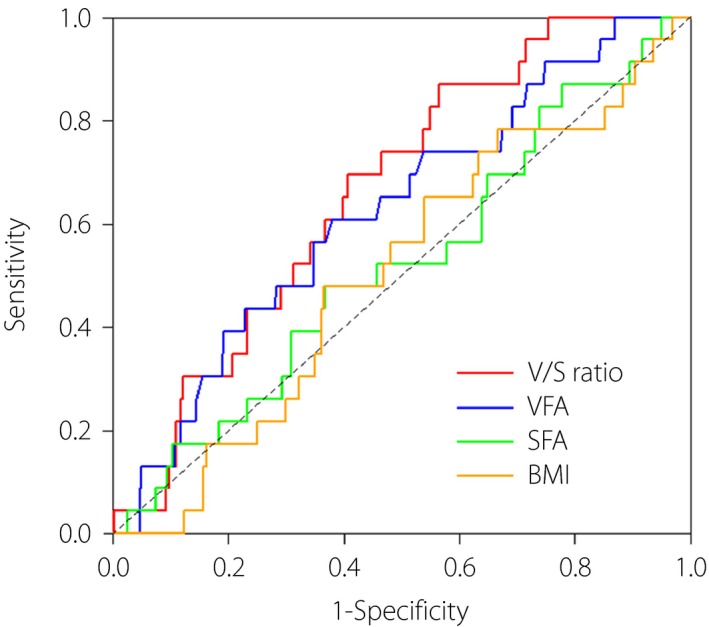
Results: Over a median follow up of 2.5 years, 21 patients reached the end-point. The number of patients who reached the end-point was increased along with the increasing of the V/S ratio quartiles. The V/S ratio was significantly associated with incident or recurrent CVD (hazard ratio [HR] 1.82, 95% CI: 1.09-3.04, P = 0.021) after adjusting for estimated glomerular filtration rate (HR 0.98, 95% CI: 0.96-1.00), brain-type natriuretic peptide (HR 1.00, 95% CI: 1.00-1.01), use of antiplatelet agents (HR 4.26, 95% CI: 1.63-11.13), coefficient of variation of R-R intervals (HR 0.85, 95% CI: 0.69-1.10) and glycated hemoglobin (HR 1.37, 95% CI: 1.05-1.79). The addition of the V/S ratio to age, estimated glomerular filtration rate, brain-type natriuretic peptide, antiplatelet agents and glycated hemoglobin significantly improved classification performance for CVD using net reclassification improvement (0.60, 95% CI: 0.21-1.00) and the integrated discrimination improvement (0.02, 95% CI: 0.00-0.05).
Conclusions: The V/S ratio measured by dual bioelectrical impedance analyzer is an independent predictor of CVD in patients with type 2 diabetes.
Keywords: Cardiovascular disease; Type 2 diabetes; Visceral-to-subcutaneous fat ratio.
© 2017 The Authors. Journal of Diabetes Investigation published by Asian Association for the Study of Diabetes (AASD) and John Wiley & Sons Australia, Ltd.
Figures
References
-
- Van Gaal LF, Mertens IL, De Block CE. Mechanisms linking obesity with cardiovascular disease. Nature 2006; 444: 875–880. - PubMed
-
- Howard BV, Ruotolo G, Robbins DC. Obesity and dyslipidemia. Endocrinol Metab Clin North Am 2003; 32: 855–867. - PubMed
-
- Rahmouni K, Correia ML, Haynes WG, et al Obesity‐associated hypertension: new insights into mechanisms. Hypertension 2005; 45: 9–14. - PubMed
-
- Kaess BM, Jozwiak J, Mastej M, et al Association between anthropometric obesity measures and coronary artery disease: a cross‐sectional survey of 16,657 subjects from 444 Polish cities. Heart 2010; 96: 131–135. - PubMed
MeSH terms
LinkOut - more resources
Full Text Sources
Other Literature Sources
Medical
