. 2017 Jul 7;7(1):4848.
doi: 10.1038/s41598-017-05186-3.

Potential risk of re-emergence of urban transmission of Yellow Fever virus in Brazil facilitated by competent Aedes populations

Affiliations

Potential risk of re-emergence of urban transmission of Yellow Fever virus in Brazil facilitated by competent Aedes populations

Dinair Couto-Lima et al. Sci Rep. .

Abstract

Yellow fever virus (YFV) causing a deadly viral disease is transmitted by the bite of infected mosquitoes. In Brazil, YFV is restricted to a forest cycle maintained between non-human primates and forest-canopy mosquitoes, where humans can be tangentially infected. Since late 2016, a growing number of human cases have been reported in Southeastern Brazil at the gates of the most populated areas of South America, the Atlantic coast, with Rio de Janeiro state hosting nearly 16 million people. We showed that the anthropophilic mosquitoes Aedes aegypti and Aedes albopictus as well as the YFV-enzootic mosquitoes Haemagogus leucocelaenus and Sabethes albiprivus from the YFV-free region of the Atlantic coast were highly susceptible to American and African YFV strains. Therefore, the risk of reemergence of urban YFV epidemics in South America is major with a virus introduced either from a forest cycle or by a traveler returning from the YFV-endemic region of Africa.


Conflict of interest statement

The authors declare that they have no competing interests.

Figures
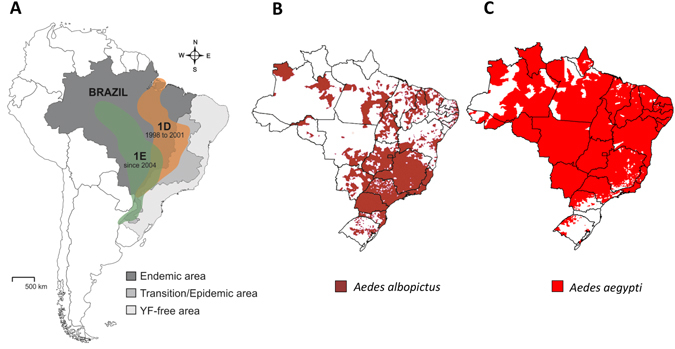
Figure 1
Figure 1
Geographic distribution of YFV strains (71016-1D and 4408-1E) (A), the mosquitoes Ae. aegypti (B) and Ae. albopictus (C) according to ref. . The map was created using software the CorelDraw X5 software (http://www.coreldraw.com/br/).
Figure 2
Figure 2
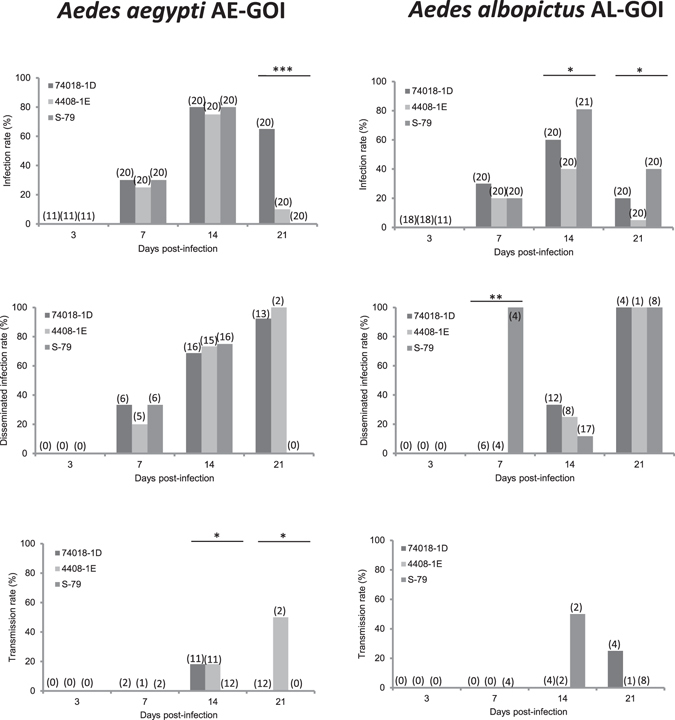
Infection, Dissemination and Transmission of YFV by Aedes aegypti AA-GOI and Aedes albopictus AL-GOI from the epizootic/epidemic region of Goiânia. Mosquitoes were exposed to blood meals at a titer of 106 PFU/mL. Engorged females were maintained in laboratory conditions until examination at 3, 7, 14, 21 days post-infection. Mosquito thorax and abdomen were processed individually to determine the infection rate (IR, proportion of mosquitoes with infected body among the engorged mosquitoes). The mosquito head was used to define the disseminated infection rate (DIR, proportion of mosquitoes with infected head among infected mosquitoes) and the saliva collected from individual females to determine the transmission rate (TR, proportion of mosquitoes with infectious saliva among mosquitoes with disseminated infection). Asterisks refer to a significant difference (*p < 0.05, **p < 10−2, ***p < 10−3). In brackets, the number of mosquitoes tested.
Figure 3
Figure 3
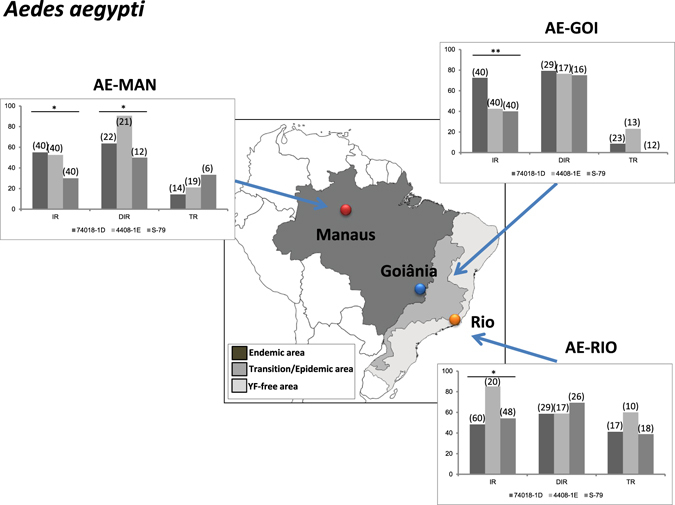
Vector competence of three Aedes aegypti populations (AA-MAN, AA-GOI and AA-RIO) for three YFV strains (74018-1D, 4408-1E and S-79). Mosquitoes were exposed to blood meals at a titer of 106 PFU/mL. Engorged females were maintained in laboratory conditions until days 14–21 post-infection. Mosquitoes were processed as previously described to determine the infection rate (IR), the disseminated infection rate (DIR) and the transmission rate (TR). Asterisks refer to a significant difference (*p < 0.05, **p < 10−2). In brackets, the number of mosquitoes tested. The map was created using software the CorelDraw X5 software (http://www.coreldraw.com/br/).
Figure 4
Figure 4
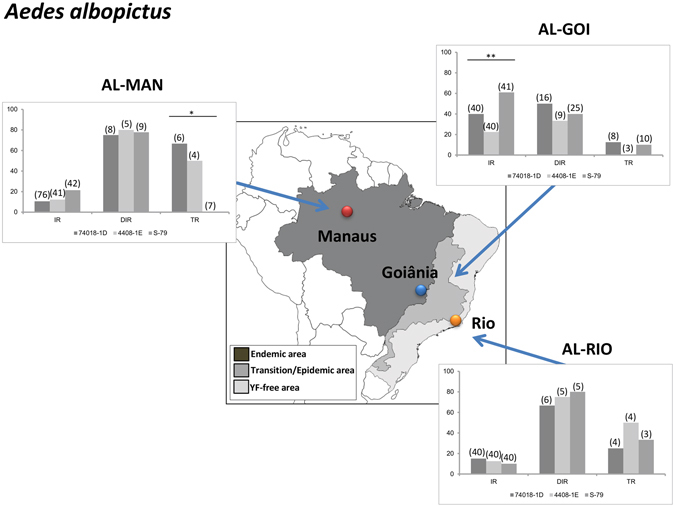
Vector competence of three Aedes albopictus populations (MAA, GOA and PMNI) for three YFV strains (74018-1D, 4408-1E and S-79). Mosquitoes were exposed to blood meals at a titer of 106 PFU/mL. Engorged females were maintained in laboratory conditions until days 14–21 post-infection. Mosquitoes were processed as previously described to calculate the infection rate (IR), the disseminated infection rate (DIR) and the transmission rate (TR). Asterisks refer to a significant difference (*p < 0.05, **p < 10−2). In brackets, the number of mosquitoes tested. The map was created using software the CorelDraw X5 software (http://www.coreldraw.com/br/).
Figure 5
Figure 5
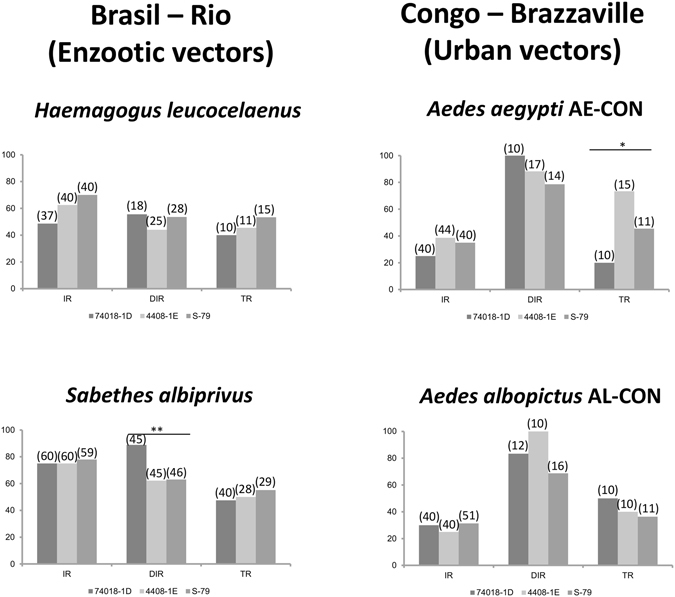
Vector competence to YFV of Brazilian enzootic vectors (Haemagogus leucocelaenus and Sabethes albiprivus) and Congolese domestic vectors (Aedes aegypti and Aedes albopictus) used as controls of YFV infection. Mosquitoes were on an infectious blood meal provided at a titer of 106 PFU/mL. Mosquitoes were processed as previously described. IR indicates to the infection rate, DIR to the disseminated infection rate and TR to the transmission rate. Asterisks refer to a significant difference (*p < 0.05, **p < 10−2). In brackets, the number of mosquitoes tested.
Figure 6
Figure 6
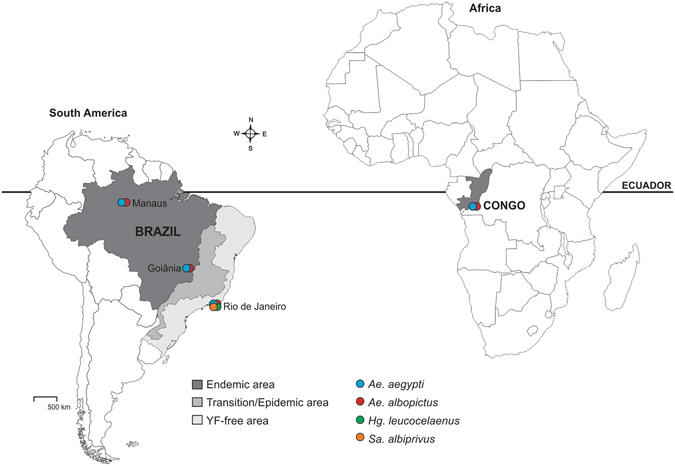
Geographical localization of tested mosquitoes in Brazil and Congo. The map was created using software the CorelDraw X5 software (http://www.coreldraw.com/br/).

References

    1. Mutebi JP, Wang H, Li L, Bryant JE, Barrett AD. Phylogenetic and evolutionary relationships among yellow fever virus isolates in Africa. Journal of virology. 2001;75:6999–7008. doi: 10.1128/JVI.75.15.6999-7008.2001. - DOI - PMC - PubMed
    1. Bryant JE, Holmes EC, Barrett AD. Out of Africa: a molecular perspective on the introduction of yellow fever virus into the Americas. PLoS pathogens. 2007;3:e75. doi: 10.1371/journal.ppat.0030075. - DOI - PMC - PubMed
    1. Staples JE, Monath TP. Yellow fever: 100 years of discovery. JAMA. 2008;300:960–962. doi: 10.1001/jama.300.8.960. - DOI - PubMed
    1. Vasconcelos PF, et al. Genetic divergence and dispersal of yellow fever virus, Brazil. Emerging infectious diseases. 2004;10:1578–1584. doi: 10.3201/eid1009.040197. - DOI - PMC - PubMed
    1. Nunes MR, et al. Genomic and phylogenetic characterization of Brazilian yellow fever virus strains. Journal of virology. 2012;86:13263–13271. doi: 10.1128/JVI.00565-12. - DOI - PMC - PubMed

Publication types

MeSH terms

LinkOut - more resources