


Increased healthcare facility use in veterans surviving sepsis hospitalization
- PMID: 28688238
- PMCID: PMC5733730
- DOI: 10.1016/j.jcrc.2017.06.026
Increased healthcare facility use in veterans surviving sepsis hospitalization
Abstract
Purpose: We sought to measure inpatient healthcare utilization among U.S. Veteran Affairs beneficiaries surviving sepsis hospitalization, and to examine how post-sepsis utilization varies by select patient characteristics.
Materials and methods: Retrospective cohort study of 26,561 Veterans who survived sepsis hospitalization in 2009. Using difference-in-differences analysis, we compared changes in healthcare utilization in one year before and one year after sepsis hospitalization by Veteran age, illness severity, and recent nursing facility use.
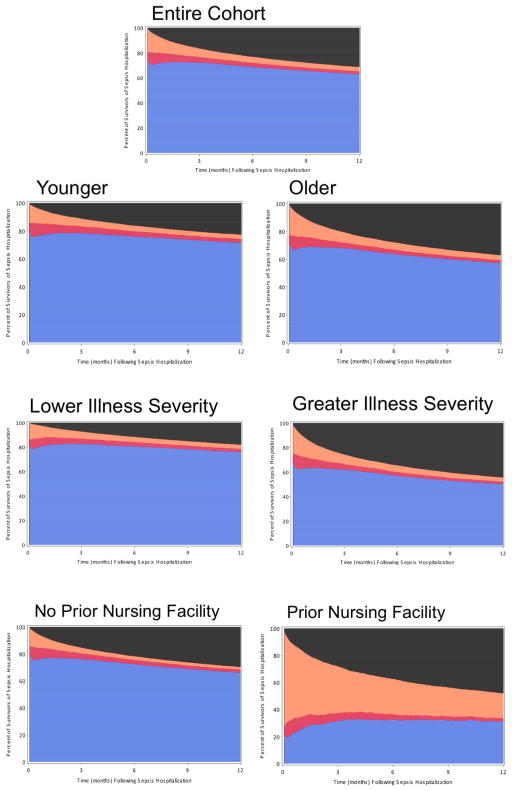
Results: Median days in a healthcare facility increased from 5 to 10. Veterans with recent nursing facility use spent a median 65days (or 86% of days alive) in a healthcare facility in the year after sepsis. Older age, greater illness severity, and recent nursing home use were each associated with spending more days, and a greater proportion of days alive, in a healthcare facility during the year after sepsis. However, none of these characteristics was associated with a greater rise in utilization after sepsis.
Conclusions: Veterans surviving sepsis experience high rates of post-sepsis mortality and significant increases in healthcare facility use. Recent nursing facility use is strongly predictive of greater post-sepsis healthcare utilization.
Published by Elsevier Inc.
Conflict of interest statement
Figures
Comment in
-
Beyond the ICU: Frailty and Post-ICU Disability. Healthcare Use after Acute Respiratory Distress Syndrome and Severe Sepsis.Am J Respir Crit Care Med. 2019 Apr 15;199(8):1028-1030. doi: 10.1164/rccm.201805-0928RR. Am J Respir Crit Care Med. 2019. PMID: 30849230 No abstract available.
References
-
- Kaukonen KM, Bailey M, Suzuki S, Pilcher D, Bellomo R. Mortality related to severe sepsis and septic shock among critically ill patients in Australia and New Zealand, 2000–2012. JAMA. 2014;311:1308–16. - PubMed
Publication types
MeSH terms
Grants and funding
LinkOut - more resources
Full Text Sources
Other Literature Sources
Medical
