


Community Policies and Programs to Prevent Obesity and Child Adiposity
- PMID: 28688728
- PMCID: PMC5650930
- DOI: 10.1016/j.amepre.2017.05.006
Community Policies and Programs to Prevent Obesity and Child Adiposity
Abstract
Introduction: Evidence regarding impact of community policies and programs (CPPs) to prevent child obesity is limited, and which combinations of strategies and components are most important is not understood. The Healthy Communities Study was an observational study to assess relationships of characteristics and intensity of CPPs with adiposity, diet, and physical activity in children, taking advantage of variation across the U.S. in community actions to prevent child obesity. The study examined the association of CPPs to prevent child obesity with measured BMI and waist circumference, hypothesizing that communities with more-comprehensive CPPs would have children with lower adiposity.
Methods: The study included 130 communities selected by probability-based sampling or because of known CPPs targeting child obesity. Data were collected at home visits on 5,138 children during 2013-2015. CPPs were scored for multiple attributes to create a CPP intensity score. A CPP target behavior score reflected the number of distinct target behaviors addressed. Scores were standardized with the smallest observed score across communities being 0 and the largest 1. Multilevel regression analysis in 2016 adjusted for community, household, and individual characteristics.
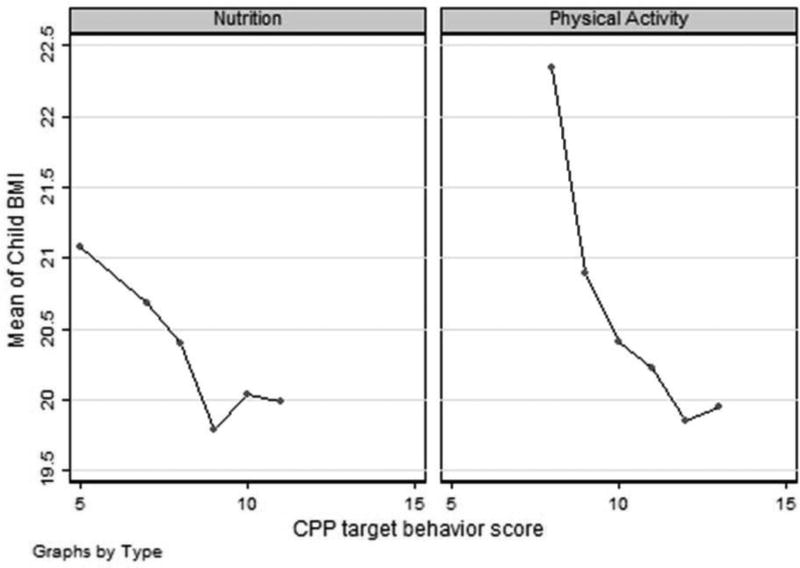
Results: Higher CPP target behavior score was significantly associated with lower BMI and waist circumference in a dose-response relationship, with magnitude for the past 3 years of CPPs of 0.843 (p=0.013) for BMI and 1.783 cm (p=0.020) for waist circumference.
Conclusions: This study provides plausible evidence that comprehensive CPPs targeting a greater number of distinct physical activity and nutrition behaviors were associated with lower child adiposity.
Copyright © 2017 American Journal of Preventive Medicine. All rights reserved.
Figures
References
-
- Ogden CL, Carroll MD, Kit BK, Flegal KM. Prevalence of childhood and adult obesity in the United States, 2011–2012. JAMA. 2014;311(8):806–814. https://doi.org/10.1001/jama.2014.732. - DOI - PMC - PubMed
-
- Shashaj B, Bedogni G, Graziani MP, et al. Origin of cardiovascular risk in overweight preschool children: A cohort study of cardiometabolic factors at the onset of obesity. JAMA Pediatr. 2014;168(10):917–924. https://doi.org/10.1001/jamapediatrics.2014.900. - DOI - PubMed
-
- Finkelstein EA, Graham WC, Malhorta R. Lifetime direct medical costs of childhood obesity. Pediatrics. 2014;133(5):854–862. https://doi.org/10.1542/peds.2014-0063. - DOI - PubMed
-
- Sanchez-Vaznaugh EV, Sanchez BN, Baek J, Crawford PB. ‘Competitive’ food and beverage policies: Are they influencing childhood overweigth trends? Health Aff (Millwood) 2010;29(3):436–446. https://doi.org/10.1377/hlthaff.2009.0745. - DOI - PubMed
-
- Madsen KA, Weedn AE, Crawford PB. Disparities in peaks, plateaus, and declines in prevalence of high BMI among adolescents. Pediatrics. 2010;126(3):434–443. https://doi.org/10.1542/peds.2009-3411. - DOI - PMC - PubMed
Publication types
MeSH terms
Grants and funding
LinkOut - more resources
Full Text Sources
Other Literature Sources
Medical
Miscellaneous
