


Diversity, Prevalence, and Longitudinal Occurrence of Type II Toxin-Antitoxin Systems of Pseudomonas aeruginosa Infecting Cystic Fibrosis Lungs
- PMID: 28690609
- PMCID: PMC5481352
- DOI: 10.3389/fmicb.2017.01180
Diversity, Prevalence, and Longitudinal Occurrence of Type II Toxin-Antitoxin Systems of Pseudomonas aeruginosa Infecting Cystic Fibrosis Lungs
Abstract
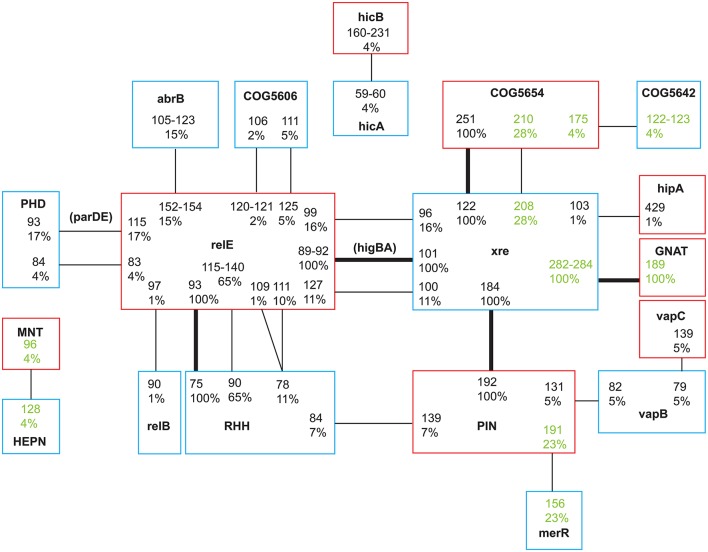
Type II toxin-antitoxin (TA) systems are most commonly composed of two genes encoding a stable toxin, which harms the cell, and an unstable antitoxin that can inactivate it. TA systems were initially characterized as selfish elements, but have recently gained attention for regulating general stress responses responsible for pathogen virulence, formation of drug-tolerant persister cells and biofilms-all implicated in causing recalcitrant chronic infections. We use a bioinformatics approach to explore the distribution and evolution of type II TA loci of the opportunistic pathogen, Pseudomonas aeruginosa, across longitudinally sampled isolates from cystic fibrosis lungs. We identify their location in the genome, mutations, and gain/loss during infection to elucidate their function(s) in stabilizing selfish elements and pathogenesis. We found (1) 26 distinct TA systems, where all isolates harbor four in their core genome and a variable number of the remaining 22 on genomic islands; (2) limited mutations in core genome TA loci, suggesting they are not under negative selection; (3) no evidence for horizontal transmission of elements with TA systems between clone types within patients, despite their ability to mobilize; (4) no gain and limited loss of TA-bearing genomic islands, and of those elements partially lost, the remnant regions carry the TA systems supporting their role in genomic stabilization; (5) no significant correlation between frequency of TA systems and strain ability to establish as chronic infection, but those with a particular TA, are more successful in establishing a chronic infection.
Keywords: Pseudomonas aeruginosa; chronic infection; cystic fibrosis; genomic islands; infection; integrative and conjugative elements; longitudinal studies; toxin-antitoxin system.
Figures
References
-
- Bonnin R. A., Poirel L., Nordmann P., Eikmeyer F. G., Wibberg D., Puhler A., et al. (2013). Complete sequence of broad-host-range plasmid pNOR-2000 harbouring the metallo-beta-lactamase gene blaVIM-2 from Pseudomonas aeruginosa. J. Antimicrob. Chemother. 68, 1060–1065. 10.1093/jac/dks526 - DOI - PubMed
LinkOut - more resources
Full Text Sources
Other Literature Sources
