Review
. 2017 Jun 23:8:1077.
doi: 10.3389/fpls.2017.01077. eCollection 2017.

Sugarcane Water Stress Tolerance Mechanisms and Its Implications on Developing Biotechnology Solutions

Affiliations
Review

Sugarcane Water Stress Tolerance Mechanisms and Its Implications on Developing Biotechnology Solutions

Thais H S Ferreira et al. Front Plant Sci. .

Abstract

Sugarcane is a unique crop with the ability to accumulate high levels of sugar and is a commercially viable source of biomass for bioelectricity and second-generation bioethanol. Water deficit is the single largest abiotic stress affecting sugarcane productivity and the development of water use efficient and drought tolerant cultivars is an imperative for all major sugarcane producing countries. This review summarizes the physiological and molecular studies on water deficit stress in sugarcane, with the aim to help formulate more effective research strategies for advancing our knowledge on genes and mechanisms underpinning plant response to water stress. We also overview transgenic studies in sugarcane, with an emphasis on the potential strategies to develop superior sugarcane varieties that improve crop productivity in drought-prone environments.

Keywords: abscisic acid; bioethanol; drought; lipid peroxidation; sugarcane; transgenic.


Figures
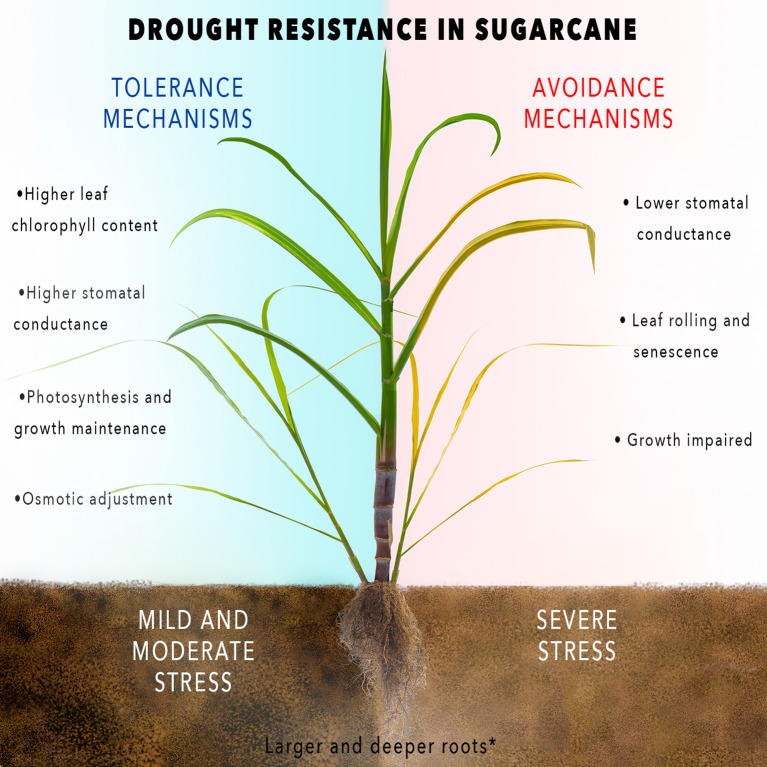
Figure 1
Figure 1
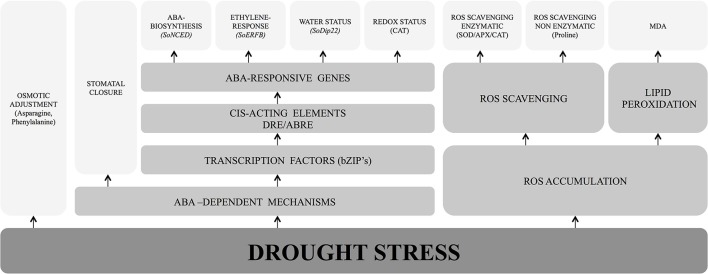
Scheme of sugarcane drought-response mechanisms.
Figure 2
Figure 2
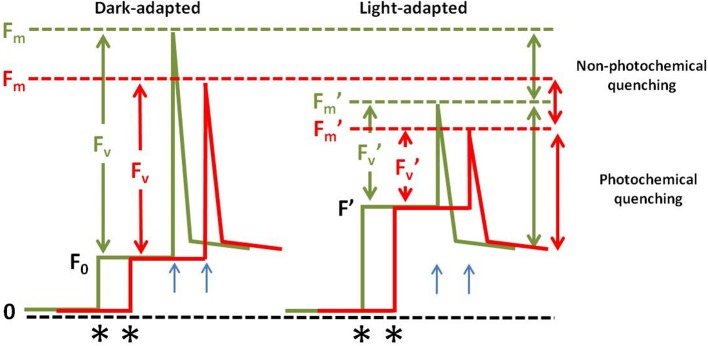
Fluorescence emission under drought stress. Fluorescence dynamics on dark- or light-adapted leaves when cultivated under normal conditions (green lines) or under drought stress (red lines). When leaves are dark-adapted the QA (Plastoquinone) is maximally oxidized and the PSII is called “open.” The exposure of the leaf to a weak measuring light (asterisks mark the point where the measuring light was turned on) results in a minimal level of measured fluorescence (F0). A saturating pulse is emitted (blue arrows) and Fm, or maximum fluorescence is recorded. The difference between Fm and F0 in called Fv or variable fluorescence. The Fv/Fm is called maximum quantum yield of QA reduction or PSII photochemistry. When the leaf is light adapted, the minimal level of fluorescence shifts above the original background (F′). In this situation less QA is oxidized and when a light pulse is emitted the maximum fluorescence for light adapted leaves (F′m) is recorded and its level is lower that the Fm because when the plants are subjected to stress the photochemical quenching is diminished due to the photoinativation of the PSII leading to a higher level of the non-photochemical quenching (NPQ) or the dissipation of energy through heat. F′v is calculated as F′m-F′. F′v/F′m is called maximum PSII efficiency. This parameter is used to measure the contribution of the NPQ on the observed changes on the PSII operation.
Figure 3
Figure 3
Key components of sugarcane responses to water deficit.

References

    1. Abbas S., Ahmad S., Sabir S., Shah A. (2014). Detection of drought tolerant sugarcane genotypes (Saccharum officinarum) using lipid peroxidation, antioxidant activity, glycine-betaine and proline contents. J. Soil Sci. Plant Nutr. 14, 233–243. 10.4067/s0718-95162014005000019 - DOI
    1. Abdeeva I., Piruzian E., Abdeev R., Bruskin S. (2012). Transgenic Plants as a Tool for Plant Functional Genomics, Rijeka: INTECH Open Access Publisher.
    1. Ahmad P., Jaleel C. A., Salem M. A., Nabi G., Sharma S. (2010). Roles of enzymatic and nonenzymatic antioxidants in plants during abiotic stress. Crit. Rev. Biotechnol. 30, 161–175. 10.3109/07388550903524243 - DOI - PubMed
    1. Alexandersson E., Fraysse L., Sjövall-Larsen S., Gustavsson S., Fellert M., Karlsson M., et al. (2005). Whole gene family expression and drought stress regulation of aquaporins. Plant Mol. Biol. 59, 469–484. 10.1007/s11103-005-0352-1 - DOI - PubMed
    1. Altpeter F., Sandhu S. (2010). Genetic transformation-biolistics, in Plant Cell Culture, Essential Methods, ed Davey M. R., Anthony P. (Hoboken, NJ: Wiley; ), 217–237.