. 2017 Jul 3:10:171.
doi: 10.1186/s13068-017-0859-0. eCollection 2017.

From grass to gas: microbiome dynamics of grass biomass acidification under mesophilic and thermophilic temperatures

Affiliations

From grass to gas: microbiome dynamics of grass biomass acidification under mesophilic and thermophilic temperatures

Christian Abendroth et al. Biotechnol Biofuels. .

Abstract

Background: Separating acidification and methanogenic steps in anaerobic digestion processes can help to optimize the process and contribute to producing valuable sub-products such as methane, hydrogen and organic acids. However, the full potential of this technology has not been fully explored yet. To assess the underlying fermentation process in more detail, a combination of high-throughput sequencing and proteomics on the acidification step of plant material (grass) at both mesophilic and thermophilic temperatures (37 and 55 °C, respectively) was applied for the first time.

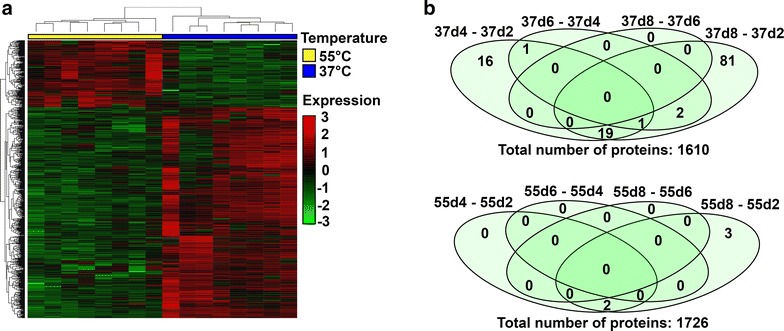
Results: High-strength liquor from acidified grass biomass exhibited a low biodiversity, which differed greatly depending on temperature. It was dominated by Bacteroidetes and Firmicutes at 37 °C, and by Firmicutes and Proteobacteria at 55 °C. At the methane stage, Methanosaeta, Methanomicrobium and Methanosarcina proved to be highly sensitive to environmental changes as their abundance in the seed sludges dropped dramatically after transferring the seed sludges from the respective reactors into the experimental setup. Further, an increase in Actinobacteria coincided with reduced biogas production at the end of the experiment. Over 1700 proteins were quantified from the first cycle of acidification samples using label-free quantitative proteome analysis and searching protein databases. The most abundant proteins included an almost complete set of glycolytic enzymes indicating that the microbial population is basically engaged in the degradation and catabolism of sugars. Differences in protein abundances clearly separated samples into two clusters corresponding to culture temperature. More differentially expressed proteins were found under mesophilic (120) than thermophilic (5) conditions.

Conclusion: Our results are the first multi-omics characterisation of a two-stage biogas production system with separated acidification and suggest that screening approaches targeting specific taxa such as Methanosaeta, Methanomicrobium and Methanosarcina could be useful diagnostic tools as indicators of environmental changes such as temperature or oxidative stress or, as in the case of Actinobacteria, they could be used as a proxy of the gas production potential of anaerobic digesters. Metaproteome analyses only detected significant expression differences in mesophilic samples, whereas thermophilic samples showed more stable protein composition with an abundance of chaperones suggesting a role in protein stability under thermal stress.


Figures
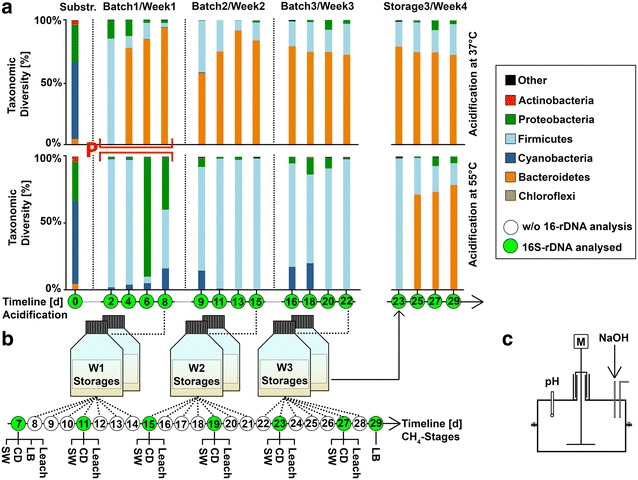
Fig. 1
Fig. 1
16S-rDNA-based taxonomic profiles from untreated grass substrate, samples during acidification and stored hydrolysate, at 37 °C (upper panel) and 55 °C (lower panel) (a). Hydrolysate was filled in anaerobic storage bottles and from there it was transferred semicontinuously into various methane stages (b). For both, mesophilic and thermophilic acidogenesis continuous stirred tank reactors (CSTR) were used. Those were equipped with a pH sensor, which automatically regulated the inflow of NaOH for pH adjustment to 5.5 (c). Proteomic analysis was performed with samples from the first week of acidification (Highlighted with a red letter P). Green circles in the timeline correspond to days of taxonomic analysis (white circles were subjected to chemical analysis). The first column (Substr.) shows the taxonomic composition of the untreated grass biomass
Fig. 2
Fig. 2
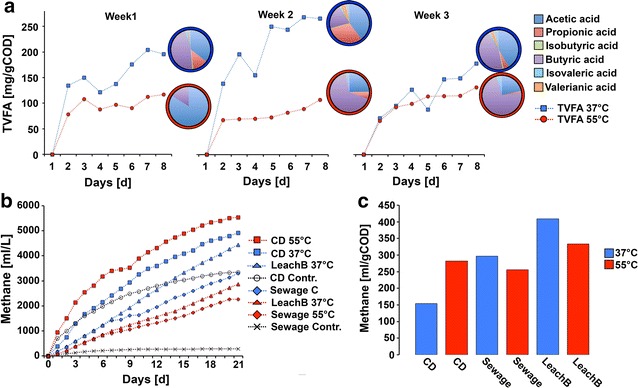
Chemical parameters during acidification and methane production: total amount of TVFA was monitored daily and samples obtained at the end of each acidification cycle were subjected to the determination of VFA spectra (a). Produced methane is shown as volume of methane per volume of sludge (b) and as volume of methane per mg of input COD (c)
Fig. 3
Fig. 3
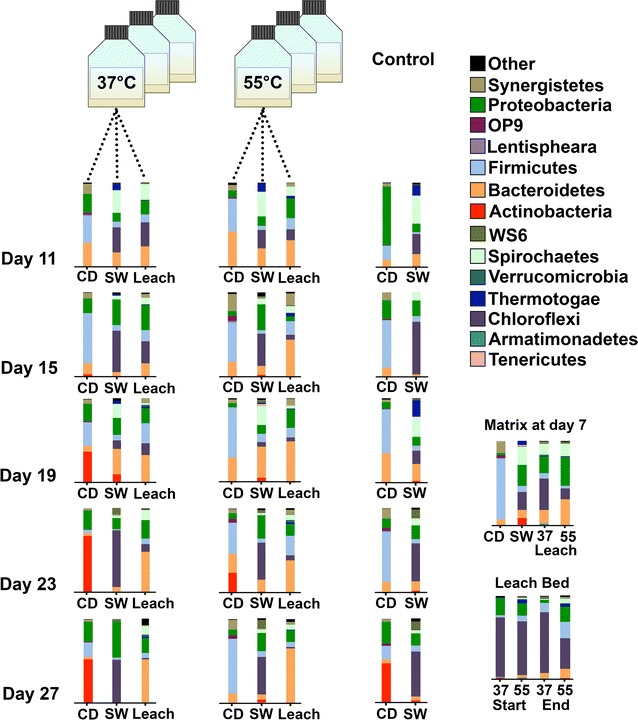
Bacterial community in the CH4-stages: Time-dependent taxonomic profiles at the phylum level over 20 days for various CH4-stages digesting hydrolysate from mesophilic and thermophilic acidification. All CH4-stages were performed at mesophilic temperatures. Control reactions were not fed. Taxonomic profiles of the sludges prior to the experimental setup were determined as controls, as well as the taxonomic profiles of the biofilms from the leach-bed systems. CD co-digester, SW sewage, Leach Leachate
Fig. 4
Fig. 4
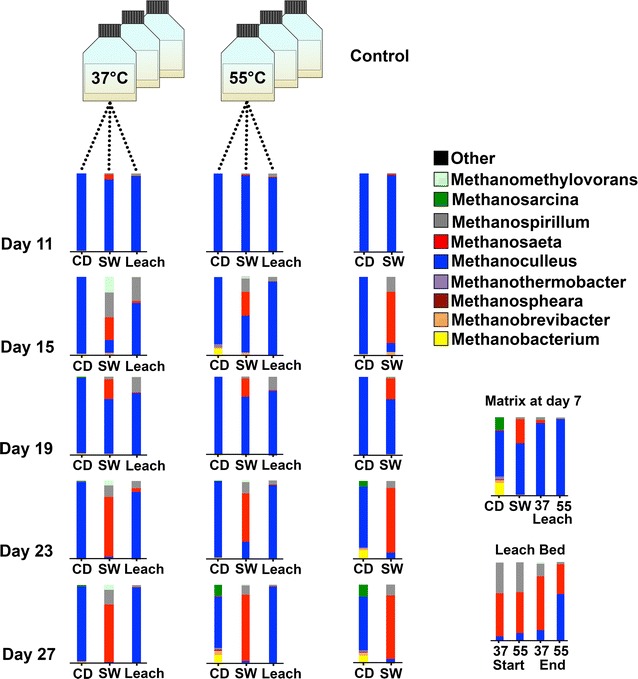
Archaeal community in the CH4-stages: Time-dependent community behaviour at the genus level over 20 days for various CH4-stages digesting hydrolysate from mesophile and thermophile acidification. All CH4-stage measurements were performed at mesophilic temperatures. CD co-digester, SW—sewage, Leach Leachate
Fig. 5
Fig. 5
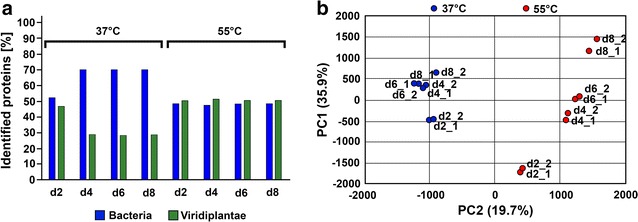
Bacteria and Viridiplantae proteomic profile evolution in the first cycle of acidification (a); PCA aggrupation of quantified peptides at mass spectroscopy analysis (b)
Fig. 6
Fig. 6
Proteomic differences between 37 and 55 °C: HCT for differentially expressed proteins between mesophilic and thermophilic conditions (a). Number of differentially expressed proteins (p value < 0.05) over time at two different culture temperatures: 37 °C (upper Venn diagram) and 55 °C (lower Venn diagram) (b)

References

    1. McCarty PL. The development of anaerobic treatment and its future. Water Sci Technol. 2001;44:149–156. - PubMed
    1. Wirth R, Kovács E, Maróti G, Bagi Z, Rákhely G, Kovács KL. Characterization of a biogas-producing microbial community by short-read next generation DNA sequencing. Biotechnol Biofuels. 2012;5:41. doi: 10.1186/1754-6834-5-41. - DOI - PMC - PubMed
    1. Haarstrick A, Hempel DC, Ostermann L, Ahrens H, Dinkler D. Modelling of the biodegradation of organic matter in municipal landfills. Waste Manag Res. 2001;19:320–331. doi: 10.1177/0734242X0101900409. - DOI - PubMed
    1. Ng A, Melvin WT, Hobson PN. Identification of anaerobic digester bacteria using a polymerase chain reaction method. Bioresour Technol. 1994;47:73–80. doi: 10.1016/0960-8524(94)90031-0. - DOI
    1. Godon JJ, Zumstein E, Dabert P, Habouzit F, Moletta R. Molecular microbial diversity of an anaerobic digestor as determined by small-subunit rDNA sequence analysis. Appl Environ Microbiol. 1997;63:2802–2813. - PMC - PubMed

LinkOut - more resources