. 2017 Nov 2;36(44):6109-6118.
doi: 10.1038/onc.2017.86. Epub 2017 Jul 10.

Pre-45s rRNA promotes colon cancer and is associated with poor survival of CRC patients

Affiliations

Pre-45s rRNA promotes colon cancer and is associated with poor survival of CRC patients

H Tsoi et al. Oncogene. .

Abstract

One characteristic of cancer cells is the abnormally high rate of cell metabolism to sustain their enhanced proliferation. However, the behind mechanism of this phenomenon is still elusive. Here we find that enhanced precursor 45s ribosomal RNA (pre-45s rRNA) is one of the core mechanisms in promoting the pathogenesis of colorectal cancer (CRC). Pre-45s rRNA expression is significantly higher in primary CRC tumor tissues samples and cancer cell lines compared with the non-tumorous colon tissues, and is associated with tumor sizes. Knockdown of pre-45s rRNA inhibits G1/S cell-cycle transition by stabilizing p53 through inducing murine double minute 2 (MDM2) and ribosomal protein L11 (RpL11) interaction. In addition, we revealed that high rate of cancer cell metabolism triggers the passive release of calcium ion from endoplasmic reticulum to the cytoplasm. The elevated calcium ion in the cytoplasm activates the signaling cascade of calcium/calmodulin-dependent protein kinase II, ribosomal S6 kinase (S6K) and ribosomal S6K (CaMKII-S6K-UBF). The activated UBF promotes the transcription of rDNA, which therefore increases pre-45s rRNA. Disruption of CaMKII-S6K-UBF axis by either RNAi or pharmaceutical approaches leads to reduction of pre-45s rRNA expression, which subsequently suppresses cell proliferation in colon cancer cells by causing cell-cycle arrest. Knockdown of APC activates CaMKII-S6K-UBF cascade and thus enhances pre-45s rRNA expression. Moreover, the high expression level of pre-45s rRNA is associated with poor survival of CRC patients in two independent cohorts. Our study identifies a novel mechanism in CRC pathogenesis mediated by pre-45s rRNA and a prognostic factor of pre-45s rRNA in CRC patients.


Conflict of interest statement

The authors declare no conflict of interest.

Figures
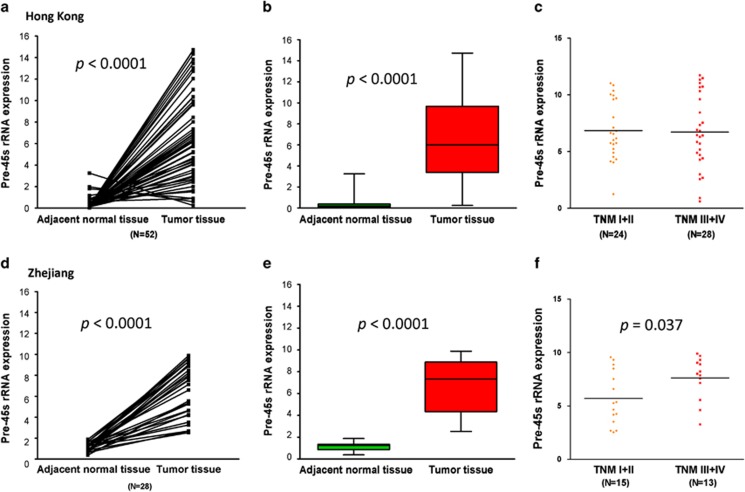
Figure 1
Figure 1
Upregulation of pre-45s rRNA in CRC patients. (a) Pre-45s rRNA was upregulated in tumor tissues obtained from CRC patients in Hong Kong cohort (P<0.0001, n=52). (b) The average relative expression of pre-45s rRNA in both adjacent normal (0.375±0.079) and tumor tissues (6.602±0.563). (c) The expression levels of pre-45s rRNA in tumor tissues from the patients at TNM I and II were compared with that from patients at TNM III and IV (P=0.867). (d) Pre-45s rRNA was upregulated in tumor tissues obtained from CRC patients in Zhejiang cohort. The expression level of pre-45s rRNA in paired adjacent normal and tumor tissues was compared (P<0.0001, n=28). (e) The average relative expression of pre-45s rRNA in adjacent normal (1.151±0.068) and tumor tissues (6.591±0.465). (f) The expression levels of pre-45s rRNA in tumor tissues from the patients at TNM I and II were compared with that from patients at TNM III and IV (P=0.037). β-Actin was used as an internal control for real-time PCR. Data are expressed as mean±s.d.
Figure 2
Figure 2
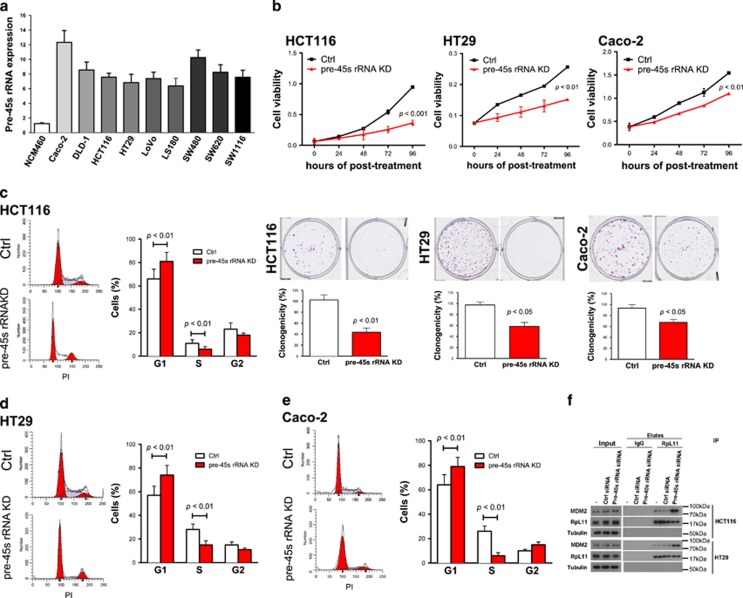
Pre-45s rRNA was essential for supporting the growth of CRC tumor cells. (a) Expression levels of pre-45s rRNA in colon cancer cell and normal colon epithelial cell were evaluated by real-time PCR. Expression of pre-45s rRNA was compared with commercial normal colon tissue. Knockdown of pre-45s rRNA suppressed cell growth. (b) MTT assay was performed in HCT116, HT29 and Caco-2. Colony formation assay was performed in HCT116, HT29 and Caco-2. Represented images were shown. Flow cytometry was used to evaluate the effect of pre-45s rRNA downregulation on cell-cycle arrest in (c) HCT116, (d) HT29 and (e) Caco-2. Representive graphs were shown. (f) Knockdown of pre-45s rRNA favored the interaction between MDM2 and RpL11. Co-immunoprecipitation was used to determine the interaction between MDM2 and RpL11. RpL11 was immunoprecipiated; immunoblot was used to determine the presence of RpL11 and MDM2 in the immunoprecipitant. siRNA of 5 pmol against pre-45s rRNA was used to knockdown the rRNA in cells. β-Actin was used as an internal control for real-time PCR. All data points are expressed as mean±s.d.
Figure 3
Figure 3
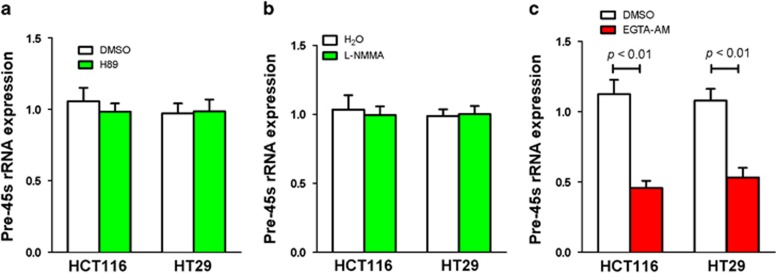
The effect of different chemical on pre-45s rRNA level. (a) Cells were treated with 0.1  μM of H89. (b) Cells were treated with 2  μM of l-NMMA. (c) Cells were treated with 1 mM of EGTA-AM. Real-time PCR was performed to test the expression of pre-45s rRNA. β-Actin was used as an internal control for real-time PCR. Data are expressed as mean±s.d.
Figure 4
Figure 4
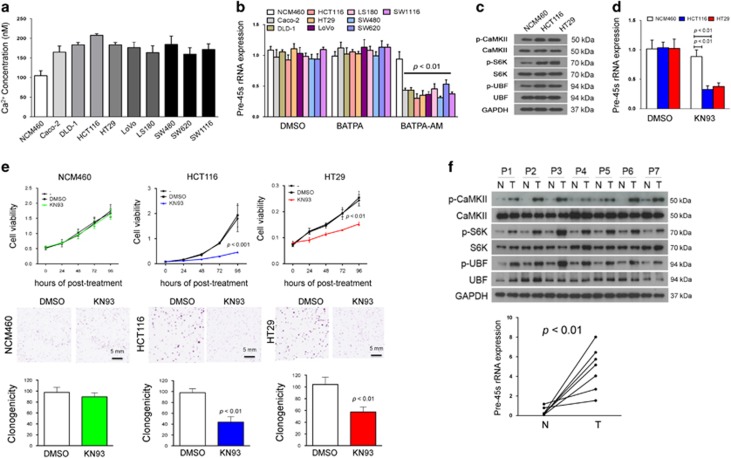
Ca2+ used CaMKII-S6K-UBF signaling cascade to mediate high expression level of pre-45s rRNA in colon cancer cells. (a) The concentration of free Ca2+ in the cytoplasm was determined by fluorescence-based method in normal colon epithelial and colon cancer cells. (b) Treatment of Ca2+ chelator BATPA-AM could suppress the expression level of pre-45s rRNA in all colon cancer cells. Real-time PCR was used to determine the expression level of pre-45s rRNA. (c) Immunoblot analysis on the levels of indicated candidates. (d) Treatment of KN93 suppressed the expression level of pre-45s rRNA in colon cancer cells. KN93 is a small molecule that can inhibit the activity of CaMKII. Real-time PCR was performed to determine the level of pre-45s rRNA. (e) The effect of KN93 on cell growth in NCM460, HCT116 and HT29 was revealed by MTT. The effect of KN93 on cell growth in NCM460, HCT116 and HT29 was revealed by colony formation assays. Represented images were shown. Five micro molar of KN93 was used to treat cells. (f) Immunoblot analysis on the levels of indicated candidates and real-time PCR analysis on pre-45s rRNA levels in paired normal adjacent (N) and tumor (T) tissues from seven patients. Corresponding siRNA of 5 pmol was used. BAPTA-AM/BAPTA of 5 μm was used. GAPDH was used as a loading control in western blot. β-Actin was used as an internal control for real-time PCR. All data points are expressed as mean±s.d.
Figure 5
Figure 5
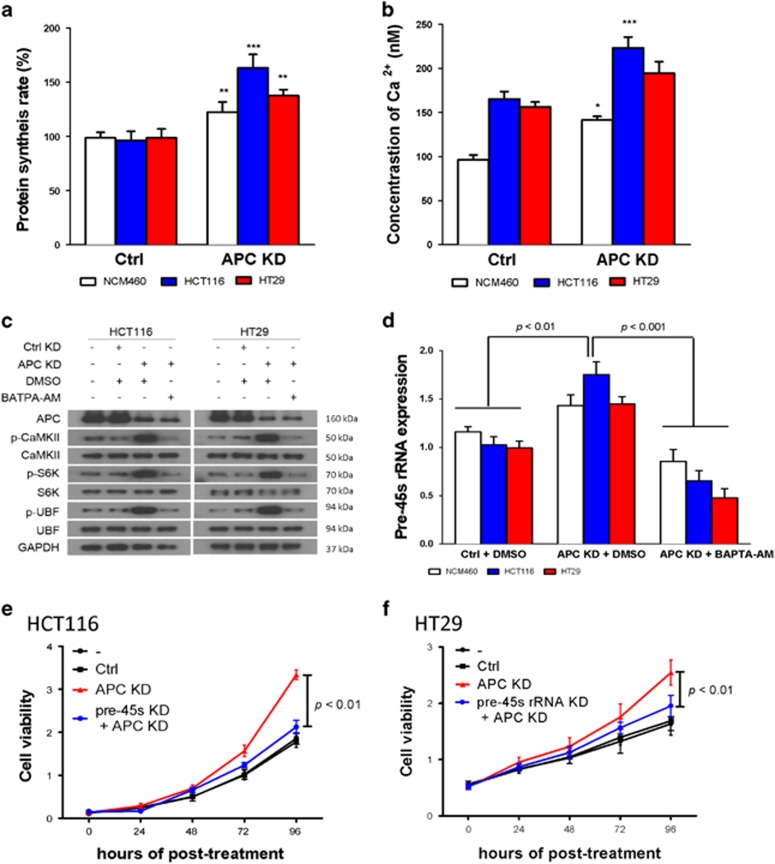
Pre-45s rRNA was essential for supporting the cell growth in colon cancer cells with APC loss of function. (a) Knockdown of APC enhanced the rate of protein synthesis in colon cell lines. (b) Knockdown of APC led to elevation of free Ca2+ in the cytoplasm in colon cells. Real-time PCR was used to determine the expression level of pre-45s rRNA. (c) Activation of CaMKII-S6K-UBF signaling cascade in APC knocked down cells depended on free Ca2+. GAPDH was used as a loading control. Cells were treated with 5  μM of BATPA-AM. (d) Upregulation of pre-45s rRNA mediated by APC knockdown was abolished by BATPA-AM treatment in colon cancer cells. Expression of pre-45s rRNA was compared with untreated NCM460, HCT116 and HT29. Knockdown of pre-45s rRNA suppressed cell growth in colon cancer cells. (e) HCT116 and (f) HT29 with APC knocked down. Cell growth was evaluated by MTT assay. siRNA of 5 pmol against pre-45s rRNA was used to knockdown the rRNA in cells. GAPDH was used as a loading control in western blot. β-Atin was used as internal control for real-time PCR. All data points are represented as mean±s.d. *P<0.05, **P<0.01 and ***P<0.001.
Figure 6
Figure 6
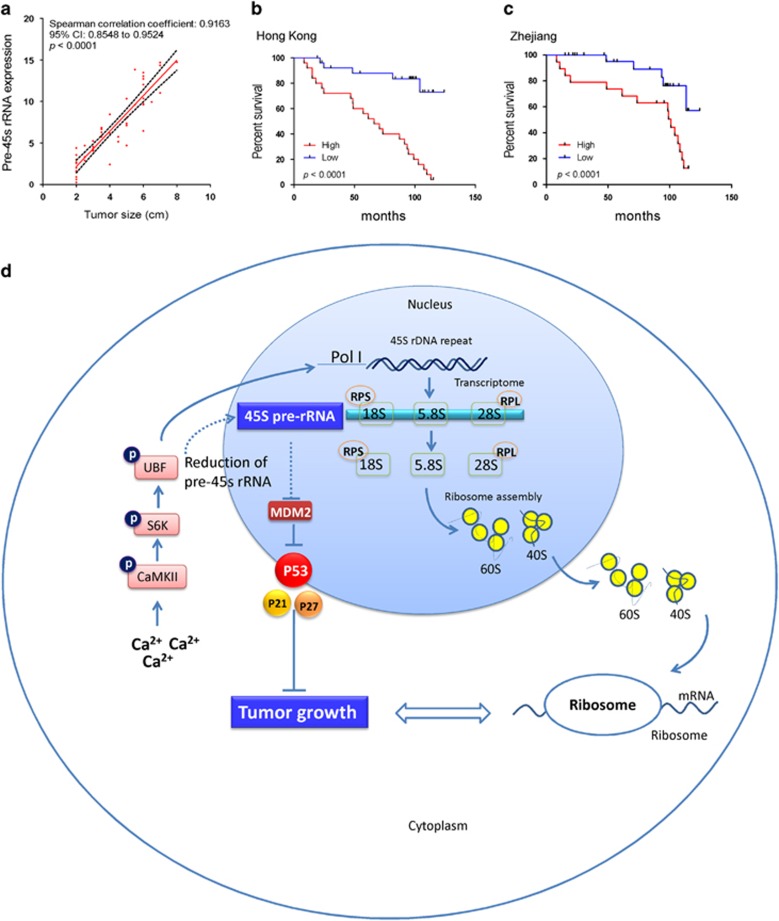
Clinical significance of pre-45s rRNA in CRC patients. (a) Tumor size positively correlated with the expression level of pre-45s rRNA. Only samples from Hong Kong were included in this analysis. Red line represents 95% CI. High expression level of pre-45s rRNA correlated with poor survival outcome of patients from (b) Hong Kong and (c) Zhejiang. Expression level of pre-45s rRNA was an independent prognostic marker for CRC patients. (d) Schematic illustration of the molecular mechanism of pre-45s rRNA in colon cancer. The high metabolism in the colon cancer cells triggers the passive release of Ca2+ from endoplasmic reticulum to the cytoplasm. The elevated Ca2+ in the cytoplasm activates the signaling cascade composed of CaMKII-S6K-UBF. The activated UBF promotes the transcription of rDNA by different mechanisms, which therefore increases the level of precursor of ribosomes, pre-45s rRNA. The enhanced pre-45s rRNA promotes G1/S cell-cycle transition by reducing the inhibitory factors on MDM2 and therefore decreasing the level of p53, which contributes to colon tumorigenesis.

References

    1. Jemal A, Bray F, Center MM, Ferlay J, Ward E, Forman D. Global cancer statistics. CA Cancer J Clin 2011; 61: 69–90. - PubMed
    1. Fujita T. Colorectal cancer. Lancet 2010; 376: 331–331. - PubMed
    1. Grummt I. Life on a planet of its own: regulation of RNA polymerase I transcription in the nucleolus. Gene Dev 2003; 17: 1691–1702. - PubMed
    1. Mullineux ST, Lafontaine DLJ. Mapping the cleavage sites on mammalian pre-rRNAs: Where do we stand? Biochimie 2012; 94: 1521–1532. - PubMed
    1. Rodnina MV, Wintermeyer W. Recent mechanistic insights into eukaryotic ribosomes. Curr Opin Cell Biol 2009; 21: 435–443. - PubMed

Publication types

MeSH terms

Substances