


The Evolution of BioSense: Lessons Learned and Future Directions
- PMID: 28692386
- PMCID: PMC5676506
- DOI: 10.1177/0033354917706954
The Evolution of BioSense: Lessons Learned and Future Directions
Abstract
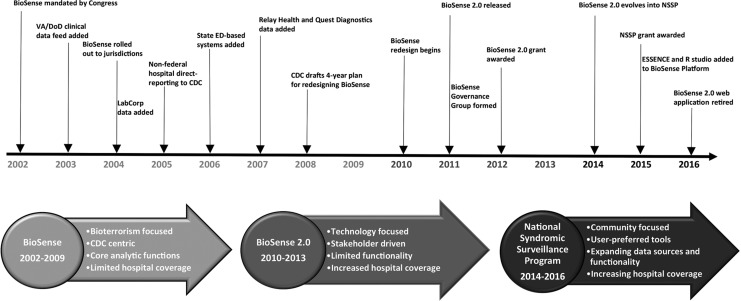
The BioSense program was launched in 2003 with the aim of establishing a nationwide integrated public health surveillance system for early detection and assessment of potential bioterrorism-related illness. The program has matured over the years from an initial Centers for Disease Control and Prevention-centric program to one focused on building syndromic surveillance capacity at the state and local level. The uses of syndromic surveillance have also evolved from an early focus on alerts for bioterrorism-related illness to situational awareness and response, to various hazardous events and disease outbreaks. Future development of BioSense (now the National Syndromic Surveillance Program) includes, in the short term, a focus on data quality with an emphasis on stability, consistency, and reliability and, in the long term, increased capacity and innovation, new data sources and system functionality, and exploration of emerging technologies and analytics.
Keywords: Biosense; emergency department data; public health surveillance; syndromic surveillance.
Conflict of interest statement
Figures
References
-
- Pub L No. 107-188, 116 Stat 594 (2002).
-
- Loonsk JW. BioSense: a national initiative for early detection and quantification of public health emergencies. MMWR Morb Mortal Wkly Rep. 2004;53(suppl):53–55. - PubMed
-
- Bradley CA, Rolka H, Walker D, et al. BioSense: implementation of a national early event detection and situational awareness system. MMWR Morb Mortal Wkly Rep. 2005;54(suppl):11–19. - PubMed
-
- Ginsberg M, Johnson J, Tokars J, et al. Monitoring health effects of wildfires using the BioSense system: San Diego County, California, October 2007. MMWR Morb Mortal Wkly Rep. 2008;57(27):741–744. - PubMed
MeSH terms
LinkOut - more resources
Full Text Sources
Other Literature Sources
Medical
