A novel, species-specific, real-time PCR assay for the detection of the emerging zoonotic parasite Ancylostoma ceylanicum in human stool
- PMID: 28692668
- PMCID: PMC5519186
- DOI: 10.1371/journal.pntd.0005734
A novel, species-specific, real-time PCR assay for the detection of the emerging zoonotic parasite Ancylostoma ceylanicum in human stool
Abstract
Background: Molecular-based surveys have indicated that Ancylostoma ceylanicum, a zoonotic hookworm, is likely the second most prevalent hookworm species infecting humans in Asia. Most current PCR-based diagnostic options for the detection of Ancylostoma species target the Internal Transcribed Spacer (ITS) regions of the ribosomal gene cluster. These regions possess a considerable degree of conservation among the species of this genus and this conservation can lead to the misidentification of infecting species or require additional labor for accurate species-level determination. We have developed a novel, real-time PCR-based assay for the sensitive and species-specific detection of A. ceylanicum that targets a non-coding, highly repetitive genomic DNA element. Comparative testing of this PCR assay with an assay that targets ITS sequences was conducted on field-collected samples from Argentina and Timor-Leste to provide further evidence of the sensitivity and species-specificity of this assay.
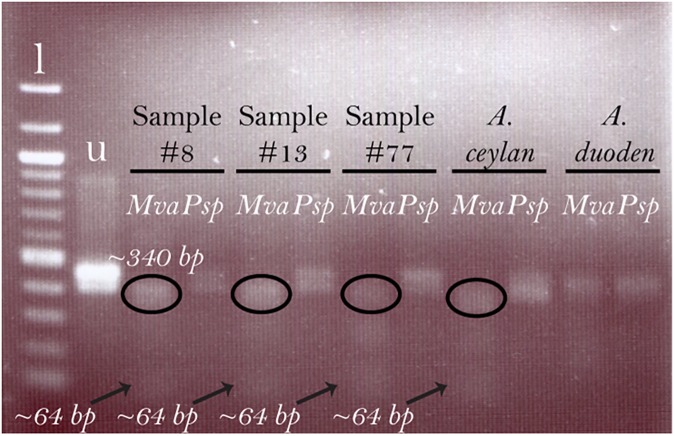
Methods/principal findings: A previously described platform for the design of primers/probe targeting non-coding highly repetitive regions was used for the development of this novel assay. The assay's limits of detection (sensitivity) and cross-reactivity with other soil-transmitted helminth species (specificity) were assessed with real-time PCR experiments. The assay was successfully used to identify infections caused by A. ceylanicum that were previously only identified to the genus level as Ancylostoma spp. when analyzed using other published primer-probe pairings. Further proof of sensitive, species-specific detection was provided using a published, semi-nested restriction fragment length polymorphism-PCR assay that differentiates between Ancylostoma species.
Conclusions/significance: Due to the close proximity of people and domestic/wild animals in many regions of the world, the potential for zoonotic infections is substantial. Sensitive tools enabling the screening for different soil-transmitted helminth infections are essential to the success of mass deworming efforts and facilitate the appropriate interpretation of data. This study describes a novel, species-specific, real-time PCR-based assay for the detection of A. ceylanicum that will help to address the need for such tools in integrated STH deworming programs.
Trial registration: ANZCTR.org.au ACTRN12614000680662.
Conflict of interest statement
The authors have declared that no competing interests exist.
Figures
References
-
- Ngui R, Lim YAL, Ismail WHW, Lim KN, Mahmud R. Zoonotic Ancylostoma ceylanicum infection detected by endoscopy. Am J Trop Med Hyg. 2014; 91(1): 86–88. doi: 10.4269/ajtmh.13-0756 - DOI - PMC - PubMed
-
- Bradbury RS, Hii SF, Harrington H, Speare R, Traub R. Ancylostoma ceylanicum hookworm in the Solomon Islands. Emerg Infect Dis. 2017; 23(2): 252–257. doi: 10.3201/eid2302.160822 - DOI - PMC - PubMed
-
- Hu W, Wu S, Yu X, Abullahi AY, Song M, Tan L, et al. A multiplex PCR for simultaneous detection of three zoonotic parasites Ancylostoma ceylanicum, Ancylostoma caninum, and Giardia lamblia assemblage A. BioMed Res Int. 2015; 2015:406168 doi: 10.1155/2015/406168 - DOI - PMC - PubMed
-
- Traub RJ, Inpankaew T, Sutthikornchai C, Sukthana Y, Thompson RCA. PCR-based coprodiagnostic tools reveal dogs as reservoirs of zoonotic ancylostomiasis caused by Ancylostoma ceylanicum in temple communities in Bangkok. Vet Parasitol. 2008; 155(1–2): 67–73. doi: 10.1016/j.vetpar.2008.05.001 - DOI - PubMed
-
- Ngui R, Lim YAL, Traub RJ, Mahmud R, Mistam MS. Epidemiological and genetic data supporting the transmission of Ancylostoma ceylanicum among human and domestic animals. PLoS Negl Trop Dis. 2012; 6(2): e1522 doi: 10.1371/journal.pntd.0001522 - DOI - PMC - PubMed
Publication types
MeSH terms
Substances
Grants and funding
LinkOut - more resources
Full Text Sources
Other Literature Sources
Medical
Miscellaneous