


The Antibiotic Guardian campaign: a qualitative evaluation of an online pledge-based system focused on making better use of antibiotics
- PMID: 28693462
- PMCID: PMC5504645
- DOI: 10.1186/s12889-017-4552-9
The Antibiotic Guardian campaign: a qualitative evaluation of an online pledge-based system focused on making better use of antibiotics
Erratum in
-
Erratum to: BMC Public Health, Vol. 18.BMC Public Health. 2017 Sep 22;17(1):736. doi: 10.1186/s12889-017-4709-6. BMC Public Health. 2017. PMID: 28938882 Free PMC article. No abstract available.
Abstract
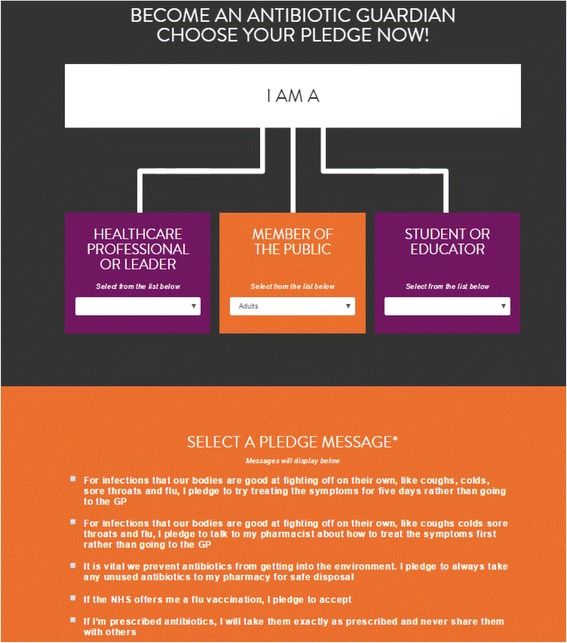
Background: The Antibiotic Guardian Campaign was developed to increase commitment to reducing Antimicrobial Resistance (AMR), change behaviour and increase knowledge through an online pledge system for healthcare professionals and members of the public to become Antibiotic Guardians (AG). This qualitative evaluation aimed to understand AG experiences of the campaign and perceived impact on behaviour.
Methods: Ninety-four AGs (48 via a survey and 46 who had agreed to future contact) were invited to participate in a telephone semi-structured interview. The sample was based on self-identification as a healthcare professional or a member of the public, pledge group (e.g. adults, primary care prescribers etc.), pledge and gender. Interviews explored how participants became aware of the campaign, reasons for joining, pledge choices, responses to joining and views about the campaign's implementation. Interviews were analysed using the Framework Method.
Results: Twenty-two AGs (10 healthcare professionals and 12 members of the public) were interviewed. AGs became aware of the campaign through professional networks and social media, and were motivated to join by personal and professional concern for AMR. Choice of pledge group and pledge were attributed to relevance and potential impact on AMR and the behaviour of others through pledge enactment and promotion of the campaign. Most AGs could not recall their pledge unprompted. Most felt they fulfilled their pledge, although this reflected either behaviour change or the pledge reinforcing pre-existing behaviour. The campaign triggered AGs to reflect on AMR related behaviour and reinforced pre-existing beliefs. Several AGs promoted the campaign to others. Responding collectively as part of the campaign was thought to have a greater impact than individual action. However, limited campaign visibility was observed and the campaign was perceived to have restricted ability to reach those unaware of AMR.
Conclusions: AGs were motivated to reduce AMR and most felt they fulfilled their pledges although for many this appeared to be through reinforcement of existing behaviours. We recommend that the campaign engages those without pre-existing knowledge of AMR by increasing its visibility, capitalising on the diffusion of its message and including more awareness-raising content for those with limited AMR knowledge.
Keywords: Antibiotic; Antimicrobial resistance; Behaviour change; Evaluation; Pledge system; Public health; Qualitative research.
Conflict of interest statement
Ethics approval and consent to participate
This evaluation did not require NHS ethical approval because it is a service evaluation. The Faculty of Medicine and Dentistry Committee for Research Ethics, University of Bristol granted exemption from requiring ethical permission. Verbal informed consent was audio recorded from all participants before the interview began.
Consent for publication
Audio recorded consent for publication was obtained prior to interview from all participants. All participants agreed to the following statement: “I understand that the information collected about me will be used to support other research in the future, may be shared anonymously with other researchers and anonymous quotes maybe included in future publications.”
Competing interests
DAO and AB were members of the PHE group that developed the Antibiotic Guardian Campaign. MG is employed by Public Health England (PHE). JK and SA are partly funded by the NIHR Health Protection Research Unit in Evaluation of Interventions at the University of Bristol in partnership with PHE.
Publisher’s Note
Springer Nature remains neutral with regard to jurisdictional claims in published maps and institutional affiliations.
Figures
References
-
- O'Neil J. Review on Antimicrobial Resistance. Antimicrobial Resistance: Tackling a Crisis for the Health and Wealth of Nations. In: 2014.
-
- WHO Global Strategy for Containment of Antimicrobial Resistance. [http://www.who.int/drugresistance/WHO_Global_Strategy.htm/en/ ]. Accessed 14 Dec 2016.
-
- Special Eurobarometer 407: Antimicrobial Resistance. [http://ec.Europa.eu/public_opinion/archives/ebs/ebs_407_en.pdf]. Accessed 14 Dec 2016.
-
- Behaviour change and antibiotic prescribing in healthcare settings Literature review and behavioural analysis. [https://www.gov.uk/government/publications/antibiotic-prescribing-and-be...]. Accessed 14 Dec 2016.
-
- Davies S. Annual Report of the Chief Medical Officer, Volume Two, 2011, Infections and the rise of antimicrobial resistance. In: London; 2013. - PubMed
Publication types
MeSH terms
Substances
Grants and funding
LinkOut - more resources
Full Text Sources
Other Literature Sources
Medical
