


Social workers' involvement in advance care planning: a systematic narrative review
- PMID: 28693527
- PMCID: PMC5504662
- DOI: 10.1186/s12904-017-0218-8
Social workers' involvement in advance care planning: a systematic narrative review
Erratum in
-
Erratum to: BMC Palliative Care, Vol. 17.BMC Palliat Care. 2017 Oct 10;16(1):51. doi: 10.1186/s12904-017-0233-9. BMC Palliat Care. 2017. PMID: 29017489 Free PMC article. No abstract available.
Abstract
Background: Advance care planning is a process of discussion that enables competent adults to express their wishes about end-of-life care through periods of decisional incapacity. Although a number of studies have documented social workers' attitudes toward, knowledge about, and involvement in advance care planning, the information is fragmented. The purpose of this review was to provide a narrative synthesis of evidence on social workers' perspectives and experiences regarding implementation of advance care planning.
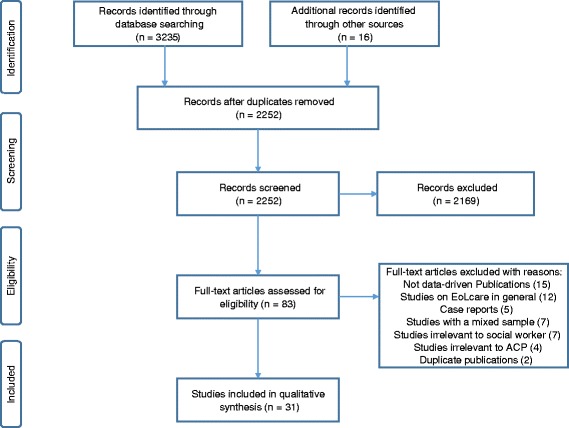
Methods: Six databases were searched for peer-reviewed research papers from their respective inception through December 2016. All of the resulting studies relevant to both advance care planning and social worker were examined. The findings of relevant studies were synthesized thematically.
Results: Thirty-one articles met the eligibility criteria. Six research themes were identified: social workers' attitudes toward advance care planning; social workers' knowledge, education and training regarding advance care planning; social workers' involvement in advance care planning; social workers' perceptions of their roles; ethical issues relevant to advance care planning; and the effect of social work intervention on advance care planning engagement. The findings suggest that there is a consensus among social workers that advance care planning is their duty and responsibility and that social workers play an important role in promoting and implementing advance care planning through an array of activities.
Conclusions: This study provides useful knowledge for implementing advance care planning through illustrating social workers' perspectives and experiences. Further studies are warranted to understand the complexity inherent in social workers' involvement in advance care planning for different life-limiting illnesses or within different socio-cultural contexts.
Keywords: Advance care planning; Advance directive; End-of-life care; Social work; Systematic review.
Conflict of interest statement
Ethics approval and consent to participate
Not applicable.
Consent for publication
Not applicable.
Competing interests
The authors declared that they have no competing interests.
Publisher’s Note
Springer Nature remains neutral with regard to jurisdictional claims in published maps and institutional affiliations.
References
-
- United Nations: World population ageing. 2009. Retrieved from http://www.un.org/esa/population/publications/WPA2009/WPA2009_WorkingPap...
-
- World Health Organization. Palliative care for older people: Better practices. 2011. Retrieved from http://www.euro.who.int/__data/assets/pdf_file/0017/143153/e95052.pdf.
-
- Morrissey MB. Role of social workers as central health care professionals in advance care and end of life planning, and end of life decision making. J Pastor Couns. 2005;40:28–48.
-
- Holloway M. Dying old in the 21st century a neglected issue for social work. Int Soc Work. 2009;52(6):713–725. doi: 10.1177/0020872809342640. - DOI
Publication types
MeSH terms
LinkOut - more resources
Full Text Sources
Other Literature Sources
Medical
Miscellaneous
