. 2017 Sep 20;85(10):e00031-17.
doi: 10.1128/IAI.00031-17. Print 2017 Oct.

In Vivo Analysis of the Viable Microbiota and Helicobacter pylori Transcriptome in Gastric Infection and Early Stages of Carcinogenesis

Affiliations

In Vivo Analysis of the Viable Microbiota and Helicobacter pylori Transcriptome in Gastric Infection and Early Stages of Carcinogenesis

Kaisa Thorell et al. Infect Immun. .

Abstract

Emerging evidence shows that the human microbiota plays a larger role in disease progression and health than previously anticipated. Helicobacter pylori, the causative agent of gastric cancer and duodenal and gastric ulcers, was early associated with gastric disease, but it has also been proposed that the accompanying microbiota in Helicobacter pylori-infected individuals might affect disease progression and gastric cancer development. In this study, the composition of the transcriptionally active microbial community and H. pylori gene expression were determined using metatranscriptomic RNA sequencing of stomach biopsy specimens from individuals with different H. pylori infection statuses and premalignant tissue changes. The results show that H. pylori completely dominates the microbiota not only in infected individuals but also in most individuals classified as H. pylori uninfected using conventional methods. Furthermore, H. pylori abundance is positively correlated with the presence of Campylobacter, Deinococcus, and Sulfurospirillum Finally, we quantified the expression of a large number of Helicobacter pylori genes and found high expression of genes involved in pH regulation and nickel transport. Our study is the first to dissect the viable microbiota of the human stomach by metatranscriptomic analysis, and it shows that metatranscriptomic analysis of the gastric microbiota is feasible and can provide new insights into how bacteria respond in vivo to variations in the stomach microenvironment and at different stages of disease progression.

Keywords: Helicobacter pylori; atrophic gastritis; gastric carcinogenesis; metatranscriptomics; stomach microbiota.


Figures

FIG 1
FIG 1
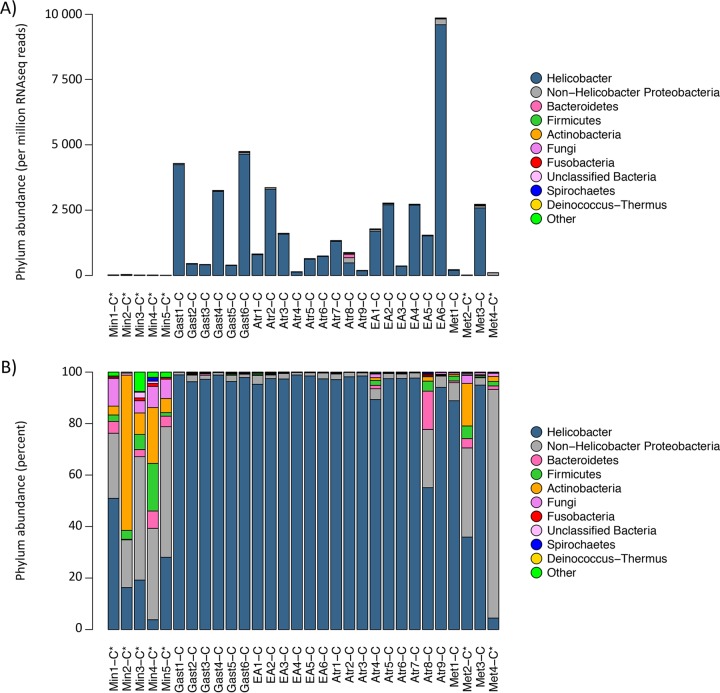
Relative phylum-level abundance in the gastric corpus, based on 16S rRNA classification. (A) Phylum-level abundances (16S rRNA reads per million total RNA-seq reads). (B) Phylum-level relative abundances. For both panels, the Proteobacteria phylum has been split into the Helicobacter genus and non-Helicobacter Proteobacteria genera. Min, H. pylori-uninfected individuals; Gast, gastritis with no atrophy or metaplasia; Atr, atrophic gastritis; EA, extensive atrophy; Met, intestinal metaplasia. rRNA reads were extracted from the RNA-seq data and classified using Metaxa2. Asterisks represent individuals negative for H. pylori infection as determined by clinical tests.
FIG 2
FIG 2
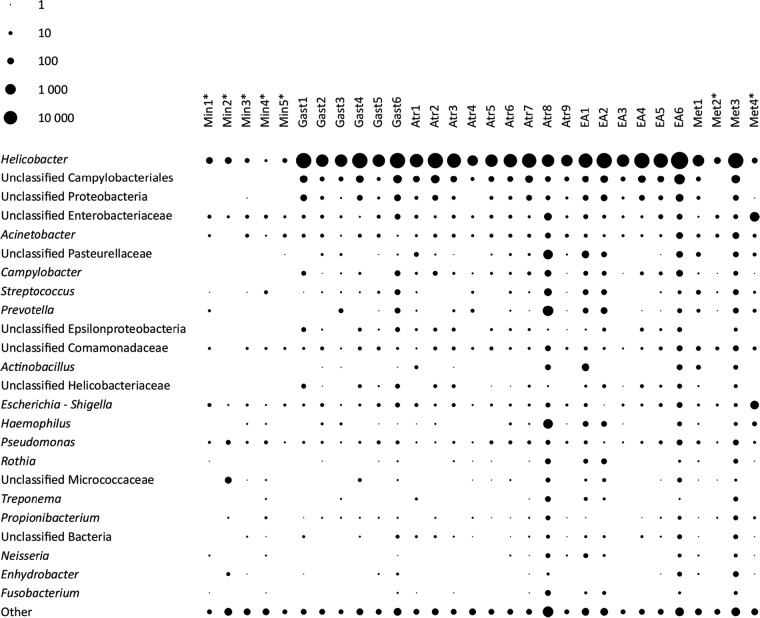
Abundances of different genera in the gastric corpus mucosa. The diameter of each spot corresponds to the relative abundance of each genus in each sample, counted as rRNA reads belonging to that genus per million reads. Only genera having more than two reads per million in at least one sample were included in the figure. Min, H. pylori-uninfected individuals; Gast, gastritis with no atrophy or metaplasia; Atr, atrophic gastritis; EA, extensive atrophy; Met, intestinal metaplasia. The asterisks denote individuals that were H. pylori negative according to clinical methods. The rRNA transcripts were classified using Metaxa2.
FIG 3
FIG 3
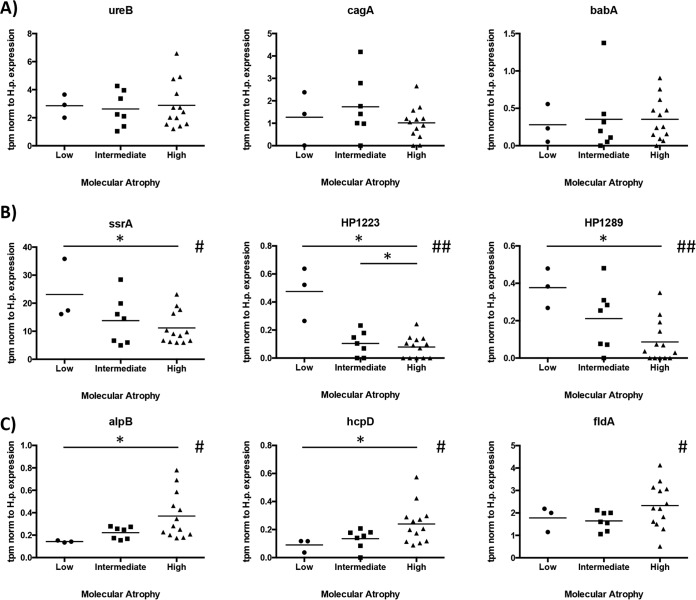
Differential expression of H. pylori genes relative to the molecular atrophy state of the tissue. (A) Unchanged genes. cagA, cytotoxin-associated gene A; ureB, urease subunit beta; babA, blood group-binding adhesin. (B) Genes with trends of negative correlation to atrophy level. ssrA, transfer-mRNA; HP1223, hypothetical protein HP1223. (C) Genes with trends of positive correlation to atrophy level. alpB, outer membrane protein AlpB; hcpD, beta-lactamase HcpD; fldA, flavodoxin. All values are shown as transcripts per million reads, normalized to total reads mapping to Helicobacter pylori genes. The atrophy score was determined by the combined relative expression of six genes (ATP4A, ATP4B, GHRL, GIF, CCKRB, PGC, PGA3, and PGA4) associated with atrophic gastritis. Asterisks denote differential expression between atrophy stages significant in the limma analysis before correction for multiple testing (*, P < 0.05). Number signs denote a significant association between mean atrophy score and expression value (#, unadjusted P < 0.05; ##, unadjusted P < 0.01).

References

    1. Marshall BJ, Warren JR. 1984. Unidentified curved bacilli in the stomach of patients with gastritis and peptic ulceration. Lancet i:1311–1315. - PubMed
    1. Sjostedt S, Kager L, Heimdahl A, Nord CE. 1988. Microbial colonization of tumors in relation to the upper gastrointestinal tract in patients with gastric carcinoma. Ann Surg 207:341–346. doi: 10.1097/00000658-198803000-00020. - DOI - PMC - PubMed
    1. Delgado S, Cabrera-Rubio R, Mira A, Suarez A, Mayo B. 2013. Microbiological survey of the human gastric ecosystem using culturing and pyrosequencing methods. Microb Ecol 65:763–772. doi: 10.1007/s00248-013-0192-5. - DOI - PubMed
    1. Zilberstein B, Quintanilha AG, Santos MA, Pajecki D, Moura EG, Alves PR, Maluf Filho F, de Souza JA, Gama-Rodrigues J. 2007. Digestive tract microbiota in healthy volunteers. Clinics (Sao Paulo) 62:47–54. doi: 10.1590/S1807-59322007000100008. - DOI - PubMed
    1. Bik EM, Eckburg PB, Gill SR, Nelson KE, Purdom EA, Francois F, Perez-Perez G, Blaser MJ, Relman DA. 2006. Molecular analysis of the bacterial microbiota in the human stomach. Proc Natl Acad Sci U S A 103:732–737. doi: 10.1073/pnas.0506655103. - DOI - PMC - PubMed

MeSH terms

LinkOut - more resources