


Menstrual hygiene management among Bangladeshi adolescent schoolgirls and risk factors affecting school absence: results from a cross-sectional survey
- PMID: 28694347
- PMCID: PMC5541609
- DOI: 10.1136/bmjopen-2016-015508
Menstrual hygiene management among Bangladeshi adolescent schoolgirls and risk factors affecting school absence: results from a cross-sectional survey
Abstract
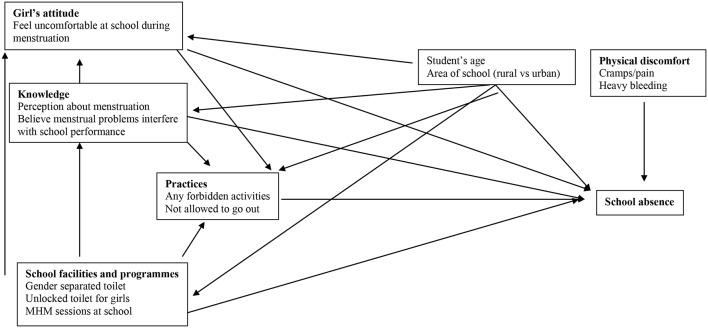
Background: Many adolescent girls in low-income and middle-income countries lack appropriate facilities and support in school to manage menstruation. Little research has been conducted on how menstruation affects school absence. This study examines the association of menstrual hygiene management knowledge, facilities and practice with absence from school during menstruation among Bangladeshi schoolgirls.
Methods: We conducted a nationally representative, cross-sectional study in Bangladeshi schools from March to June 2013 among girls 11 to 17 years old who reached menarche. We sampled 700 schools from 50 urban and 50 rural clusters using a probability proportional to size technique. We interviewed 2332 schoolgirls and conducted spot checks in each school for menstrual hygiene facilities. To assess factors associated with reported school absence, we estimated adjusted prevalence difference (APD) for controlling confounders' effect using generalised estimating equations to account for school-level clustering.
Results: Among schoolgirls who reached menarche, 41% (931) reported missing school, an average of 2.8 missed days per menstrual cycle. Students who felt uncomfortable at school during menstruation (99% vs 32%; APD=58%; CI 54 to 63) and who believed menstrual problems interfere with school performance (64% vs 30%; APD=27; CI 20 to 33) were more likely to miss school during menstruation than those who did not. School absence during menstruation was less common among girls attending schools with unlocked toilet for girls (35% vs 43%; APD=-5.4; CI -10 to -1.6). School absence was more common among girls who were forbidden from any activities during menstruation (41% vs 33%; APD=9.1; CI 3.3 to 14).
Conclusion: Risk factors for school absence included girl's attitude, misconceptions about menstruation, insufficient and inadequate facilities at school, and family restriction. Enabling girls to manage menstruation at school by providing knowledge and management methods prior to menarche, privacy and a positive social environment around menstrual issues has the potential to benefit students by reducing school absence.
Keywords: Adolescent girls; Bangladesh; Menstrual hygiene; School absenteeism.
© Article author(s) (or their employer(s) unless otherwise stated in the text of the article) 2017. All rights reserved. No commercial use is permitted unless otherwise expressly granted.
Conflict of interest statement
Competing interests: None declared.
Figures
References
-
- Water Engineering and Development Centre. Developing knowledge and capacity in water and sanitation: menstruation hygiene management for schoolgirls in low-income countries, 2012. http://wedc.lboro.ac.uk/resources/factsheets/FS007_MHM_A4_Pages.pdf
-
- Kirk J, Sommer M. Menstruation and body awareness: linking girls’ health with girls’ education. Amsterdam, The Netherlands: Royal Tropical Institute (KIT), 2006:1–22.
-
- United Nations, World Population Monitoring 2003. Population, education and development, in United Nations publication, 2004.
-
- World Bank Group. Education Global Practice: Smarter Education Systems for Brighter Futures, 2016. http://documents.worldbank.org/curated/en/212341467999691082/pdf/98450-R....
MeSH terms
LinkOut - more resources
Full Text Sources
Other Literature Sources
Medical
