


Genome Data Provides High Support for Generic Boundaries in Burkholderia Sensu Lato
- PMID: 28694797
- PMCID: PMC5483467
- DOI: 10.3389/fmicb.2017.01154
Genome Data Provides High Support for Generic Boundaries in Burkholderia Sensu Lato
Erratum in
-
Corrigendum: Genome Data Provides High Support for Generic Boundaries in Burkholderia Sensu Lato.Front Microbiol. 2018 Mar 2;9:373. doi: 10.3389/fmicb.2018.00373. eCollection 2018. Front Microbiol. 2018. PMID: 29576763 Free PMC article.
Abstract
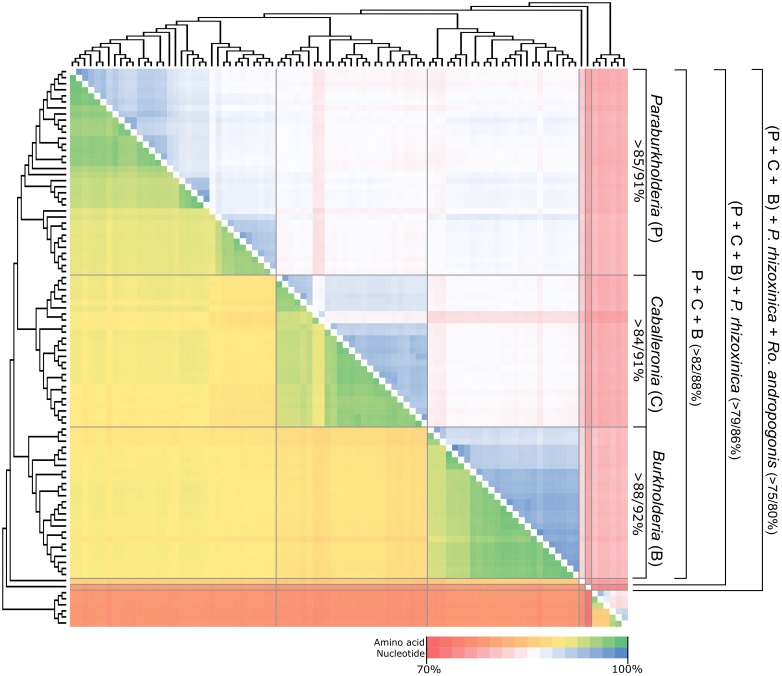
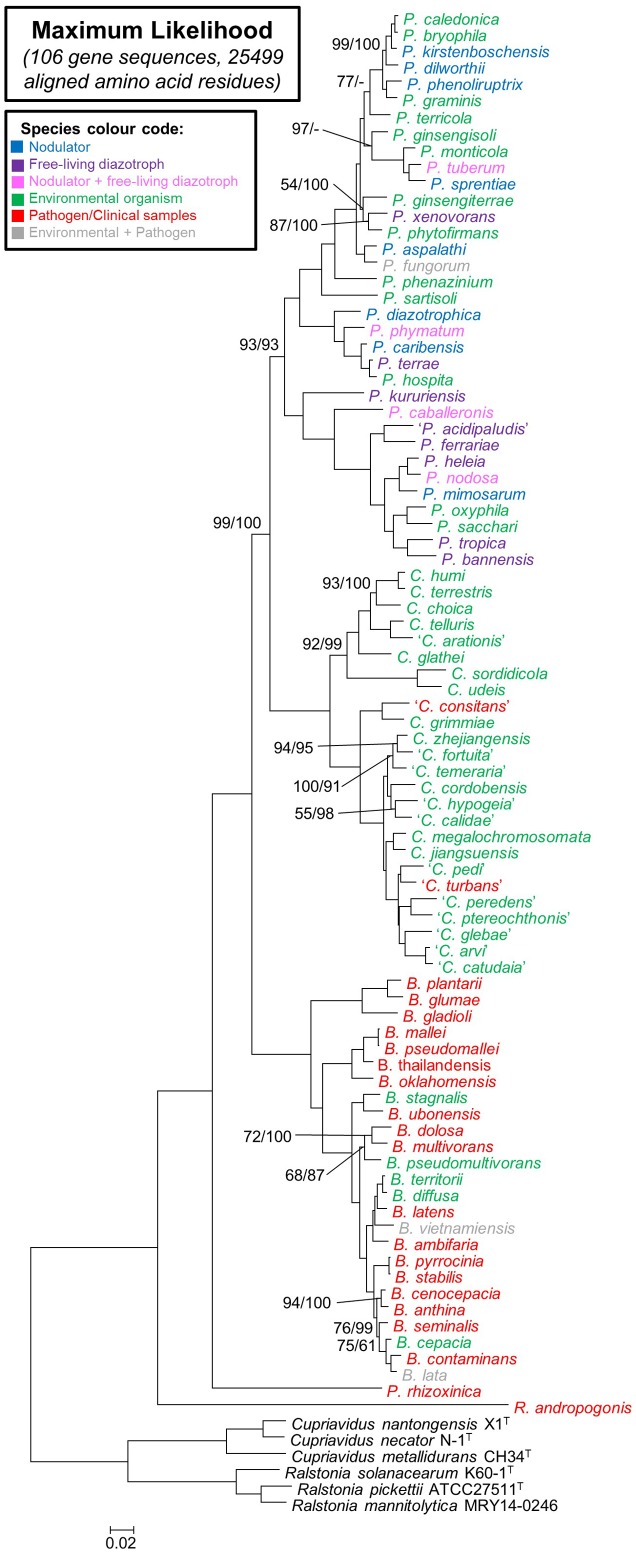
Although the taxonomy of Burkholderia has been extensively scrutinized, significant uncertainty remains regarding the generic boundaries and composition of this large and heterogeneous taxon. Here we used the amino acid and nucleotide sequences of 106 conserved proteins from 92 species to infer robust maximum likelihood phylogenies with which to investigate the generic structure of Burkholderia sensu lato. These data unambiguously supported five distinct lineages, of which four correspond to Burkholderia sensu stricto and the newly introduced genera Paraburkholderia, Caballeronia, and Robbsia. The fifth lineage was represented by P. rhizoxinica. Based on these findings, we propose 13 new combinations for those species previously described as members of Burkholderia but that form part of Caballeronia. These findings also suggest revision of the taxonomic status of P. rhizoxinica as it is does not form part of any of the genera currently recognized in Burkholderia sensu lato. From a phylogenetic point of view, Burkholderia sensu stricto has a sister relationship with the Caballeronia+Paraburkholderia clade. Also, the lineages represented by P. rhizoxinica and R. andropogonis, respectively, emerged prior to the radiation of the Burkholderia sensu stricto+Caballeronia+Paraburkholderia clade. Our findings therefore constitute a solid framework, not only for supporting current and future taxonomic decisions, but also for studying the evolution of this assemblage of medically, industrially and agriculturally important species.
Keywords: Burkholderia; Burkholderia rhizoxinica; Caballeronia; Paraburkholderia; Robbsia andropogonis; phylogenomics.
Figures
References
-
- Aizawa T., Ve N. B., Vijarnsorn P., Nakajima M., Sunairi M. (2010). Burkholderia acidipaludis sp. nov., aluminium-tolerant bacteria isolated from Chinese water chestnut (Eleocharis dulcis) growing in highly acidic swamps in South-East Asia. Int. J. Syst. Evol. Microbiol. 60 2036–2041. 10.1099/ijs.0.018283-0 - DOI - PubMed
LinkOut - more resources
Full Text Sources
Other Literature Sources
Molecular Biology Databases
