


A study protocol of a three-group randomized feasibility trial of an online yoga intervention for mothers after stillbirth (The Mindful Health Study)
- PMID: 28694991
- PMCID: PMC5501104
- DOI: 10.1186/s40814-017-0162-7
A study protocol of a three-group randomized feasibility trial of an online yoga intervention for mothers after stillbirth (The Mindful Health Study)
Erratum in
-
Erratum to: Pilot and Feasibility Studies, Vol. 4.Pilot Feasibility Stud. 2017 Oct 24;3:48. doi: 10.1186/s40814-017-0183-2. eCollection 2017. Pilot Feasibility Stud. 2017. PMID: 29123916 Free PMC article.
Abstract
Background: In the USA, stillbirth (in utero fetal death ≥20 weeks gestation) is a major public health issue. Women who experience stillbirth, compared to women with live birth, have a nearly sevenfold increased risk of a positive screen for post-traumatic stress disorder (PTSD) and a fourfold increased risk of depressive symptoms. Because the majority of women who have experienced the death of their baby become pregnant within 12-18 months and the lack of intervention studies conducted within this population, novel approaches targeting physical and mental health, specific to the needs of this population, are critical. Evidence suggests that yoga is efficacious, safe, acceptable, and cost-effective for improving mental health in a variety of populations, including pregnant and postpartum women. To date, there are no known studies examining online-streaming yoga as a strategy to help mothers cope with PTSD symptoms after stillbirth.
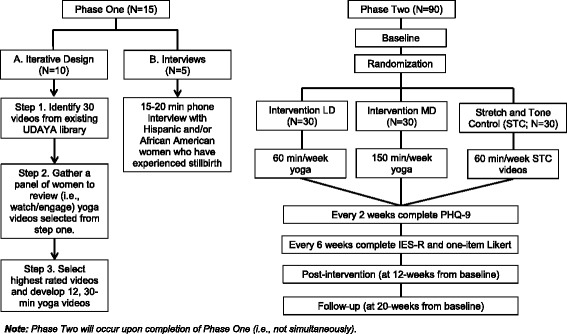
Methods: The present study is a two-phase randomized controlled trial. Phase 1 will involve (1) an iterative design process to develop the online yoga prescription for phase 2 and (2) qualitative interviews to identify cultural barriers to recruitment in non-Caucasian women (i.e., predominately Hispanic and/or African American) who have experienced stillbirth (N = 5). Phase 2 is a three-group randomized feasibility trial with assessments at baseline, and at 12 and 20 weeks post-intervention. Ninety women who have experienced a stillbirth within 6 weeks to 24 months will be randomized into one of the following three arms for 12 weeks: (1) intervention low dose (LD) = 60 min/week online-streaming yoga (n = 30), (2) intervention moderate dose (MD) = 150 min/week online-streaming yoga (n = 30), or (3) stretch and tone control (STC) group = 60 min/week of stretching/toning exercises (n = 30).
Discussion: This study will explore the feasibility and acceptability of a 12-week, home-based, online-streamed yoga intervention, with varying doses among mothers after a stillbirth. If feasible, the findings from this study will inform a full-scale trial to determine the effectiveness of home-based online-streamed yoga to improve PTSD. Long-term, health care providers could use online yoga as a non-pharmaceutical, inexpensive resource for stillbirth aftercare.
Trial registration: NCT02925481.
Keywords: Complementary; Mental health; Mindfulness; Perinatal loss; Women.
Figures
References
-
- Macdorman MF, Kirmeyer S. The challenge of fetal mortality. NCHS Data Brief. 2009;16(16):1–8. - PubMed
-
- Heazell A, Siassakos D, Blencowe H, Burden C, Bhutta Z, Cacciatore J, Dang N, Das J, Flenady V, Gold K, Mensah O, Millum J, Nuzum D, O'Donoghue K, Redshaw M, Rizvi A, Roberts T, Saraki H, Storey C, Wojcieszek A, Downe S. Lancet Ending Preventable Stillbirths, Lancet Ending Preventable Stillbirths investigator group, Lancet Ending Preventable Stillbirths Series study group: Stillbirths: economic and psychosocial consequences. Lancet. 2016;387(10018):604–616. doi: 10.1016/S0140-6736(15)00836-3. - DOI - PubMed
-
- Scheidt CE, Hasenburg A, Kunze M, Waller E, Pfeifer R, Zimmermann P, Hartmann A, Waller N. Are individual differences of attachment predicting bereavement outcome after perinatal loss? A prospective cohort study. J Psychosom Res. 2012;73(5):375–382. doi: 10.1016/j.jpsychores.2012.08.017. - DOI - PubMed
-
- Wayment HA, Vierthaler J. Attachment style and bereavement reactions. J Loss and Trauma. 2002;7(2):129–149. doi: 10.1080/153250202753472291. - DOI
Associated data
Grants and funding
LinkOut - more resources
Full Text Sources
Other Literature Sources
Medical
Research Materials
