. 2017 Oct;165(3):531-543.
doi: 10.1007/s10549-017-4380-8. Epub 2017 Jul 10.

New FTY720-docetaxel nanoparticle therapy overcomes FTY720-induced lymphopenia and inhibits metastatic breast tumour growth

Affiliations

New FTY720-docetaxel nanoparticle therapy overcomes FTY720-induced lymphopenia and inhibits metastatic breast tumour growth

Heba Alshaker et al. Breast Cancer Res Treat. 2017 Oct.

Abstract

Purpose: Combining molecular therapies with chemotherapy may offer an improved clinical outcome for chemoresistant tumours. Sphingosine-1-phosphate (S1P) receptor antagonist and sphingosine kinase 1 (SK1) inhibitor FTY720 (FTY) has promising anticancer properties, however, it causes systemic lymphopenia which impairs its use in cancer patients. In this study, we developed a nanoparticle (NP) combining docetaxel (DTX) and FTY for enhanced anticancer effect, targeted tumour delivery and reduced systemic toxicity.

Methods: Docetaxel, FTY and glucosamine were covalently conjugated to poly(lactic-co-glycolic acid) (PLGA). NPs were characterised by dynamic light scattering and electron microscopy. The cellular uptake, cytotoxicity and in vivo antitumor efficacy of CNPs were evaluated.

Results: We show for the first time that in triple negative breast cancer cells FTY provides chemosensitisation to DTX, allowing a four-fold reduction in the effective dose. We have encapsulated both drugs in PLGA complex NPs (CNPs), with narrow size distribution of ~ 100 nm and excellent cancer cell uptake providing sequential, sustained release of FTY and DTX. In triple negative breast cancer cells and mouse breast cancer models, CNPs had similar efficacy to systemic free therapies, but allowed an effective drug dose reduction. Application of CNPs has significantly reversed chemotherapy side effects such as weight loss, liver toxicity and, most notably, lymphopenia.

Conclusions: We show for the first time the DTX chemosensitising effects of FTY in triple negative breast cancer. We further demonstrate that encapsulation of free drugs in CNPs can improve targeting, provide low off-target toxicity and most importantly reduce FTY-induced lymphopenia, offering potential therapeutic use of FTY in clinical cancer treatment.

Keywords: Breast cancer; Docetaxel; FTY720; Lymphopenia; PLGA nanoparticle; Reduced toxicity; Sensitisation.


Conflict of interest statement

The authors declare that they have no conflict of interest.

Figures
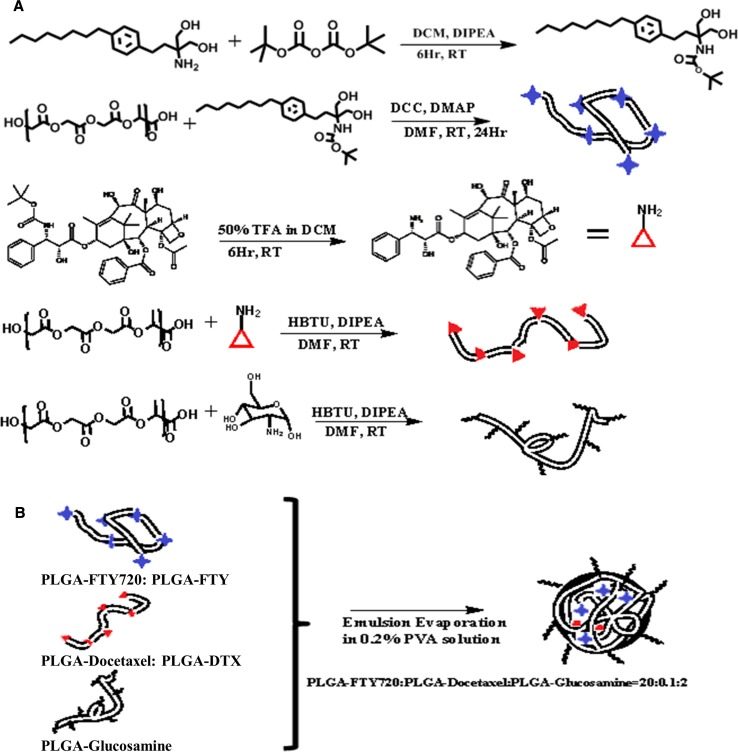
Fig. 1
Fig. 1
Synthesis of CNPs. a Schematic representation of drug modifications: amine head protection in FTY720 (FTY, blue stars) to facilitate ester conjugation with PLGA. Deprotection of amine group in docetaxel (DTX, red triangles) and amide conjugation with PLGA. Amide conjugation reaction between glucosamine (black coils) and PLGA. b Synthesis of CNPs through self-assembly from PLGA-FTY, PLGA-DTX and PLGA-glucosamine. DCC dicyclo carbodiimide, DCM dichloromethane, DIPEA diisopropylethylamine, DMAP dimethyl amino pyridine, DMF dimethyl formamide, HBTU N,N,N′,N′-tetramethyl-O-(1H-benzotriazol-1-yl)uronium hexafluorophosphate, t-Boc di-tert-butyl dicarbonate, TFA trifluoroacetic acid, PVA poly vinyl alcohol
Fig. 2
Fig. 2
Characterization of CNPs. Morphology of CNPs was assessed by SEM (a) and TEM (b). Scale bars indicate 1 µm and 100 nm, respectively. c Distribution of hydrodynamic diameter of PLGA NPs in PBS solution stored for 14 days at 4 °C measured using DLS. d Physiochemical release of DTX and FTY was quantified over 120 h using UV–Vis spectrophotometer. e, f CNPs were incubated in solutions shown on graphs for 5 days. CNP size (e) and polydispersity index (PDI) (f) were measured as described in methods. Points, mean of three independent experiments performed in triplicate. Data is presented as mean ± SE. ns non-significant, *p < 0.05, **p < 0.01, § p < 0.001 (in d vs. DTX; in e, f vs. PBS)
Fig. 3
Fig. 3
CNPs internalise into cancer cells and reduce SK1 activity and expression. a Representative fluorescent microscopy images showing internalisation of CNPs in 4T1 cells. Images were captured at 63X using a Carl Zeiss confocal microscope after 8 h of incubation with rhodamine labelled CNPs. Cells were counter stained with lysotracker blue. Colocalization signals from superimposed images reveal internalisation of CNPs into the endolysosomal compartments. b Fluorescence-activated cell sorting (FACS) assisted quantification of rhodamine labelled CNPs internalisation over 36 h time period in MDA-MB-231 and 4T1 cells. ce 4T1 cells were treated with DTX-FTY free drug combination (5 nM + 2.5 µM, respectively) or CNPs (containing same doses of DTX and FTY) for 24 h and 48 h. c SK1 activity was measured using radiolabeling. Expression of SK1 (d) and VEGF (e) was determined by qRT-PCR and analysed using qBase software. Graphs show mean of three independent experiments performed in triplicates. Data is presented as mean ± SE. ns non-significant, *p < 0.05, **p < 0.01, § p < 0.001 vs. control
Fig. 4
Fig. 4
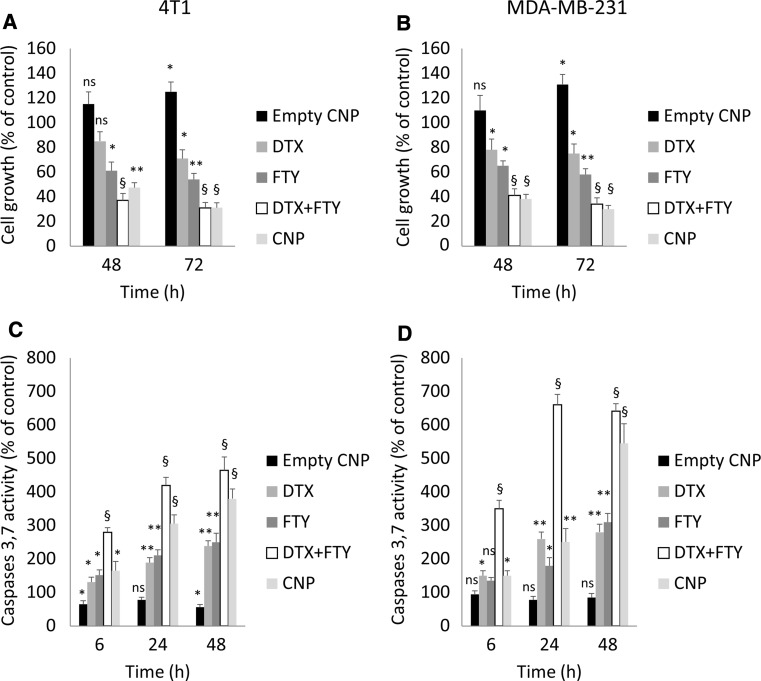
CNPs reduce cancer cell viability and induce apoptosis through caspases 3/7 activation. 4T1 and MDA-MB-231 breast cancer cells were treated with 5 nM DTX + 2.5 µM FTY or CNPs with same doses of drugs for 72 h. Cell viability of 4T1 (a) and MDA-MB-231 (b) cells was measured using MTT assay. Caspases 3/7 activity in 4T1 (c) and MDA-MB-231 (d) cells was measured using caspases 3/7 luminescence assay. Graphs depict quantification of three independent experiments performed in triplicates. Data is presented as mean ± SE. ns non-significant, *p < 0.05, **p < 0.01, § p < 0.001 vs control
Fig. 5
Fig. 5
CNPs inhibit 4T1 murine breast tumour growth and SK1 expression and activity. 106 4T1 breast cancer were implanted subcutaneously in 6–8 week-old female nude mice. Tumours were grown for 2 weeks and then treated for 2 weeks biweekly with intravenous: control (1% dimethyl sulfoxide in saline), empty CNP, 5 mg/kg DTX, 3 mg/kg FTY, free DTX-FTY (5 mg/Kg DTX and 3 mg/Kg FTY), CNP1 (containing 5 mg/Kg DTX + 3 mg/Kg FTY) and CNP2 (containing 2 mg/Kg DTX + 2 mg/Kg FTY). a Tumour volume. b Tumour SK1 activity. c Tumour SK1 and VEGF expression. d Fluorescent microscopy of mouse organs and primary tumours. Graph indicates the levels of fluorescence in each organ quantified using ImageJ. Data is presented as mean ± SE. ns non-significant, *p < 0.05, **p < 0.01, § p < 0.001 vs. control group
Fig. 6
Fig. 6
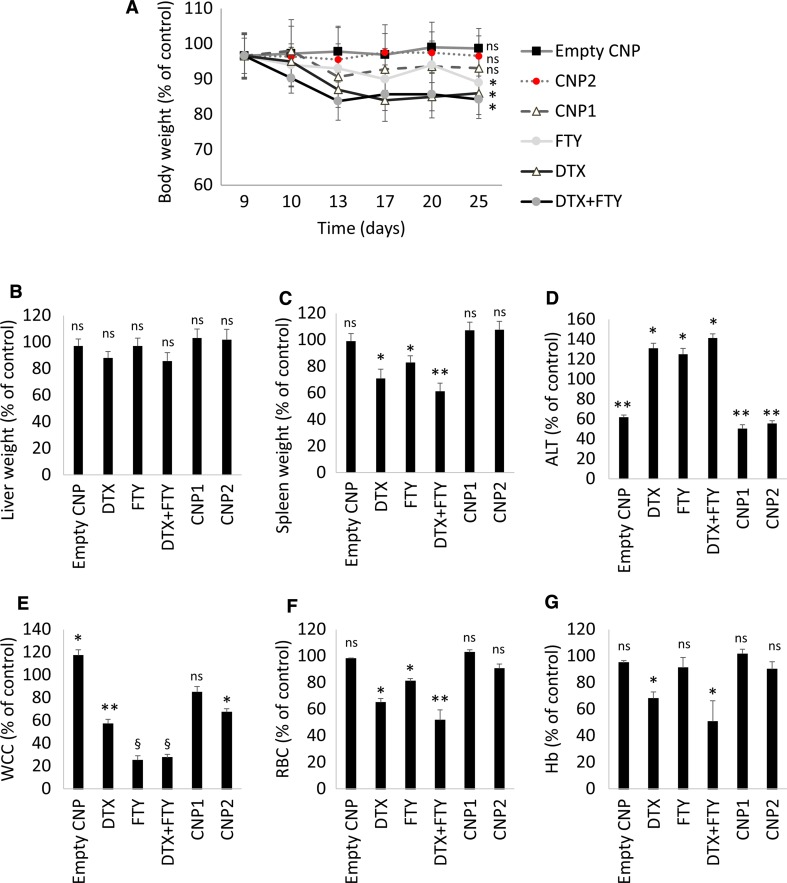
In vivo CNPs demonstrate reduced toxicity in comparison with systemic therapy. 4T1 breast tumours were grown in female nude mice for 2 weeks and treated biweekly in the last two weeks with control, empty CNP, DTX, FTY, free DTX-FTY, CNP1 and CNP2 (as indicated in the legend of Fig. 5). a Mouse body weight. b Liver weight. c Spleen weight. d Serum alanine aminotransferase (ALT). e White cell count (WCC). f Red blood cell count (RBC). g Haemoglobin (Hb). Data is normalised vs control group and presented as mean ± SE, ns non-significant, *p < 0.05, **p < 0.01, § p < 0.001 vs. control group

References

    1. Jemal A, et al. Cancer statistics, 2009. CA Cancer J Clin. 2009;59(4):225–249. doi: 10.3322/caac.20006. - DOI - PubMed
    1. Esteva FJ. The current status of docetaxel for metastatic breast cancer. Oncology. 2002;16(6):17–26. - PubMed
    1. Alshaker H, et al. Therapeutic potential of targeting SK1 in human cancers. Adv Cancer Res. 2013;117:143–200. doi: 10.1016/B978-0-12-394274-6.00006-6. - DOI - PubMed
    1. French KJ, et al. Discovery and evaluation of inhibitors of human sphingosine kinase. Cancer Res. 2003;63(18):5962–5969. - PubMed
    1. Alshaker H, et al. Leptin induces upregulation of sphingosine kinase 1 in oestrogen receptor-negative breast cancer via Src family kinase-mediated, janus kinase 2-independent pathway. Breast Cancer Res. 2014;16(5):426. doi: 10.1186/s13058-014-0426-6. - DOI - PMC - PubMed