Review
. 2017 Jul 11;23(7):804-814.
doi: 10.1038/nm.4350.

Insulin action and resistance in obesity and type 2 diabetes

Affiliations
Review

Insulin action and resistance in obesity and type 2 diabetes

Michael P Czech. Nat Med. .

Abstract

Nutritional excess is a major forerunner of type 2 diabetes. It enhances the secretion of insulin, but attenuates insulin's metabolic actions in the liver, skeletal muscle and adipose tissue. However, conflicting evidence indicates a lack of knowledge of the timing of these events during the development of obesity and diabetes, pointing to a key gap in our understanding of metabolic disease. This Perspective reviews alternate viewpoints and recent results on the temporal and mechanistic connections between hyperinsulinemia, obesity and insulin resistance. Although much attention has addressed early steps in the insulin signaling cascade, insulin resistance in obesity seems to be largely elicited downstream of these steps. New findings also connect insulin resistance to extensive metabolic cross-talk between the liver, adipose tissue, pancreas and skeletal muscle. These and other advances over the past 5 years offer exciting opportunities and daunting challenges for the development of new therapeutic strategies for the treatment of type 2 diabetes.


Figures
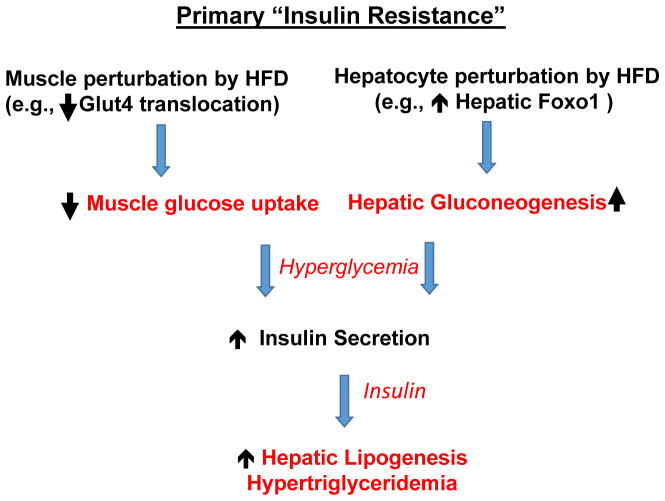
Figure 1
Figure 1. Plausible pathways whereby insulin resistance is the initiating response to high fat diet feeding and obesity to cause hyperglycemia and hyperlipidemia
High fat diets and overfeeding, either directly or indirectly through gut perturbations, disrupt downstream hepatocyte regulators of gluconeogenesis (e.g., increasing nuclear actions of the transcription factor Foxo1), causing increased hepatic glucose output, and disrupt Glut4 glucose transporter response to insulin. Inhibition of adipose insulin responsiveness to insulin also occurs (not shown). These disruptions cause hyperglycemia, which stimulates islet beta cells to secrete insulin, leading to hyperinsulinemia, which in turn activates hepatic lipogenesis and increased secretion of VLDL (hyperlipidemia).
Figure 2
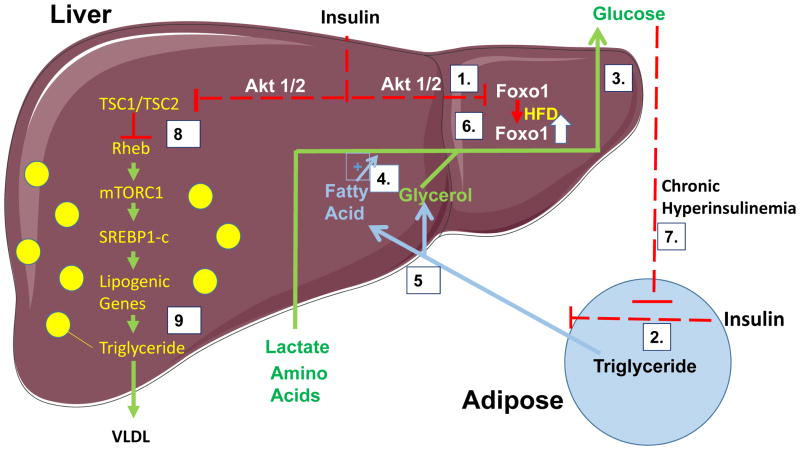
Figure 2. A deleterious cycle between adipose tissue and liver whereby release of free fatty acids from adipocytes promote hepatic gluconeogenesis under high fat feeding/obesity conditions
Under normal fed conditions, Insulin suppresses gluconeogenesis through Akt dependent pathways (boxed 1) which phosphorylate and retain Foxo1 in the cytoplasm. Insulin also suppresses (boxed 2) adipocyte lipolysis (boxed 5), thereby limiting the flow to liver of glycerol, which is a substrate along with lactate and amino acids for gluconeogenesis (boxed 3). According to this model, HFD/obesity mediates a primary effect to upregulate Foxo1 (boxed 6) and disrupt its suppression by insulin signaling to protein kinase Akt, causing increased glucose output. The resultant hyperglycemia/chronic hyperinsulinemia is hypothesized to disrupt the normal acute insulin suppression of adipocyte lipolysis (boxed 7). Increased fatty acid delivery and metabolism in liver promotes gluconeogenesis through allosteric regulation of fatty acid oxidation products such as Acetyl CoA (boxed 4). Thus, under conditions of HFD/obesity, gluconeogenesis is promoted by both directed upregulation and deregulation of Foxo1 and by products of adipose lipolysis, while under normal diet/lean conditions, the direct action of insulin on Foxo1 (boxed 1) is sufficient to suppress gluconeogenesis. Insulin is also required for lipogenesis through an insulin receptor-dependent, Akt-dependent pathway (boxed 8) that activates mTOR1, promoting SREBP1 and stimulates expression of enzymes in the de novo lipogenesis pathway (boxed 9). This model requires Akt to have significant activity, even under HFD and obesity conditions.
Figure 3
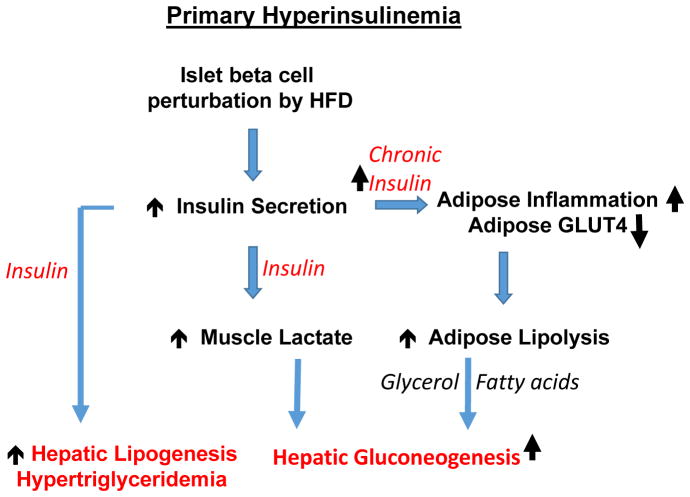
Figure 3. Plausible pathways whereby nutrient-induced hyperinsulinemia is the initiating response to high fat diet feeding and obesity to cause insulin resistance, hyperglycemia and hyperlipidemia
High fat diets and overfeeding, either directly or indirectly through gut secretions, cause increased insulin release from islet beta cells and primary hyperinsulinemia. Insulin increases muscle glycolysis and lactate formation, which is released to the circulation as a substrate to increase gluconeogenesis in liver. The hyperinsulinemia also activates hepatic lipogenesis and increased secretion of VLDL, causing hyperlipidemia. In the adipose tissue, hyperinsulinemia activates an inflammatory response, which through cytokine action on adipocytes compromises their lipogenic capacity and increases lipolysis. Fatty acid flow (from overnutrition and decreased lipid storage and increased lipolysis in adipocytes) to the liver promotes gluconeogenesis through metabolic allosteric regulation.
Figure 4
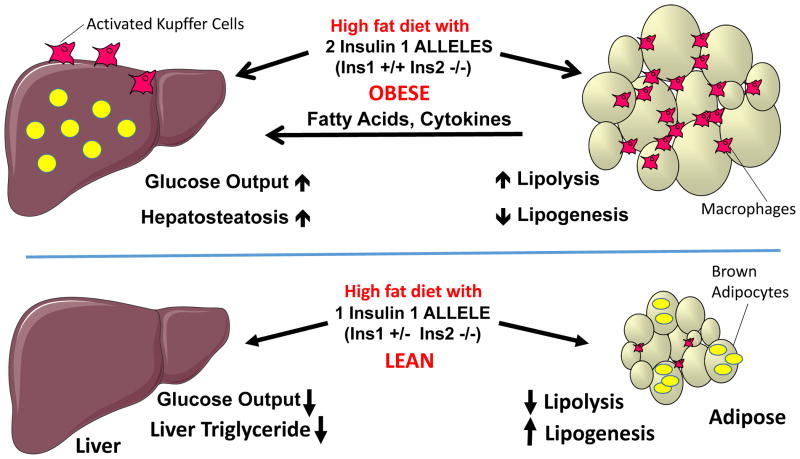
Figure 4. Genetically-induced Insulin deficiency enhances energy expenditure and adipose browning, while preventing adipose expansion, glucose intolerance and hepatosteatosis in mice on a high fat diet
The Figure compares the effects of HFD on genetic mouse models that display either a normal hyperinsulinemic response to the diet (Top panel) versus a hypoinsulinemic response due to partial genetic deletion of insulin alleles(Bottom panel). Top panel: A mouse model that responds to HFD with hyperinsulinemia displays similar effects as the response of wild type mice to HFD: adipose expansion and inflammation, glucose intolerance, hepatic steatosis and hyperlipidemia. Expanded, inflamed adipose is thought to secondarily promote hepatic steatosis and gluconeogenesis. Bottom panel: A mouse model with one less insulin allele than that described in the top panel, which does not display hyperinsulinemia in response to HFD, shows little or no adipose expansion, glucose intolerance or hepatic steatosis under HFD conditions. In addition, adipose browning occurs with upregulation of uncoupling protein 1 and energy expenditure is increased under HFD feeding in this mouse model.
Figure 5
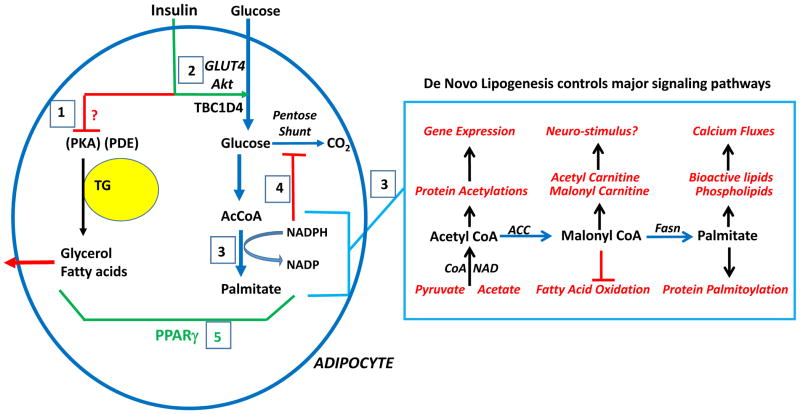
Figure 5. Adipocyte pathways downstream of insulin signaling to Akt disrupted by HFD/obesity that may contribute to systemic insulin resistance in mice and humans
Contained within the circle at left are pathways of glucose and lipid metabolism that become impaired in their response to insulin in obesity. Insulin inhibits hydrolysis of triglyceride (TG) to glycerol and fatty acids (boxed 1) by a mechanism independent of phosphodiesterase (PDE) phosphorylation by Akt that remains a major unknown and key challenge in the field. Also unknown is how disruption of this anti-lipolytic effect of insulin in obesity is impaired. Insulin enhances glucose uptake into adipocytes through Akt-dependent translocation of Glut4 glucose transporters to the plasma membrane (boxed 2). Adipocyte Glut4 expression is decreased in obesity, and this is mimicked by chronic insulin stimulation in vitro, suggesting that hyperinsulinemia may contribute to this effect in vivo. Adipocyte de novo lipogenesis (DNL) (boxed 3) is markedly inhibited in HFD/obesity by mechanisms that are not defined. According to this model, DNL inhibition through feedback inhibition by NADPH decreases glucose flux through the pentose shunt (boxed 4), contributing to increased free glucose and decreased glucose uptake. PPARγ (boxed 5) is a master regulator of adipocyte genes, thus attenuation of its activity in obesity has the potential to cause adipocyte dysfunction and insulin resistance. Large rectangle at right illustrates the many ways that intermediates of DNL may act as signaling molecules to regulate gene expression and many other cellular functions, for example through histone and other protein acetylations, allosteric modulation, protein palmitoylation and generation of bio-active lipids.

References

    1. Reaven GM. The insulin resistance syndrome: definition and dietary approaches to treatment. Annu Rev Nutr. 2005;25:391–406. - PubMed
    1. National Diabetes Statistics Report. 2014 www.CDC.gov.
    1. Kloting N, et al. Insulin-sensitive obesity. Am J Physiol Endocrinol Metab. 2010;299:E506–515. - PubMed
    1. DeFronzo RA, Bonadonna RC, Ferrannini E. Pathogenesis of NIDDM. A balanced overview. Diabetes Care. 1992;15:318–368. - PubMed
    1. Kim SH, Reaven GM. Insulin resistance and hyperinsulinemia: you can’t have one without the other. Diabetes Care. 2008;31:1433–1438. - PMC - PubMed