


Using LMS tables to determine waist circumference and waist-to-height ratios in Colombian children and adolescents: the FUPRECOL study
- PMID: 28697745
- PMCID: PMC5506645
- DOI: 10.1186/s12887-017-0919-4
Using LMS tables to determine waist circumference and waist-to-height ratios in Colombian children and adolescents: the FUPRECOL study
Abstract
Background: Waist circumference (WC) and waist-to-height ratio (WHtR) are often used as indices predictive of central obesity. The aims of this study were: 1) to obtain smoothed centile charts and LMS tables for WC and WHtR among Colombian children and adolescents; 2) to evaluate the utility of these parameters as predictors of overweight and obesity.
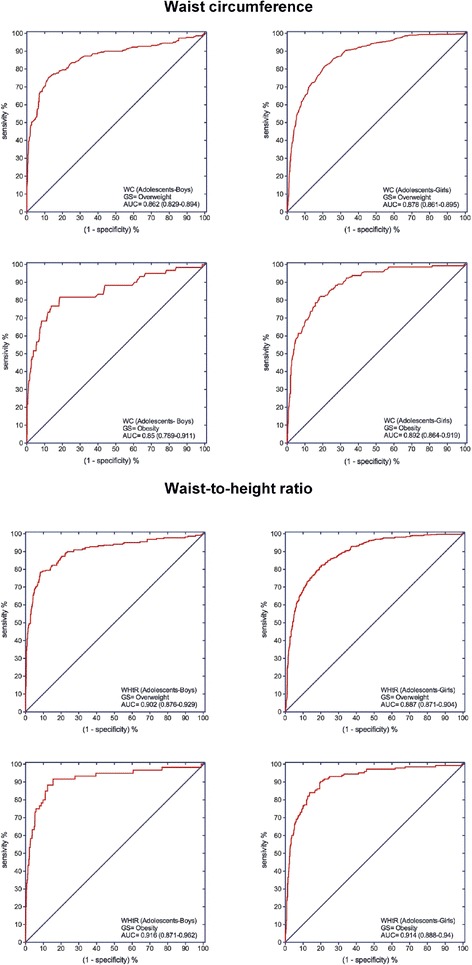
Method: A cross-sectional study was conducted of a sample population of 7954 healthy Colombian schoolchildren [3460 boys and 4494 girls, mean age 12.8 (±2.3) years]. Weight, height, body mass index (BMI), WC and WHtR were measured, and percentiles were calculated using the LMS method (Box-Cox, median and coefficient of variation). Appropriate cut-off points of WC and WHtR for overweight and obesity, according to International Obesity Task Force definitions, were selected using receiver operating characteristic (ROC) analysis. The discriminating power of WC and WHtR is expressed as area under the curve (AUC).
Results: Reference values for WC and WHtR are presented. Mean WC increased and WHtR decreased with age for both genders. A moderate positive correlation was observed between WC and BMI (r = 0.756, P < 0.01) and between WHtR and BMI (r = 0.604, P < 0.01). ROC analysis revealed strong discrimination power in the identification of overweight and obesity for both measures in our sample population. Overall, WHtR was a slightly better predictor of overweight/obesity (AUC 95% CI 0.868-0.916) than WC (AUC 95% CI 0.862-0.904).
Conclusion: This paper presents the first sex and age-specific WC and WHtR percentiles for Colombian children and adolescents aged 9.0-17.9 years. The LMS tables obtained, based on Colombian reference data, can be used as quantitative tools for the study of obesity and its comorbidities.
Keywords: Anthropometric indices; Central obesity; Reference values.
Conflict of interest statement
Ethics approval and consent to participate
The Review Committee for Research on Human Subjects at Universidad del Rosario (Bogotá, Colombia) [Code CEI-ABN026–000262] approved all of the study procedures. At the beginning of the study, written informed consent was obtained from all participants as well as the parents or guardians of all minors (subjects under 18 years of age) enrolled in the study. All participants as well as parents/guardians had been previously informed of the research objectives and protocols. Participants were assured that participation was voluntary and that the information provided would be kept anonymous and strictly confidential. This research was performed in strict compliancewith the International Code of Medical Ethics established by the World Medical Association, the Declaration of Helsinki and with current Colombian laws governing clinical research on human subjects (Resolution 008430/1993 Ministry of Health).
Consent for publication
In every case, written informed consent was provided by the participant’s parent or guardian. In addition, each participant gave verbal assent. The Ethics Committee of the University of Rosario, which is recognised by the Colombian National Ethics Committee, provided ethical approval.
Competing interests
The authors declare that they have no competing interests.
Publisher’s Note
Springer Nature remains neutral with regard to jurisdictional claims in published maps and institutional affiliations.
Figures

References
-
- Expert Panel on Detection, Evaluation, and Treatment of High Blood Cholesterol in Adults. Executive Summary of The Third Report of The National Cholesterol Education Program (NCEP) Expert Panel on Detection, Evaluation, And Treatment of High Blood Cholesterol In Adults (Adult Treatment Panel III). JAMA 2001;285:2486–2497. - PubMed
MeSH terms
LinkOut - more resources
Full Text Sources
Other Literature Sources
Medical
