


Symmetric and asymmetric dimethylarginine as risk markers of cardiovascular disease, all-cause mortality and deterioration in kidney function in persons with type 2 diabetes and microalbuminuria
- PMID: 28697799
- PMCID: PMC5505150
- DOI: 10.1186/s12933-017-0569-8
Symmetric and asymmetric dimethylarginine as risk markers of cardiovascular disease, all-cause mortality and deterioration in kidney function in persons with type 2 diabetes and microalbuminuria
Abstract
Background: To evaluate symmetric dimethylarginine (SDMA) and asymmetric dimethylarginine (ADMA) as risk markers of cardiovascular disease, all-cause mortality and deterioration in renal function in a well characterised type 2 diabetic population with microalbuminuria and without symptoms of coronary artery disease.
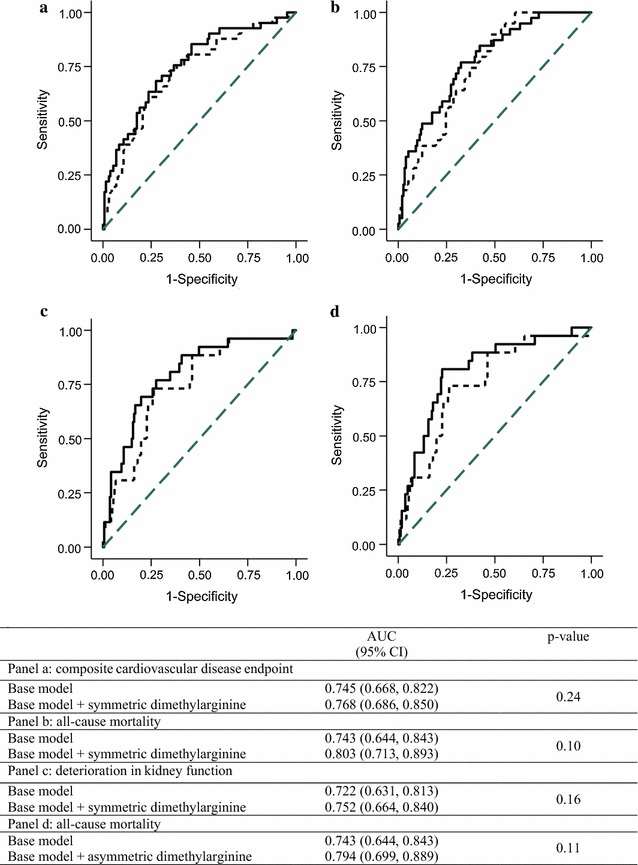
Methods: 200 participants followed for 6.1 years. SDMA and ADMA were measured at baseline. Endpoints included (1) composite cardiovascular endpoint (n = 40); (2) all-cause mortality (n = 26); and (3) decline in eGFR of >30% (n = 42). Cox models were unadjusted and adjusted for traditional risk factors (sex, age, systolic blood pressure, LDL-cholesterol, smoking, HbA1c, creatinine and urinary albumin excretion rate). To assess if SDMA or ADMA improved risk prediction beyond traditional risk factors we calculated c statistics and relative integrated discrimination improvement (rIDI). C statistic (area under the curve) quantifies the model's improved ability to discriminate events from non-events. rIDI quantifies the increase in separation of events and non-events on a relative scale.
Results: Higher SDMA was associated with increased risk of all three endpoints (unadjusted: p ≤ 0.001; adjusted: p ≤ 0.02). Higher ADMA was associated with all-cause mortality (unadjusted: p = 0.002; adjusted: p = 0.006), but not cardiovascular disease or decline in eGFR (p ≥ 0.29).The c statistic was not significant for any of the endpoints for either SDMA or ADMA (p ≥ 0.10). The rIDI for SDMA was 15.0% (p = 0.081) for the cardiovascular endpoint, 52.5% (p = 0.025) for all-cause mortality and 48.8% (p = 0.007) for decline in eGFR; for ADMA the rIDI was 49.1% (p = 0.017) for all-cause mortality.
Conclusion: In persons with type 2 diabetes and microalbuminuria higher SDMA was associated with incident cardiovascular disease, all-cause mortality and deterioration in renal function. Higher ADMA was associated with all-cause mortality. SDMA and ADMA significantly improved risk prediction for all-cause mortality, and SDMA for deterioration in renal function beyond traditional risk factors.
Keywords: Asymmetric dimethylarginine; Cardiovascular disease; Macrovascular disease; Microalbuminuria; Symmetric dimethylarginine; Type 2 diabetes.
Figures
References
-
- Gaede P, Oellgaard J, Carstensen B, Rossing P, Lund-Andersen H, Parving HH, Pedersen O. Years of life gained by multifactorial intervention in patients with type 2 diabetes mellitus and microalbuminuria: 21 years follow-up on the Steno-2 randomised trial. Diabetologia. 2016;59(11):2298–2307. doi: 10.1007/s00125-016-4065-6. - DOI - PMC - PubMed
-
- Willeit P, Freitag DF, Laukkanen JA, Chowdhury S, Gobin R, Mayr M, Di Angelantonio E, Chowdhury R. Asymmetric dimethylarginine and cardiovascular risk: systematic review and meta-analysis of 22 prospective studies. J Am Heart Assoc. 2015;4(6):e001833. doi: 10.1161/JAHA.115.001833. - DOI - PMC - PubMed
Publication types
MeSH terms
Substances
LinkOut - more resources
Full Text Sources
Other Literature Sources
Medical
Research Materials
Miscellaneous
