


Published Erratum
doi: 10.3389/fnmol.2017.00218.
eCollection 2017.
Corrigendum: Adenosine Kinase Inhibition Protects against Cranial Radiation-Induced Cognitive Dysfunction
Affiliations
- PMID: 28698714
- PMCID: PMC5502282
- DOI: 10.3389/fnmol.2017.00218
Item in Clipboard
Published Erratum
Corrigendum: Adenosine Kinase Inhibition Protects against Cranial Radiation-Induced Cognitive Dysfunction
Front Mol Neurosci.
.
Abstract
[This corrects the article on p. 42 in vol. 9, PMID: 27375429.].
Keywords: adenosine; adenosine kinase; astrogliosis; cancer therapy; cognition; neuroprotection; radiation.
Figures
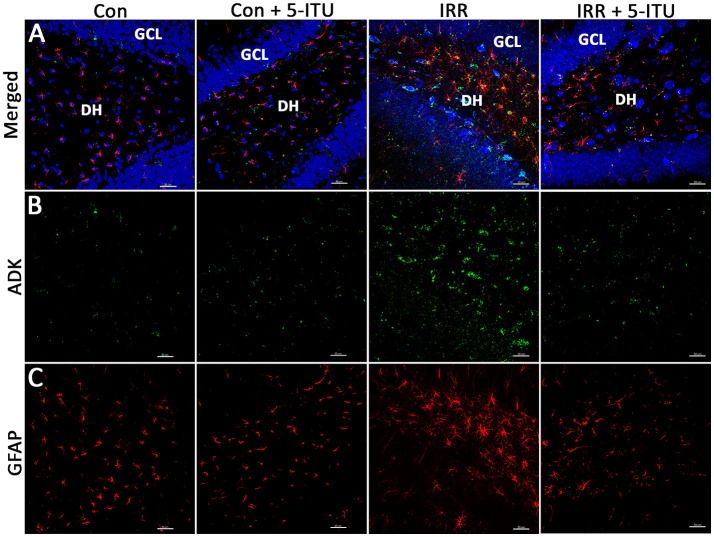
Cranial irradiation elevates adenosine kinase (ADK) immunoreactivity and astrogliosis. Immunofluorescence analysis demonstrates that at 1 month post-treatment, compared to controls (Con and Con + 5-ITU), exposure to cranial irradiation (10 Gy) leads to elevated ADK immunoreactivity (A,B; IRR group; ADK, green; DAPI nuclear counterstain, blue) that is reduced to control levels in irradiated animals treated with 5-ITU (IRR + 5-ITU). Representative confocal micrographs show the presence reactive astrocytic cell bodies (A,C; glial fibrillary acidic protein; GFAP, red) in the hippocampal dentate hilus (DH), sub-granular zone and granule cell layer (GCL) indicating astrogliosis. IRR + 5-ITU animals showed reduced ADK and GFAP immunoreactivity compared to IRR animals. Scale bar: 30 μm.
Erratum for
-
Adenosine Kinase Inhibition Protects against Cranial Radiation-Induced Cognitive Dysfunction.Front Mol Neurosci. 2016 Jun 3;9:42. doi: 10.3389/fnmol.2016.00042. eCollection 2016. Front Mol Neurosci. 2016. PMID: 27375429 Free PMC article.
Publication types
Grants and funding
LinkOut - more resources
Full Text Sources
Other Literature Sources
