Review
. 2017:2017:1485283.
doi: 10.1155/2017/1485283. Epub 2017 Jun 18.

Reactive Oxygen Species-Mediated Mechanisms of Action of Targeted Cancer Therapy

Affiliations
Review

Reactive Oxygen Species-Mediated Mechanisms of Action of Targeted Cancer Therapy

Hanna-Riikka Teppo et al. Oxid Med Cell Longev. 2017.

Abstract

Targeted cancer therapies, involving tyrosine kinase inhibitors and monoclonal antibodies, for example, have recently led to substantial prolongation of survival in many metastatic cancers. Compared with traditional chemotherapy and radiotherapy, where reactive oxygen species (ROS) have been directly linked to the mediation of cytotoxic effects and adverse events, the field of oxidative stress regulation is still emerging in targeted cancer therapies. Here, we provide a comprehensive review regarding the current evidence of ROS-mediated effects of antibodies and tyrosine kinase inhibitors, use of which has been indicated in the treatment of solid malignancies and lymphomas. It can be concluded that there is rapidly emerging evidence of ROS-mediated effects of some of these compounds, which is also relevant in the context of drug resistance and how to overcome it.


Figures
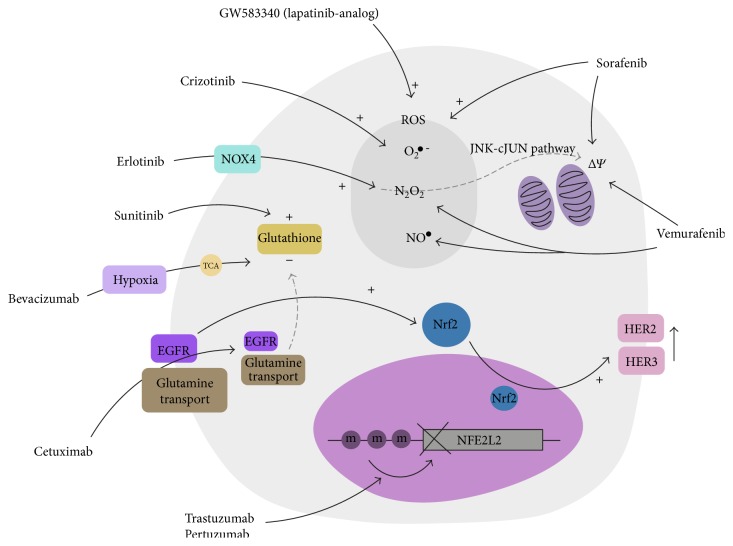
Figure 1
Figure 1
Expected ROS-mediated effects of targeted therapies. In addition to the respective signalling pathway that a targeted agent affects, the diagram represents their putative ROS-related effects. CRC: colorectal cancer; GISTs: gastrointestinal stromal tumours; RCC: renal cell carcinoma; ROS: reactive oxygen species; O2•−: superoxide; H2O2: hydrogen peroxide; NO: nitric oxide; ΔΨ: mitochondrial membrane polarity; TCA: tricarboxylic acid cycle; m: methylation; NFE2L2: nuclear factor erythroid 2-related factor 2.

References

    1. Swain S. M., Baselga J., Kim S. B., et al. Pertuzumab, Trastuzumab, and docetaxel in HER2-positive metastatic breast cancer. The New England Journal of Medicine. 2015;372:724–734. doi: 10.1056/NEJMoa1413513. - DOI - PMC - PubMed
    1. Brown C. Targeted therapy: an elusive cancer target. Nature. 2016;537:S106–S108. doi: 10.1038/537S106a. - DOI - PubMed
    1. Bauer S., Joensuu H. Emerging agents for the treatment of advanced, imatinib-resistant gastrointestinal stromal tumors: current status and future directions. Drugs. 2015;75:1323–1334. doi: 10.1007/s40265-015-0440-8. - DOI - PMC - PubMed
    1. Franklin C., Livingstone E., Roesch A., Schilling B., Schadendorf D. Immunotherapy in melanoma: recent advances and future directions. European Journal of Surgical Oncology. 2017;43:604–611. doi: 10.1016/j.ejso.2016.07.145. - DOI - PubMed
    1. Lee S. Y., Oh S. C. Advances of targeted therapy in treatment of unresectable metastatic colorectal cancer. BioMed Research International. 2016;2016:14. doi: 10.1155/2016/7590245.7590245 - DOI - PMC - PubMed

MeSH terms

Substances

LinkOut - more resources
